Building the Pipeline
Expanding CTE, Strengthening STEM, and Aligning Education with Local Industry
In a rural county where agriculture continues to shape the economy and community identity, Sampson County Schools is sharpening its focus on what comes next for students. For John Goode, Director of Career and Technical Education, the district’s purpose can be summarized clearly: preparing all students for success in the 21st century through close collaboration with stakeholders, community partners, and local businesses.
That emphasis on partnership is not abstract. It is driving tangible changes across career readiness, work-based learning, and STEM access, while also supporting major capital investment that the community views as a generational step forward.
Sampson County is one of the largest counties in North Carolina by land area and, as Goode describes it, very much a rural district with a strong agricultural foundation. That reality influences both the workforce needs of local employers and the opportunities the district prioritizes for students.
Community engagement, he notes, has long been integral to district planning and to building support for large-scale initiatives, especially capital projects. In the case of the new Hobbton High School, Goode points to broad enthusiasm among residents, alumni, and business leaders who see the project as an investment not only in education, but in community growth.
To maintain that connection, the district prioritizes transparency through public meetings, digital updates, and partnerships with local media, ensuring stakeholders remain informed and able to provide input. That approach is increasingly important as school systems are expected to act not only as education providers, but as workforce builders and economic contributors.
From a career and technical education standpoint, Goode describes the district’s intent using a single word that resonates with employers: pipeline. Sampson County Schools is rebuilding its work-based learning structure to become a consistent, local source of skilled, job-ready graduates.
At present, the district’s primary structured work-based learning opportunity is a student intern tech team that provides desktop IT support across schools and is employed during both the school year and summer. While successful, Goode is candid that the district needs broader opportunities that connect students to more industries and more real-world work experiences.
That urgency is shaping an active initiative with ApprenticeshipNC and Sampson Community College to develop registered pre-apprenticeship and apprenticeship programs. Goode explains that this work is still early-stage, but it reflects the district’s commitment to building a workforce system in partnership with local employers rather than in isolation.
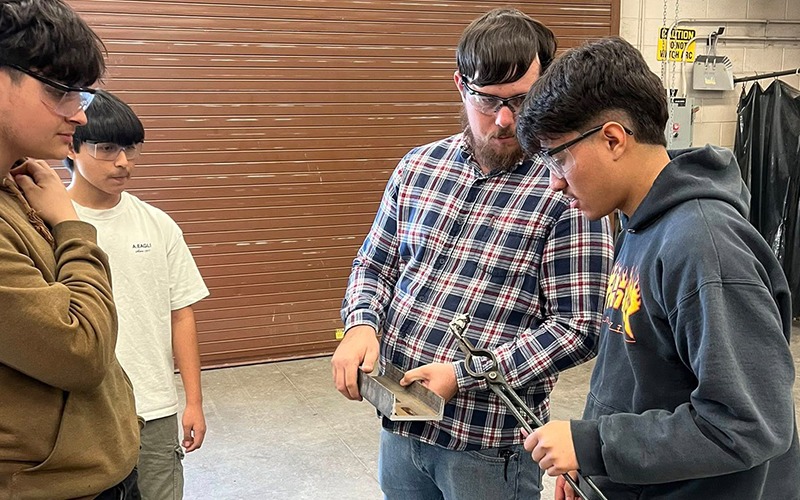
A key step in that process is an upcoming presentation to local businesses, where Goode plans to frame the district’s value in terms that matter most to industry. The goal is not merely to describe what students are taught, but to show what the district can provide: trained, capable employees grown locally, reducing the need for employers to search outside the county for talent.
As Sampson County Schools expands workforce alignment, it is also strengthening the technology foundation that supports modern learning. The district accelerated its move toward one-to-one learning during the pandemic and now provides devices throughout grade levels. Middle and high school students, from grade six through 12, have laptops, while elementary students make extensive use of iPads.
For Goode, technology integration is not simply about devices, but about access, equity, and the ability to prepare students for a world where digital fluency is no longer optional.
A major STEM advancement is the district’s designation as a SparkNC district. SparkNC, supported by the Leon Levine Foundation, is described as a new way to do school, built around hands-on STEM pathways delivered through a structured lab-based model. Sampson County Schools opened its Spark Lab with a ribbon cutting on October 27, making the program still new but already positioned for growth.
The Spark Lab introduces students to multiple STEM pathways through a modular structure that includes an introductory experience, a series of pathway modules, and a culminating capstone. Students can explore areas such as cybersecurity, data analysis, robotics, bioengineering, and coding, and the program is structured so that completion satisfies North Carolina’s computer science graduation requirement.
While the lab is physically located at one high school, Spark programming is accessible to students across all four traditional high schools through online participation. The district is also exploring ways to bring more students into the physical lab environment over time, expanding hands-on access as logistics and scheduling evolve.
As technology and STEM expand, Goode emphasizes that soft skills remain equally critical to student success. He notes that as students transition from high school into postsecondary programs, especially in career-aligned settings, gaps in communication, professionalism, and workplace readiness are becoming more apparent. Even within CTE curriculum frameworks, Goode sees a need for stronger intentional focus on soft skills development, because those skills are essential regardless of whether students pursue college, trades, military service, or direct employment.
One of the district’s most effective strategies in this area has been participation in Teamship, a program designed to simulate professional environments through a structured, team-based problem-solving model. In Teamship, students work in teams and are paired with representatives from local businesses. Employers present real problems they are facing, and student teams develop solutions over a defined period.
The program culminates in a pitch-style presentation day, where students deliver formal recommendations back to the business representatives. Goode describes this experience as an exceptional way to teach communication, collaboration, business writing, and practical problem-solving in a setting that feels real rather than theoretical.
The challenge, he acknowledges, is reach. While the program is high impact, participation numbers remain limited due to class sizes and staffing capacity. Even so, the model is proving valuable as Sampson County Schools continues building a culture of career readiness that extends beyond technical skill alone.
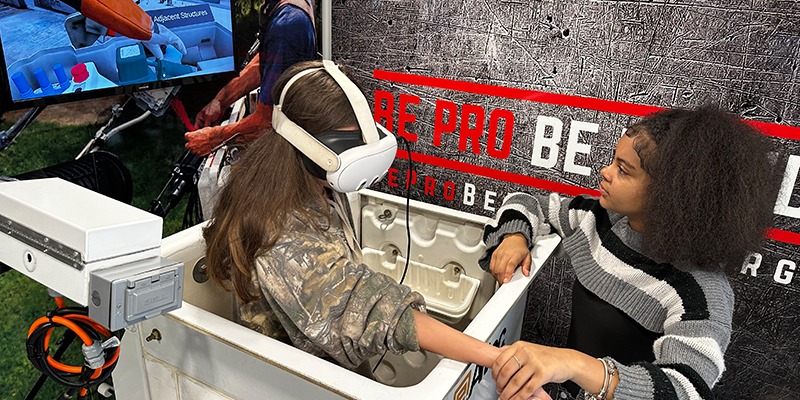
Work-based learning partnerships across the county are also evolving. While the district currently places some students in internships through CTE coursework, these placements tend to be local and informal, often connected to smaller businesses within each high school’s attendance zone. Goode cites a successful automotive program that regularly places interns with garages, dealerships, and transmission shops, demonstrating the value of strong program leadership and industry trust.
The district is now working to formalize and expand these relationships, including early conversations with larger agricultural businesses and employers such as Hog Slat, Murphy Family Ventures, and Star Communications. These discussions highlight an important reality in workforce development: some sectors, like agriculture, may offer easier pathways to internships and apprenticeships, while fields such as healthcare and telecommunications introduce constraints around privacy, liability, and age requirements that require careful program design.
Alongside programming efforts, Sampson County Schools is making significant capital investments. The district’s largest active project is the construction of a new Hobbton High School in the Hobbton attendance zone. The existing facility, completed in 1958, has served the community for decades but now faces limits tied to aging infrastructure and outdated instructional layouts. The new high school project is supported by a major state grant totaling $62 million, with additional local support, and construction is expected to begin in 2026 with completion scheduled for August 2028.
Goode describes the planning process as highly collaborative, with district leadership and architects actively collecting stakeholder input to shape a facility that supports modern instructional models and expanded career readiness opportunities. He highlights the level of attention given to teacher feedback, particularly among CTE educators, as a meaningful signal of how the district is designing the building around teaching and learning realities rather than simply replicating older facility patterns.
On the business alignment side, the district maintains an active Business Advisory Council, required under Perkins V and designed to ensure career education remains aligned with labor market needs. In a county with both Sampson County Schools and Clinton City Schools, Goode notes this is one area where the two districts work collaboratively, sharing a joint advisory council of dozens of local businesses. Through regular meetings and structured feedback, the council helps the district stay connected to employer expectations and skills demand.
The district further strengthens alignment through its comprehensive local needs assessment process, which collects input from teachers, administrators, students, parents, business partners, and specific demographic groups through focus groups and electronic surveys. Goode also points to strong collaboration with the local Chamber of Commerce, including student participation in junior leadership programming that exposes learners to local business opportunities through direct site visits and engagement.
Looking ahead, Sampson County Schools is also engaged in strategic planning, developing a roadmap designed to guide priorities for the near future. Goode expects that plan to emphasize inclusivity across postsecondary pathways, ensuring the district supports students headed to four-year universities as well as those pursuing two-year programs, trades, skilled employment, or military service. He notes that the district is also investing in community engagement models in parts of the county, placing staff in schools to strengthen the relationship between families, communities, and the public life of the school system.
Across all of these initiatives, Sampson County Schools is working to expand opportunity while staying rooted in local identity. With growing STEM access through SparkNC, renewed focus on work-based learning and apprenticeship development, major capital investment through the new Hobbton High School, and a clear intent to serve as a pipeline for local employers, the district is positioning career readiness not as an add-on, but as a core part of student success and community sustainability.
AT A GLANCE
Who: Sampson County Schools
What: Rooted in the community while expanding career education and academic opportunities for its valued students
Where: Clinton, North Carolina
Website: www.sampson.k12.nc.us
PREFERRED VENDORS/PARTNERS

SfL+a Architects: www.sfla.biz
Founded in 1982, SfL+a Architects has four decades of experience delivering innovative, sustainable, and community-focused design solutions. SfL+a has grown into a national leader in energy-positive architecture, designing more energy-positive buildings than any firm in the United States. With a commitment to architectural excellence and environmental stewardship, the firm continues to shape spaces where people live, learn, work, and thrive.