Growing Without Losing Its Soul
Michigan’s Bedroom Community Proves That Steady Population Growth and Agricultural Innovation Can Coexist with Small-Town Values.
Tucked between Michigan’s capital region and the agricultural heartland of mid-Michigan, Clinton County’s distinctive identity differentiates it from typical suburban sprawl. With a population of roughly 80,000 residents spread across 575 square miles, this county has grown by 20,000 people over the past two decades while maintaining the close-knit character that originally drew families here. Named after DeWitt Clinton, the early 19th-century New York governor who championed the Erie Canal, the county was organized in 1839 and has since evolved into what locals proudly call a bedroom community with substance.
“What is unique to Clinton County, although I think it’s more personal than unique, is that this is truly a bedroom community,” says John F. Fuentes, the county administrator who oversees day-to-day operations. “Countywide, it’s very personal and homely while being part of a larger region. The county overall takes pride in that family feeling and environment.” Bruce DeLong, the District 3 Commissioner who chairs the Board of Commissioners, emphasizes this quality attracts residents seeking refuge from metropolitan intensity without sacrificing access to urban amenities.
The county’s position within the Lansing-East Lansing Metropolitan Statistical Area provides residents with an enviable arrangement. Many commute south to Ingham County for state government positions or to Michigan State University for employment and education, then return home to enjoy the quieter pace Clinton County offers. With a median household income of $85,928 and a homeownership rate of 82.8 percent, well above the national average of 65 percent, residents have found economic stability alongside their preferred lifestyle.
Agricultural Heritage Meets Modern Development
Clinton County’s agricultural roots run deep, ranking eighth statewide in the value of agricultural products. The county’s 31,500 dairy cows contribute to Michigan’s distinction as the nation’s top producer of milk per cow. “Right now, we don’t have anything major on the horizon that we are aware of,” Fuentes explains. “We’ve had some recent developments in the last five years. We had a significant rural industrial project for milk and dairy production and distribution for the local dairy farming community. It’s the second largest distribution hub in the state, if not the Midwest region, and probably the most significant economic development that has occurred here in Clinton County in the past 10 years.”
The facility Fuentes references is the $555 million Glanbia-led cheese and dairy processing complex that opened in November 2020 in the St. Johns Industrial Park. Processing 8 million pounds of milk daily, the 375,000-square-foot operation produces a 40-pound cheese block every 20 seconds and is one of North America’s two largest dairy processing facilities. The partnership between Irish food giant Glanbia Nutritionals, Dairy Farmers of America, and Select Milk Producers addressed a critical need. In 2017, Michigan milk producers lost more than $164 million due to oversupply and high transportation costs.

“One of the priorities that has been discussed by the board of commissioners is to pursue opportunities that are consistent with that same rural economic development that fits in and benefits the agricultural nature of the county overall,” Fuentes adds. “Those opportunities are fewer and far between at this point, but from both the elected officials and the community, the priority has been opportunities that make sense within the agricultural heritage of the county.”
Building Tomorrow’s Workforce
The dairy processing facility’s arrival highlighted a broader challenge facing Clinton County and rural communities nationwide: developing a workforce equipped for increasingly sophisticated agricultural operations. Modern dairy processing requires technical skills far removed from traditional farming, encompassing food safety protocols, mechanical systems, and quality assurance procedures that demand specialized training.
The county addresses this gap through its Regional Education Service Agency, a Michigan-specific governmental structure that coordinates multiple school districts within the county. “There’s a specific example administered by the county Regional Education Service Agency,” Fuentes says. “They have a specific career expo that focuses on what I would call more trade and training-oriented opportunities rather than just educational opportunities, strictly focused on local industry and local employers. Local employers are involved in agricultural business and agribusiness, so they target the available opportunities here in the county.”
Beyond institutional programs, the county maintains a robust 4-H presence that continues agricultural education from an early age. “I would say from my perspective, it’s encouraging because not only does it open the next generation’s eyes to those types of opportunities, but what it does in the broader sense is it lessens the risk that we’re going to have outward flight as far as population,” Fuentes explains. “If there are jobs that they know they can perform here, they don’t have to look elsewhere and leave the county, region, or state.”
The Affordability and Housing Challenge
When asked about top priorities from the county perspective, Fuentes responds without hesitation. “I think probably one of the priorities is maintaining or continuing affordable living, overall affordability.” In a region where the median property value reached $243,700 in 2023, up 7.83 percent from the previous year, that priority takes on practical urgency even as Clinton County’s housing costs remain below the national median of $303,400.
However, the challenge is multifaceted. Large sections of the county lack the water and sewer infrastructure necessary to support residential development, a limitation that constrains housing options regardless of demand. “I would say we’re not seeing the developments to the extent that are necessary at current time,” Fuentes acknowledges. “That goes back to some of the character of the county itself. There are large portions or sections of the county that lacked necessary infrastructure for those types of development, water and sewer, et cetera.”
Some progress is present through local initiative. “There are some opportunities. There are some local initiatives amongst a couple of the local units trying to expand that opportunity to bring in some additional multifamily dwellings,” Fuentes says. “But currently that’s one of our limitations at the county level.” DeLong has worked to facilitate partnerships between municipalities that could expand infrastructure reach. “We’ve been supportive in trying to be involved to work through this so we can get a cooperative agreement and authority,” DeLong says. “It will definitely expand the area in and around St. Johns for future development.”
Infrastructure and Connectivity to Meet Growth Needs
The steady population increase from 60,000 to 80,000 residents over two decades created infrastructure demands. Transportation is a particular challenge in a county where population density averages just 113 inhabitants per square mile across 566 square miles of land. “Our public transit is, because of the population distribution, primarily a dollar-ride service,” Fuentes explains. “We don’t have the population volumes to support public dedicated route service within the county.”
The commuting patterns further shape infrastructure priorities. “Within our region, we’re part of the capital region. There’s a lot of state employment which happens in the county to the south of us in Ingham County, as well as Michigan State University,” Fuentes notes. “A lot of our population travels out of the county for employment and returns home to enjoy their quiet living that we promote. There’s not really large local initiatives related specifically to expanding public transit opportunities.”

The water and sewer expansion Fuentes and DeLong mentioned are the more pressing infrastructure needs. The partnership initiative between city and township will unlock development potential in areas currently constrained by lack of utilities. “At the county level, we are not directly involved in water and sewer infrastructure as far as funding or construction,” Fuentes says. “But there is a potential expansion through cooperation of a city and township here within the county that would provide a very necessary and valuable infrastructure addition in one of those areas that are prime for development.”
Walkable Downtown and Community Spaces
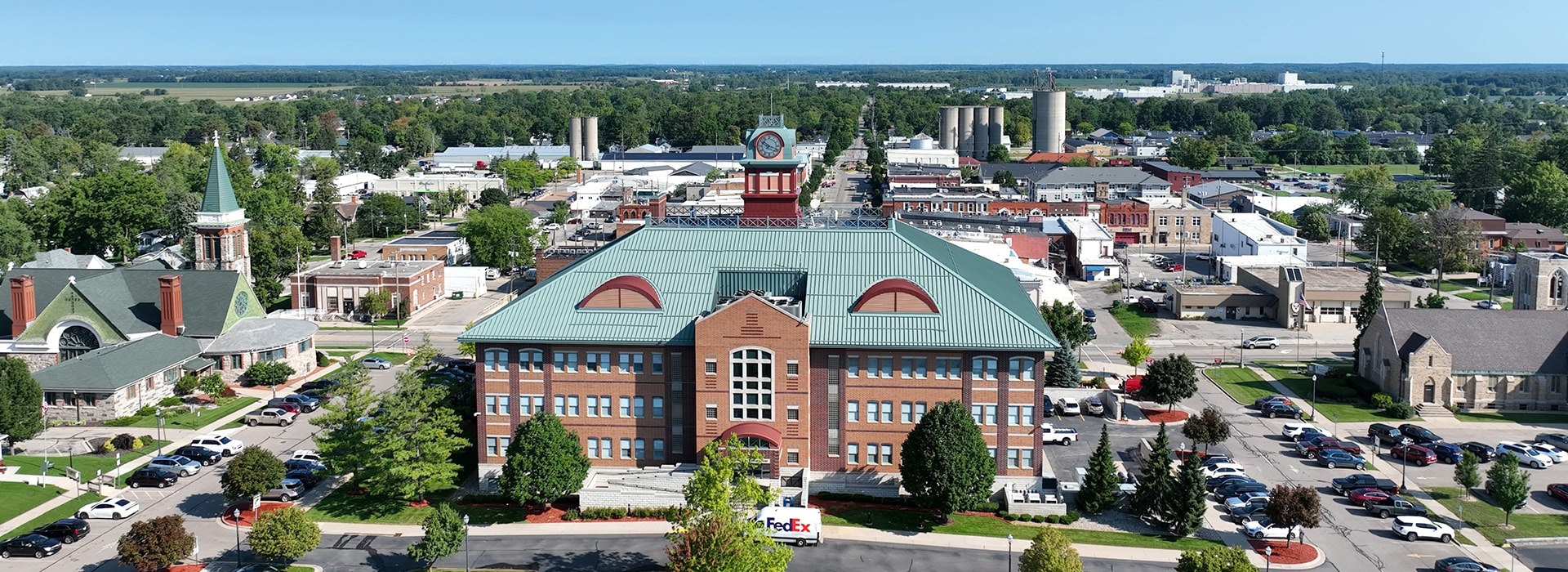
St. Johns, the county seat, benefits from active downtown revitalization efforts led by its Downtown Development Authority and Principal Shopping District, organizations that have worked in tandem since 1998. “Right here in St. Johns, they have a DDA that basically works downtown,” DeLong says. “They basically provide a lot of extra funding to help the city with improvements.” The downtown features locally owned shops, restaurants, and cafés, plus a Social District that allows beverage service beyond traditional boundaries, encouraging foot traffic throughout the commercial core.
“I would say from my experience here in the city of St. Johns where the courthouse is located, that’s definitely walkable,” Fuentes observes. “Walkability is a priority with the limitations that Bruce mentioned but compared to some other similar areas in the state, it’s much more vibrant here in St. Johns.” Those limitations include a mixed development pattern where significant business activity occurs several miles from the historic downtown, creating two distinct commercial zones rather than a single concentrated center.
Beyond downtown amenities, the county has expanded recreational assets. “The county has, from a recreation standpoint, directly for the county, four county parks now,” Fuentes says. “One recently acquired. We just acquired in late 2023 property that’s now known as Clinton Trails County Park, and we will be looking at future development of a walkable trail network within that property.”
The 67-acre Clinton Trails property joins Clinton Lakes County Park and Motz County Park in providing fishing, hiking, and nature observation opportunities. Clinton Lakes features former gravel pits transformed into swimming beaches and carries-in boat access for fishing walleye, perch, bass, and panfish. “The county has been active in terms of pursuing grant opportunities to foster additional development at both the existing and now the most recently acquired park,” Fuentes adds.
Preserving Character While Moving Forward
Looking ahead to the next 18 months, county leadership prioritize preservation rather than transformation. “As I mentioned, we don’t have any major projects currently underway,” Fuentes says. “The most important focus that the county places on potential projects or potential development, particularly in that short term timeframe, is compatibility with the existing nature, character, and feel of the county. That’s the primary interest, speaking for the commissioners. From what I hear at their meetings and discussions, the primary interest is maintaining that feel and the existence of being a place you want to live and have fun and raise a family.”

DeLong agrees with this measured approach. “I think that pretty much sums it up,” he says, reflecting consensus among county leadership about protecting what residents value most about Clinton County. The philosophy accepts growth as inevitable given the county’s proximity to Lansing and Michigan State University, but insists development aligns with community character rather than reshaping it.
“To the extent that a project or development fits in and is consistent with that, I think that’s the most interesting or appealing from a county perspective,” Fuentes explains. The standard applies equally to agricultural ventures like the dairy processing facility and residential developments seeking to address housing needs. Each proposal faces the same fundamental question: does it enhance or diminish the qualities that define Clinton County as a place where families choose to put down roots?
The approach may limit certain opportunities, but it points to deliberate choice by a community that has watched neighboring areas struggle with rapid change. Clinton County is choosing to grow at a pace its infrastructure and culture can absorb while maintaining the personal, down-home character that residents treasure. In an era when many communities feel powerless against development pressures, Clinton County shows that intentional, compatible growth remains achievable when leadership and residents share clear priorities about what matters most.
AT A GLANCE
Who: Clinton County
What: A 575-square-mile county in mid-Michigan with a population of 80,000; home to one of North America’s largest dairy processing facilities and ranked eighth in the state for agricultural product value
Where: Central Michigan
Website: www.clinton-county.org
PREFERRED VENDORS/PARTNERS
Lansing Economic Area Partnership: www.purelansing.com
LEAP is the economic development organization representing Clinton, Eaton and Ingham counties. We are a private-public partnership governed by a board of directors including business and municipal leaders from across the tri-county region. From small towns to downtowns, rural to city centers, LEAP builds stronger communities for all.

Clinton County Regional Educational
Service: www.ccresa.org
Clinton County RESA supports local districts with leadership, collaboration and services that help every learner thrive. From early childhood and special education to mental health supports and career exploration, we behind the scenes to strengthen schools, expand opportunities and ensure every child in Clinton County can learn, grow and feel supported.
