Building a Second Act as an Advanced Manufacturer with Specialty Alloys
How a 48-Year-Old Wisconsin Manufacturer Transformed Difficult Alloys into Dual Competitive Advantages
When Stephen A. Dickinson founded Winsert at 29 years old in 1977, he built the Marinette-based company around a singular focus: manufacturing valve seat inserts for heavy-duty engines. For the better part of four decades, the company refined this specialty, carving out a reputation in the heavy-duty truck, agriculture, and power generation markets. But survival in manufacturing demands more than perfection in one product line. Today, under the leadership of President Mark Coduti, the company finds itself at an inflection point it calls Winsert 2.0, a strategic evolution that transforms a focused manufacturer into a diversified solutions provider with dual core competencies.
“The first go around, you know, say the first 40 years of our organization’s history, we were very focused on a specific market in a specific product,” Coduti explains. “That is what ultimately led us to get into the alloy development side of our business. But that alloy development has really kind of morphed into creating a second core competency for us.” The shift began out of necessity. To differentiate Winsert from competitors in the valve seat insert market, the company developed proprietary alloys resistant to wear and extreme heat. These materials proved so difficult to machine and grind that mastering their fabrication became a marketable skill in itself, opening doors to industries far beyond internal combustion engines.
The company now holds five patented alloys, a remarkable achievement for a mid-sized manufacturer, and supplies critical components to Fortune 500 OEMs including John Deere, Cummins, and Daimler. Winsert has earned John Deere’s Partner-Level Supplier status for 13 consecutive years and holds dual induction into the John Deere Supplier Hall of Fame.
From Specialization to Diversification
The materials that set Winsert apart initially created manufacturing headaches. Valve seat inserts, the components that form the critical seal between an engine’s valves and cylinder head, must withstand punishing conditions: extreme temperatures, constant friction, and corrosive combustion byproducts. Coduti notes that the alloys engineered to survive these environments are resistant to wear and high heat applications, making them exceptionally difficult to work with and machine. “They are very difficult to grind,” he adds, describing the technical challenge that would paradoxically become an opportunity.
The valve seat insert themselves and demand exacting tolerances. “Those valve seat inserts are of a very precise nature in terms of specification and tolerance that they have to be machined to,” Coduti says. Developing the capability to work with such unforgiving materials while maintaining microscopic precision created expertise that went far beyond engine components. The company’s product portfolio now includes spherical bearings, linkage arms, grinding knives for the food processing industry, butterfly valves, and actuator levers.
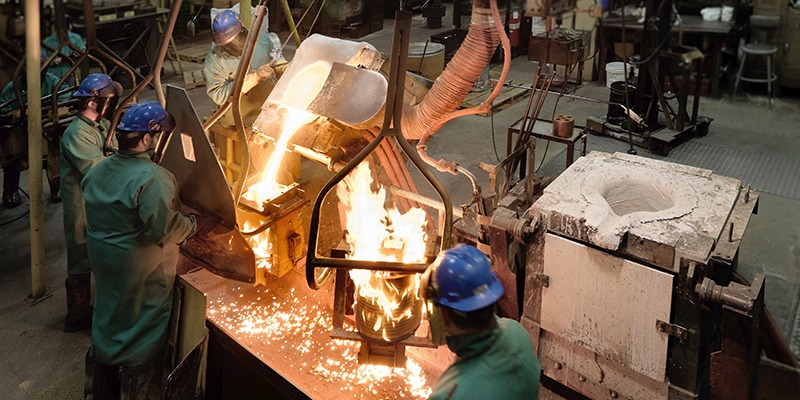
Winsert’s alloy development efforts, which began formally in 1992 with the establishment of its Materials Research Department, focused on displacing expensive cobalt-based materials. The proprietary formulations deliver comparable performance at lower cost with greater price stability, particularly important given cobalt’s volatile market pricing and geopolitical supply concerns.
The company’s flagship W77T6-P® alloy and W10-P® demonstrate performance advantages while offering customers relief from the cost fluctuations that plague traditional trade materials. This combination of metallurgical innovation and advanced machining capability positions Winsert to serve transportation, aerospace, energy, industrial valve, and food processing markets across 35 countries.
Industry 4.0: Data-Driven Decision Making
Manufacturing excellence today requires more than skilled workers and quality equipment. Winsert has embraced Industry 4.0 principles, building an information infrastructure that transforms raw operational data into actionable intelligence. “We feel that in order for us to truly make good business decisions, we have to understand where we are at,” Coduti says. “And that is not just final state financials, right? That is costing analysis and understanding all the way through the process.”
The foundation rests on integrating manufacturing equipment directly into the company’s enterprise resource planning system. Machine-level data flows continuously into centralized databases, enabling real-time visibility into production costs, equipment performance, and process efficiency. “This comes from integrating all of our manufacturing equipment, the data that comes from them, into our ERP system and the analysis work that happens with that,” Coduti explains. The company recently upgraded its ERP infrastructure, working through initial implementation challenges while building toward enhanced analytical capabilities.
Coduti frames the approach as essential groundwork for advanced technologies. “It’s been about infrastructure in getting the data in place,” he says. “But now that you have the data, this is where AI can truly start to step up and help and streamline a lot of aspects of our business.” The company plans significant investments in artificial intelligence applications throughout 2026, focusing on production planning, labor management, and processing the vast datasets generated by connected equipment. Rather than replacing human expertise, these systems will accelerate analysis that currently consumes considerable time, allowing managers to identify inefficiencies and optimization opportunities faster than manual review permits.
Smart Automation and the Future of Manufacturing Work
Foundries and machine shops face a persistent challenge: attracting younger workers to careers that involve heavy materials, heat, and physical labor. “These are careers that are not as desirable as some of the other fancy tech stuff going forward,” Coduti acknowledges. “Personnel resources are always a challenge for any manufacturer going forward. How are you getting the younger generation interested in coming to work in a foundry or manufacturing environment?”
Winsert’s response centers on automation that improves safety and reduces the physical demands of manufacturing work. The company focuses particularly on material handling, where most workplace injuries occur. “If you start to look at where most injuries or accidents happen, it’s in material handling, not in the actual piece of equipment itself,” Coduti notes. “It’s lifting too heavy of a load or an awkward transfer of product from one bin or table to another.” Automated loading and unloading systems eliminate these high-risk manual tasks, making the work environment safer and more appealing to potential employees.
Artificial intelligence fits into this strategy as a complement rather than replacement. “I don’t see AI necessarily replacing anything that happens in our shop or manufacturing environment by any stretch, but I do see it complementing and making us much smarter about what we do,” Coduti says. Applications include front-office functions like sales operations and human resources, where AI assists with recruiting efficiency. “We are constantly going through tons of data,” he explains. “AI is already starting to transform that and give you the opportunities to process significant amounts of data in a much shorter time period.”
Growing Market Share Through Strategic Partnerships
When markets soften, manufacturers face a choice: wait for recovery or fight for larger pieces of a shrinking pie. Winsert chose the latter. “Manufacturing as a whole has been fairly depressed,” Coduti says, pointing to weakness in truck, transportation, and construction sectors over recent years. “The only way you can truly affect that is market share. We don’t want to sit back and wait for the market to recover for a better day for us.”
The strategy requires more than aggressive sales tactics. Winsert positions itself as an extension of customer engineering and development teams, co-creating solutions rather than simply fulfilling purchase orders. “We want to do the things that we can control and go out and work and partner with our customers, be an extension of their engineering department, be an extension of their development team and create solutions,” Coduti explains. “And by doing that, we are creating a greater share of the spend in that market space.”
This approach, which the company describes as “blocking and tackling” or fundamental execution excellence, has set Winsert for growth regardless of broader market conditions. “We are going to grow as an organization starting in ‘26 through ‘29, regardless of what the market does,” Coduti says. “And we’re excited about that.”
Acquisitions accelerate capability expansion. Since Altus Capital Partners acquired Winsert in March 2022, the company has completed two strategic purchases. The most recent, Mack Tool & Engineering in South Bend, Indiana, closed in August 2025 and brings aerospace-focused precision machining with AS9100D, NADCAP, and ITAR certifications. Before that, Alloy Cast Products in New Jersey added investment casting expertise in exotic cobalt alloys. “We’re already starting to think about and look at what this next one is really going to bring for us,” Coduti notes.
Looking Ahead: Priorities for 2026-2027
Growth creates its own demands. Equipment must be installed, facilities must expand, and people must be hired and trained. For Winsert, the next two years are a transition from planning to execution. “Our biggest priorities are the continued integration of our recent acquisitions,” Coduti says. “Those need to get up and be fully contributing to the organization as our base business in Marinette is.”
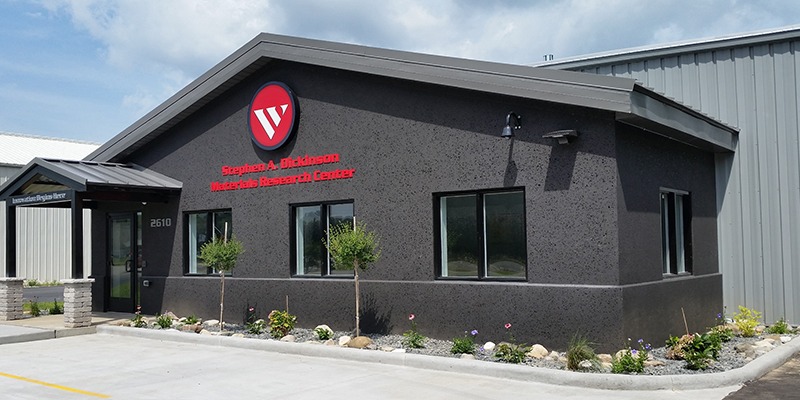
The Marinette headquarters already houses multiple foundry types, advanced multi-axis machining centers, and the Stephen A. Dickinson Materials Research Center, opened in 2016 with state-of-the-art equipment for wear simulation, corrosion testing, and alloy benchmarking. Now the facility must expand to accommodate growth that Coduti describes as imminent rather than aspirational. “The planning for that growth is already underway,” he says. “So the execution of that plan is really going to be critical for us on 26 and 27. Because again, as I mentioned, that is when this growth starts to kick in for us.”
Physical expansion solves only part of the equation. “There’s going to be some people that need to come along with this whole thing,” Coduti notes. “And getting those people on board and getting those people trained and brought together is going to be a challenge in itself. Finding good machinists and manufacturing people is not just a common thing anymore. These people are desirable. There’s less of them.”
The technology investments planned for 2026 support both objectives. Enhanced business analytics, upgraded ERP capabilities, and artificial intelligence deployment will allow existing staff to work more efficiently while making the company more attractive to prospective employees. With 45-55% of revenue coming from exports to 35 countries, Winsert enters its next phase from a position of operational strength built over nearly five decades in Marinette.
Click The Cover To View Or Download The Brochure
AT A GLANCE
Who: Winsert
What: Global advanced manufacturer of specialty alloys and precision-machined components for transportation, aerospace, energy, industrial valve, and food processing markets
Where: Marinette, Wisconsin
Website: www.winsert.com