Personalizing the Journey
How One Leading School District Is Turning Innovation, Community, and Care into Student Opportunity
In Vance County, North Carolina, education is deeply personal. District leaders are building a system where each learner’s path is visible, supported, and purposeful—whether that path leads to a four-year university, a skilled trade, the military, entrepreneurship, or a field that doesn’t yet exist.
Superintendent Dr. Cindy Bennett frames the vision in clear terms: provide a personalized educational experience that becomes a catalyst for each student’s future success. “It sounds broad,” she acknowledges, “but personalization is the point. Whatever pathway students choose, we want them to leave us with the skill set and confidence to thrive.”
That focus on individual growth is rooted in the realities—and strengths—of a rural community with global ties. Vance County Schools sits about 45 minutes from Research Triangle Park, the state’s innovation engine, yet it is very much a hub in its own right. Public schools serve roughly three-quarters of the local student population, and the district’s footprint extends across the county’s faith communities, businesses, newcomers, and long-time residents.
The community is resilient and welcoming, shaped by a transient workforce and an unusually international faculty: approximately 90 global educators from countries such as Jamaica and the Philippines have made Vance County their professional and personal home. Their presence has broadened the county’s cultural life—with new restaurants, faith communities and small businesses—and deepened the district’s capacity to serve multilingual and multicultural learners.
“Families here figure it out together,” Bennett says. “We try to honor that in our schools. We want every student and every educator to feel they belong the moment they walk in.”
A Whole-Child Promise
Belonging is not just an aspiration in Vance County; it is operational. The district invests in layered supports that match the needs of its students and families. Every school is staffed with a counselor and a social worker. English learners and migrant students receive dedicated services that extend beyond classwork to family outreach and community resources.
Exceptional Children’s programming covers the full spectrum of special education services, from speech and occupational therapy to adaptive support. Academically or intellectually gifted students access enrichment designed to challenge and accelerate. The aim is the same at each point: remove barriers, connect care to instruction, and create schools that feel safe, warm, and purposeful.

Those same wraparound commitments extend to adults. Vance County thinks of each school as a “micro-system” within a district ecosystem and asks principals to build internal support for staff while the central office adds targeted layers on top. Professional growth is not a calendar event; it is the work itself. Multi-classroom leaders coach teams of teachers, co-plan and co-teach, and drive the instructional playbook. Teacher Development Specialists provide content-specific support—math, literacy, and more—based on each school’s needs. Advanced
Teaching Roles have evolved from a simple ladder into a lattice of possibilities: educators can lead, specialize, or expand their reach without leaving the classroom. “Everyone gets coached up,” Bennett says. “Coaching is not remediation; it’s how professionals grow.”
Technology as Tool, Not Tether
Chief Officer of Instruction and Innovation Destiny Ross-Putney has watched classroom technology evolve for nearly two decades. She remembers when one-to-one devices were a frontier; now they’re a baseline. What the district has learned in that time is that access alone is not the goal. Deliberate use is.
“We teach digital citizenship explicitly,” Ross-Putney says. “Students need to evaluate sources, cite properly, and distinguish quality information in a world that is flooded with it.” At the same time, the district has embraced a balanced return to the basics in certain settings. Some schools remain one-to-one; others purposefully structure device use around specific tasks to preserve attention for handwriting, composition, discourse, and the linear thinking required by rigorous research. Neuroscience, she notes, supports that balance. “It’s technology and talk; simulation and Socratic seminar.”
The district’s approach to artificial intelligence mirrors that posture. Rather than racing to blanket adoption, Vance County is training educators to use AI as a planning and feedback aid while keeping originality and judgment at the center of student work. “AI can accelerate preparation,” Bennett says, “but it cannot replace the human work of thinking, questioning, and collaborating. We’re being intentional about where and how it lives in the ecosystem.”
STEM That Meets the Moment
For students, technology and STEM are not abstract ideas; they are experiences. Through a statewide partnership, Vance County offers SPARK NC, a modular elective that exposes learners to high-tech career fields—cybersecurity, artificial intelligence, computer programming—by pairing self-paced coursework with live interactions with industry professionals.
Students can try a module for two or three weeks, reflect on the fit, then stack additional modules to earn elective credit. “It’s a low-risk, high-insight model,” Ross-Putney explains. “Students can explore without fear of failure and discover where curiosity turns into commitment.”
Down the road at the district’s Center for Innovation, exploration becomes kinetic. The facility houses the STEAM Early High School, the district’s Virtual School, a nontraditional program, audio and video production labs, and two signature experiences: the SLICE Lab—Simulated Labs for Interactive Career Exploration—and SLICE Medical.
Here, students from kindergarten through twelfth grade rotate through immersive stations that simulate real work: drafting and building a structure, pricing and merchandising products, following recipes and managing a service line, performing CPR and learning first-response protocols, solving mock crime scenes, and more. The medical lab adds billing, intake, pharmacy, phlebotomy, and other health roles, all designed with feedback from business partners.

“This is our Disney,” Bennett says, laughing. “Students personalize what they explore, and if something resonates, we show them exactly how to build on it—what courses to take at the middle or high school level, which credentials matter, and what next steps look like.”
Pathways That Answer to Students and the Economy
The district’s career and technical education is built at the intersection of labor market demand and student interest. Vance County’s local comprehensive needs assessment—conducted biannually—keeps those lines aligned. Tried-and-true pathways in culinary and hospitality remain strong; so do automotive services and carpentry.
Over the last several years, student interest in emergency management, law and justice, and public safety has surged. The district responded by building a feeder program into the middle grades and expanding hands-on coursework at the high school.
A recent tiny-home build, led by the carpentry and construction pathway and supported by small business and entrepreneurship students, culminated in a community auction—and a job for one graduate, now employed by the district’s maintenance department. Partnerships with firms like Kilian Engineering provide internships and job shadowing that move students from simulation to site experience.
“We want our students to see the world beyond their immediate pond,” Bennett says. “Sometimes that means a field trip across the county or a virtual visit with a cyber engineer. Sometimes it means a shift at a local employer. The point is to widen their aperture and then personalize the path.”
Across these programs, a single through-line holds: soft skills are not soft. They are durable. The district treats communication, collaboration, problem solving, and professionalism as core content. Students practice structured conversation, deliver TED-style talks, write technically and persuasively, and engage in peer critique.
In labs, they work the way teams do—assigning roles, tracking workflow, documenting decisions, iterating on feedback. “If students leave us with enduring skills,” Bennett says, “they can learn the career-specific ones when the time comes—even if the job didn’t exist when they were in fifth grade.”
Capital Investments with Staying Power
Like many rural systems, Vance County’s facilities average half a century old. When federal ESSER funds arrived, the district resisted the temptation to use them for short-term staffing and invested instead in improvements with long shelf life. HVAC systems were upgraded and filtration modernized. Lighting was enhanced. Safety got a comprehensive refresh with badge-controlled access points, expanded camera systems, and the design of interior safety vestibules that channel visitors into controlled spaces before they enter instructional areas.
The district also reimagined outdoor spaces as engines of health and learning. Elementary “playgrounds” became fitness parks, equipped for inclusive access and ringed with walking trails and signage that encourages movement. Outdoor learning environments with Wi-Fi coverage now give teachers fresh instructional options and students a chance to work in the open air.
Repurposing also plays a central role. Instead of building new, the district consolidated facilities and converted an existing campus into the Center for Innovation, allowing it to house STEAM, virtual, and nontraditional programs under one roof and serve as the district’s experiential hub.
Professional Growth as a Pathway, Not a Ladder
The district takes the same personalized approach with adult learning that it does with students. Advanced Teaching Roles began as a career ladder designed to retain top talent; today they function as a lattice of roles and routes.
Teachers who want to lead can step into multi-classroom leadership; content experts can serve as Teacher Development Specialists; highly effective practitioners who prefer to stay rooted in classroom instruction can opt to extend their impact to larger rosters with additional compensation and support. “Not everyone wants the same career,” Bennett says. “We want great educators to see a future here—without feeling like the only way up is out of the classroom.”
The Next 24 Months: Deepen, Expand, Personalize
Over the coming two years, Vance County’s priorities are clear. The district will deepen its personalized learning model for students and staff; expand the SLICE and SPARK NC experiences to reflect new careers and community input; strengthen pathways in emergency management, public safety, and health; and continue tuning its technology strategy so devices remain tools rather than tethers. The Center for Innovation will remain the district’s engine for exposure, choice, and skill-building; the professional lattice will continue to grow so educators can map careers without leaving kids.

Above all, Bennett and Ross-Putney say, the district will keep naming and nurturing the enduring skills that travel with students into every future. “Our job is to fertilize the soil,” Bennett says. “We can’t know every job that’s coming. But we can make sure students can write, speak, think, collaborate, and lead. If we get that right, they’ll be ready for whatever they choose—and for whatever the economy invents next.”
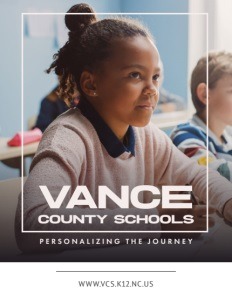
Click The Cover To View Or Download The Brochure
AT A GLANCE
Who: Vance County Schools
What: A close-knit, community collaborative school district that individualizes the students learning experience
Where: Vance County, North Carolina
Website: www.vcs.k12.nc.us
PREFERRED VENDORS/PARTNERS
Jordan Driving School of the Carolinas: www.jdscarolinas.com
Jordan Driving School of the Carolinas provides trusted, high-quality driver education across North Carolina. With certified instructors and a commitment to safety, JDS partners with schools and families to develop confident, responsible drivers. Learn more at www.jdscarolinas.com or contact jdsvanceboro@gmail.com to start your road to success.