Photo Credit: Albert Yee
Laying the Ground Work for Its Members
Pragmatic Solutions for Equitable Growth in the City of Neighborhoods
Philadelphia is often described as a “city of neighborhoods” – a patchwork of long-established communities, working families, commercial corridors, and, increasingly, new infill housing that is reshaping formerly overlooked areas. Sitting at the intersection of this transformation is the Philadelphia Building Industry Association (BIA), an organization that has evolved far beyond a traditional builders’ lobby to become a policy partner, community voice, and catalyst for economic mobility.
“The Philadelphia Building Industry Association is the largest building industry association in the state of Pennsylvania,” says Mo Rushdi, Managing Partner of River Ward Group and President of the BIA. “We have over 400 real estate development and contractor members.” The association has been in existence for decades, but its footprint and influence have expanded significantly in the last 15 to 20 years as the city’s housing market has changed.
Rushdi himself wears multiple hats in the housing ecosystem. In addition to leading the BIA, he chairs the Philadelphia Housing Development Corporation (PHDC), a quasi-governmental nonprofit that serves as a clearinghouse for subsidies and housing programs across the city.
Rushdi co-chairs the mayor’s business roundtable for construction and development, and chairs the Philadelphia Accelerator Fund, a $20 million fund now scaling toward $100 million that is designed to provide flexible capital to small and disadvantaged developers. That combination of on-the-ground development experience and policy-level influence gives Rushdi a rare, holistic view of how projects move from idea to reality in Philadelphia’s neighborhoods.
A Stable Market Under Pressure
On a macro level, the story of housing and construction over the past decade is familiar: a long recovery from the 2008 financial crisis, followed by a surge in demand and rising prices leading into and through the pandemic era. For Philadelphia, the forces are the same, but the dynamics are different.
“Philadelphia is, in general, a stable market,” Rushdi notes. “You don’t typically see sharp increases or sharp decreases, even in recessions, when it comes to pricing.” That stability, however, comes with a trade-off: development margins are tight. When construction lending is in the four-and-a-half to five percent range, projects can just barely “pencil out.” When interest rates climb to eight percent, entire deal stacks fall apart.
He traces the turning point back to COVID. “From 2019 through 2022, we saw a big jump in construction costs, driven largely by supply chain issues. With those increased costs came higher prices on both the rental and for-sale side.” At the same time, the Federal Reserve reacted to inflation with the fastest interest rate increases in decades. That one-two punch hit developers particularly hard.

Photo Credit: Albert Yee
“A project that might have required 25 to 30 percent equity now needed 50 percent or more, simply because the amount of debt that could be serviced at 8 percent was much lower than at 4.5 or 5 percent,” Rushdi explains. “So a lot of projects that were penciled out and were ready to go were just put on hold. That’s not a Philadelphia issue, that’s national, but the severity depends on your submarket.”
In Philadelphia, the combination of high construction costs and slim margins led to what Rushdi calls a “supply hit.” Between 2022 and 2024, he estimates that building permits in the city dropped by more than 75 percent. Material costs, meanwhile, jumped more than 20 percent from 2020 through 2024 and never really retreated once supply chain issues eased. “It created a new baseline for costs,” he says. “Jobs became very tough to pencil out.”
Another major factor was the change to Philadelphia’s famed ten-year tax abatement program, a long-standing incentive considered one of the most powerful drivers of housing production in the city. For years, the full abatement helped make development viable in neighborhoods far beyond Center City and the most affluent districts, offsetting lower revenues in “up and coming” areas with reduced operating expenses. Under public pressure, however, the program was restructured into a sliding scale abatement that averages out to roughly half of its earlier value.
“Between cheap capital and the full tax abatement, it became possible to do projects in neighborhoods that had never seen development before,” Rushdi says. “With rates more than doubling and the abatement reduced, those two critical pillars changed. That’s reshaped the feasibility of building in many communities.”
From Industry Lobby to Civic Problem-Solver
Historically, the BIA, like many industry associations, focused primarily on its members’ immediate interests: more development, fewer regulatory hurdles. But as housing production accelerated and neighborhood concerns became louder around gentrification, affordability, and equity, the association made a conscious pivot.
“Today, the BIA is not just representing the interests of developers,” Rushdi emphasizes. “We have a seat at the table with the city government, developing policies that promote diversity within the industry and policies that promote affordable housing. We can’t develop in a vacuum.”
Central to that shift is a more nuanced understanding of gentrification. Rushdi acknowledges that it is often treated as a “dirty word,” especially in politically progressive cities, but argues that gentrification itself is not inherently negative. The real issue, he says, is displacement.
“If you have safeguards in place and can handle displacement, development that raises property values can create enormous generational wealth,” he explains. He cites Brewerytown as a case study, where homes that once sold for $10,000 to $15,000 are now valued in the $150,000 to $200,000 range. “If you have a thousand homes in a small area and each one gains $50,000 to $100,000 in value, that’s $100 million of wealth created for existing residents. We need to talk about that upside, not just fear change.”
The key, in his view, is ensuring that long-time homeowners are not forced out by rising property taxes or predatory sales. That means better use of homestead exemptions and other tax relief programs, and a stronger emphasis on education and outreach.
“It’s the job of local elected officials to go out and say, ‘Your home value is going to go up. Don’t rush to sell. Take advantage of these protections,’” he says. “If your income is under a certain threshold, your taxes can be frozen. Your expenses stay the same, but your net worth goes up. That’s the conversation we push for.”
Affordable Housing That Actually Pencils Out
The BIA’s evolving role is especially visible in the way it approaches affordable housing. Rather than relying on slogans or mandates that can inadvertently stifle production, the association has worked alongside city government to craft programs that “organically” increase affordable supply while remaining financially viable for builders.
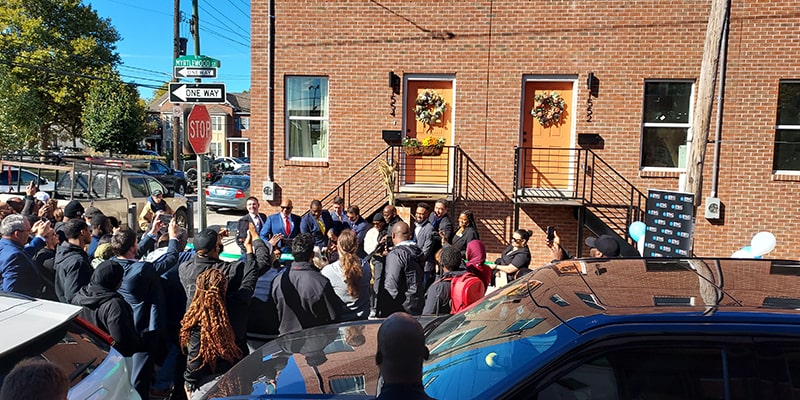
One flagship initiative is the Turn the Key program, which Rushdi describes as “the best program in the nation.” On publicly owned vacant land, developers build two-story single-family homes priced around $280,000. For qualified buyers, the city provides a $75,000 non-payable second mortgage – effectively more than 25 percent down – that sits behind the primary mortgage and is forgiven over time.
“You can buy a three-bedroom, two-bath single-family home with a yard in a neighborhood where other houses might be selling for five to six hundred thousand dollars,” he says. “You come in with almost no money down and end up with a monthly payment of around $1,100 to $1,200. It’s less than what people are paying to rent studios in the same area, where they still need to come up with thousands of dollars upfront for deposits.”
The implications for working families are profound. Typical buyers earn between $23 and $25 per hour. For households at that income level, building savings for a traditional down payment is increasingly out of reach in the face of rising everyday costs, from groceries to utilities. Turn the Key not only breaks that barrier, it sets them on a path to long-term wealth.
“If you’re making $50,000 a year, you’re barely keeping your head above water,” Rushdi says. “Under this program, within fifteen years you could have between $250,000 and $400,000 in equity. That’s life-changing. It’s a pathway out of poverty and a way to create real economic mobility.”
The current plan envisions 1,000 to 2,000 such homes, with potential growth to 5,000 under the city’s broader $800 million housing bond program, which the BIA strongly supported. All told, those homes could impact upwards of 20,000 residents, giving them a way to benefit from the very development reshaping their neighborhoods.
Diversity, Capital Access, and the Accelerator Fund
Equity and inclusion in the development community itself is another area where the BIA has taken a hands-on, results-driven approach. Rushdi is candid about what he sees as the shortcomings of traditional diversity efforts.
“A lot of organizations handle diversity in a very superficial way,” he says. “They count the percentage of minority members, set a goal to increase that number, host a few seminars, and then declare success. As an engineer, I deal in numbers and outcomes. That doesn’t actually improve people’s lives.”
Instead, the BIA set out to change the structural barriers that prevent Black and brown developers from scaling. The core problem, Rushdi notes, is access to capital, particularly equity. To do a $2.5 million project, a developer typically needs $300,000 to $400,000 in equity. Without that capital – and without strong banking relationships – many would-be developers are effectively locked out of larger deals.
“That’s where the Philadelphia Accelerator Fund comes in,” he explains. Seeded with $5 million each from Citizens Bank and Univest Bank, along with additional support from the city, the fund has grown to about $20 million and is designed to be leveraged at roughly ten to one. That means enabling around $200 million worth of projects in the city.
The fund offers pre-construction loans that function effectively as equity, without putting undue weight on traditional markers like credit scores or past borrowing history. Projects are evaluated on their merits, with two key criteria: the developer is a small or disadvantaged operator looking to grow, and the project delivers at least 51 percent affordability.
“Up until three years ago, there wasn’t a single 100 percent Black- or brown-owned development company in Philadelphia doing more than $10 million worth of work,” Rushdi says.
“Today we’re at 23. These aren’t joint ventures where someone is just satisfying a minority participation quota. They are the true owners and landlords of these projects.”
The financing comes at very favorable rates – often around five to five-and-a-half percent, which is lower than many construction loans and far cheaper than hard money. That differential is often enough to make or break a project’s feasibility and gives emerging developers the ability to step up from $500,000 jobs to $3–4 million projects.
A Full-Circle Model: Mentorship, Events, and Policy
The BIA’s efforts extend beyond finance. Through an affiliated group, the Urban Development Association (UDA), experienced developers volunteer their time to mentor minority and small developers, guiding them through the full project lifecycle – from acquiring public land and assembling a capital stack to building and leasing or selling finished units.
Photo Credit: Albert Yee
“Think of it as a full 360,” Rushdi says. “We’re building depth in the minority development community through mentorship. We’re leveraging our banking relationships to get them construction loans. We’re providing equity through the Accelerator Fund. And we’re encouraging them to build affordable housing. Minority developers building affordable housing with access to capital and the right support – that’s the full circle we’re aiming for.”
The association also maintains an active calendar, with 20 to 30 events each year, including an annual – and now semi-annual – builders’ show and connection event where members network, forge partnerships, and discuss the latest trends in housing and construction. An affordable housing committee keeps the focus on policy and program design, working closely with city officials to ensure that new legislation promotes, rather than unintentionally restricts, housing supply.
Across the board, the BIA has become known as a pragmatic, middle-of-the-road voice – one that cares about its development partners and the communities in which they build. “We’re like a think tank for the industry,” Rushdi says. “We’re very focused on results, not just process. You can pass any legislation that sounds great on paper, but if the math doesn’t work, nothing gets built. Our job is to bring that technical reality into the conversation and make sure solutions actually pencil out.”
Looking ahead over the next two years, the association has set an ambitious target: to grow to 50 fully Black- and brown-owned development companies doing more than $5 million in work each, while continuing to expand affordable housing programs that create genuine wealth-building opportunities for residents.
In a city defined by its neighborhoods, that focus on equitable growth – grounded in numbers, community needs, and real-world feasibility – is positioning the Philadelphia Building Industry Association as a crucial connector between policy, development, and long-term prosperity.
Click The Cover To View Or Download The Brochure
AT A GLANCE
Who: Philadelphia Building Industry Association
What: The leading advocacy and educational association representing Philadelphia based builders and associated construction professionals
Where: Philadelphia, Pennsylvania