Photo Credit: Christin Austin Photography
Oil Heritage and Winning Small-Town Character
This Southeastern Illinois City Leverages Historic Assets, Oversized Infrastructure, and Family-Centered Planning to Create Opportunity in Rural America.
In the heart of Crawford County, where oil derricks once dotted the landscape during Illinois’ first petroleum boom, Robinson is a community shaped by its industrial heritage and agricultural roots. The city of 7,150 residents is the county seat, a role it has held since 1844, when it replaced the nearby town of Palestine. Mayor Mike Shimer describes Robinson as fundamentally “a rural area of farming and oil” that has evolved into something more.
The southeastern Illinois location, just seven miles from the Indiana border, places the community within a landscape of scenic farmland punctuated by the low-production stripper wells that continue pumping crude from the historic Southeastern Oilfield discovered in 1906. Robinson is home to three Fortune 500 companies, including Marathon Petroleum Company, The Hershey Company, and Dana Incorporated.
“We have beautiful parks, a great school system, and good healthcare,” says Lisa Schaefer, executive director of the Robinson Chamber of Commerce. These quality-of-life factors form the foundation of a community that maintains its small-town character while working to attract new residents and businesses. The city’s parks and recreation infrastructure are particularly robust for a community of its size, offering amenities that larger municipalities might envy.
Crawford County’s population of 18,679 spreads across a rural landscape where 67 percent of residents live outside urban areas. Robinson itself anchors this agricultural region, where farming remains central to the local economy alongside the petroleum industry. Marathon Petroleum Company operates a refinery in town, continuing the oil production legacy that once made Crawford County responsible for 98 percent of Illinois’ oil output in the early twentieth century.
Reimagining Downtown as a Community Gathering Place
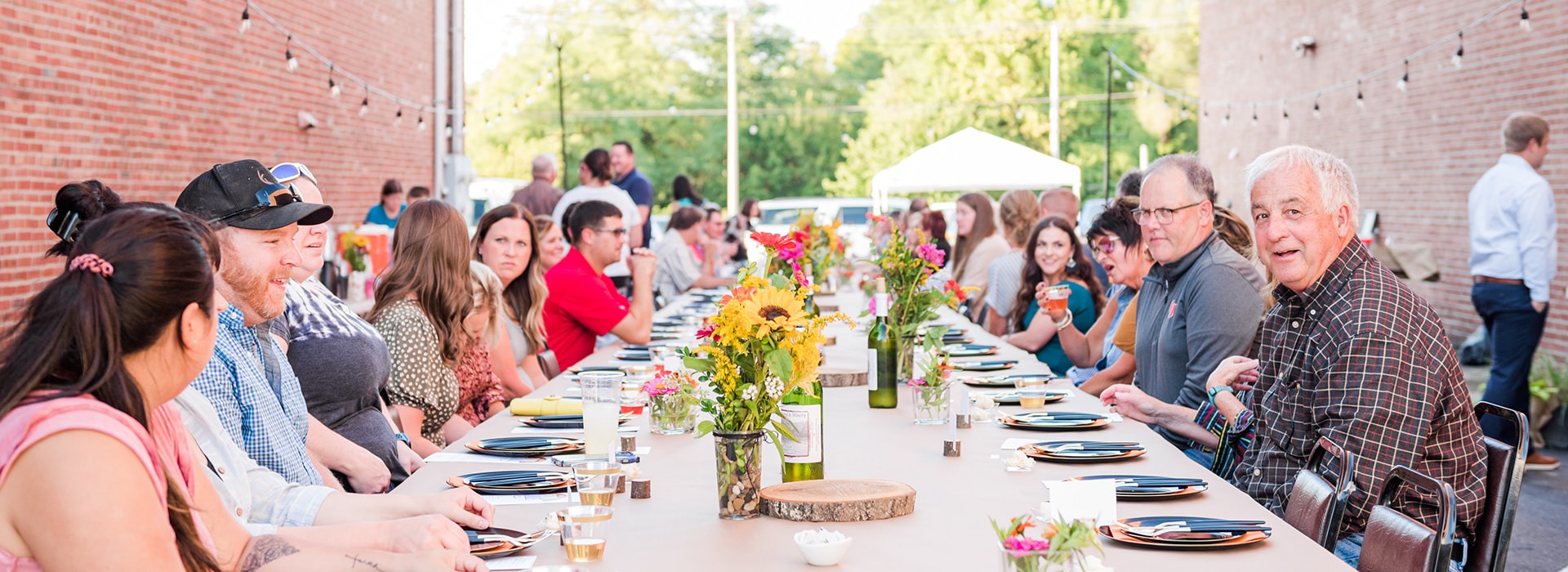
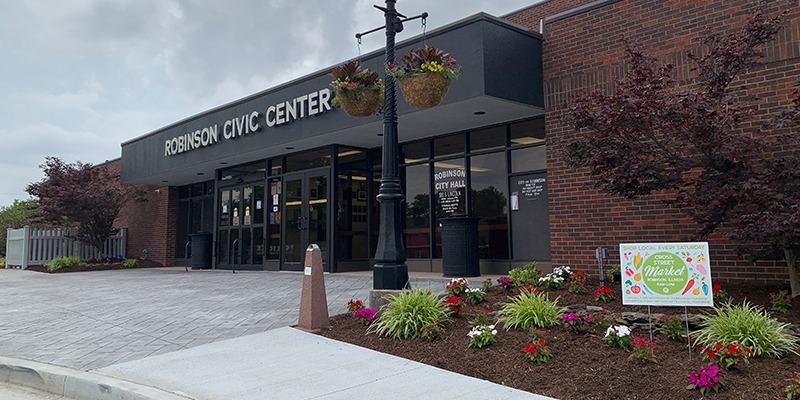
Robinson’s downtown square has undergone a deliberate transformation from purely commercial space into what Mayor Shimer calls “a park setting in the whole downtown area.” The city has invested in new streetscape lighting, extensive landscaping, and flower beds that create an atmosphere designed to draw families rather than just shoppers. “We’ve tried to create a park setting where we have markets, and we have a nighttime concert series in the summer,” Mayor Shimer explains. The strategy positions the square as a gathering spot for Crawford County’s residents, reinforcing Robinson’s identity as the county seat and community hub.
Cross Street Station, developed within the downtown footprint, hosts regular events including farmers markets and evening concerts throughout the summer months. The approach indicates a broader shift in how small Midwestern towns are rethinking their commercial centers, moving beyond retail-only models to create multipurpose civic spaces. “We utilize it as a gathering spot for many outdoor events; it’s the hub for our community,” Mayor Shimer says. Any major event the city organizes ties into the downtown merchant area and the family-friendly setting they have cultivated.
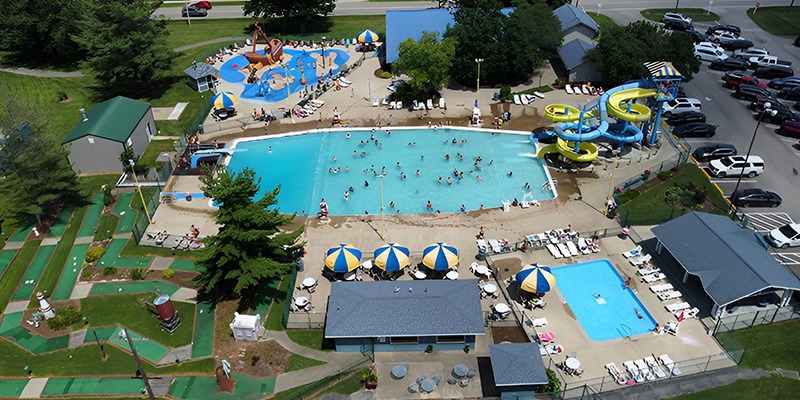
The beautification efforts extend beyond aesthetics into practical business support. Several storefronts currently sit vacant on the square, presenting both challenge and opportunity. The city works actively to fill these spaces with tenants that complement the family-oriented vision Mayor Shimer describes. “We do have a couple of open spaces in our square area that we are actively pursuing new tenants,” he says. The approach seeks businesses that will thrive in an environment increasingly focused on events and foot traffic rather than traditional retail alone, recognizing that successful downtown squares in communities of Robinson’s size often mix retail with service businesses, restaurants, and entertainment venues.
Supporting Business Growth Through Strategic Incentives
Robinson operates four Tax Increment Financing districts across the city, financial tools that capture property tax revenue from new development to reinvest in designated areas. The downtown TIF provides the most direct support to square merchants, though Mayor Shimer acknowledges “we’ve had several businesses, well, not several, a couple of businesses flip here lately.” The candid assessment highlights the reality facing many rural Illinois communities, where maintaining a viable retail core requires persistent effort.
The enterprise zone designation adds incentive for businesses considering Robinson, particularly for industrial or manufacturing operations. These zones, authorized by the state, offer tax breaks and regulatory relief to companies that locate or expand within their boundaries. “We do have a downtown TIF; we have four TIF districts inside our community,” Mayor Shimer says, outlining the geographic scope of available incentives. The multiple districts allow the city to target support where development needs it most.
Schaefer describes the Chamber’s role as distinct from business attraction work. “Our primary function is to promote and connect our businesses,” she explains. The organization focuses on supporting local businesses and organizations, creating networking opportunities and promotional platforms for members. “We assist the city with recruiting new business, but our primary focus is to support businesses once they’re here.”
Mayor Shimer identifies specific gaps in the local business landscape, noting “I think we definitely need a small implement farming business of some type that sells lawnmowers or tractors.” The agricultural character of Crawford County creates a natural demand for equipment sales and service that is currently unmet locally.
Infrastructure Ready for Expansion
Robinson’s infrastructure capacity tells a story of foresighted planning for growth without requiring massive capital investment. The wastewater treatment plant, built larger than immediate needs required, can handle up to 12,000 residents or connections at full capacity. “Right now, we’re running at about half capacity, so we have much room in our wastewater just alone in that particular area to handle quite a lot of growth,” Mayor Shimer says. The oversized facility eliminates a common barrier that hampers development in similarly sized communities, where aging or maxed-out treatment plants force expensive upgrades before new projects can proceed.
Water supply has no constraints either. The Robinson-Palestine Water Commission manages the system, providing abundant water resources for residential and commercial needs. Ameren is the primary electrical provider, while internet connectivity meets modern business requirements. “We have very good utility service. I would say we’re very pleased with that and we have plenty of room for expansion there too,” Mayor Shimer notes.
The city maintains an aggressive ongoing infrastructure maintenance program rather than waiting for systems to fail. “We reline a lot of sewer lines every year. We have companies come in and upgrade that,” Mayor Shimer explains. Robinson recently completed a new sewer line installation from North Cross to North Jefferson Street, addressing a specific capacity need. The public works department operates its own filming equipment, allowing staff to inspect all wastewater and storm sewer lines internally. The city has mapped its entire underground infrastructure and upgraded filming systems within the past three years, creating detailed records that inform maintenance decisions and prevent costly emergency repairs.
Building a Family-Centered Community
Mayor Shimer frames Robinson’s two-year priorities around a simple philosophy: “Keep people interested, informed, engaged, and inspired.” Housing expansion tops the agenda, alongside continued business community growth and downtown beautification. The goal centers on creating an environment where potential residents driving through town can envision a future there. “We need people driving into towns thinking that this is a place I could see ourselves living,” Mayor Shimer says, articulating the impression Robinson works to project.
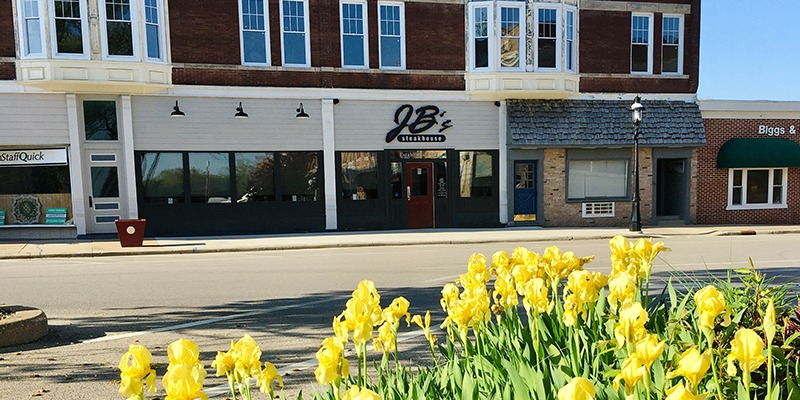
The park system receives ongoing attention despite already ranking as outstanding for a city of 7,150. Robinson plans to add a lazy river to the Pelican Cove aquatic center at the city park within the next two years, joining recently installed pickleball courts in the recreation offerings. Quail Creek Country Club, now within city limits, provides an 18-hole championship golf course designed by Tom Bendelow in 1919. The historic course hosted the PGA Tour’s Robinson Open from 1968 to 1973, with legends like Lee Trevino and Bob Goalby playing the layout. “We have a very good golf program,” Mayor Shimer notes, referencing both the country club and public options.
The newly established Boys and Girls Club addresses childcare needs. “Another activity that we provide for families with kids, especially those families that have both parents working,” Mayor Shimer says. Multiple childcare centers operate in town, both of which perform well, according to city officials. Karnell Fiscus, executive assistant at Robinson City Hall, compiled a comprehensive information booklet available free to residents covering everything from sewer hookups to trash collection and recreation center locations.
Lincoln Trail College, founded in 1969 and currently expanding, serves approximately 717 full-time students. Schaefer emphasizes its importance: “It’s always been one of my philosophies, the larger your college system is, the more the community can continue to grow.” Additionally, the Robinson Community Unit School District is dedicated to fostering a supportive and enriching environment for students.
“We are fortunate to have a robust healthcare system in Robinson”, says Schaefer. Crawford Memorial Hospital is a fully licensed and accredited 25-bed critical-access acute care facility with an extensive range of services.
Celebrating Community
Robinson’s festival calendar has grown substantially, with the spring Daffodil Festival expanding from 40 vendor units to over 150. The event takes its name from thousands of daffodil bulbs the city has planted throughout community corridors, creating waves of yellow blooms each spring. “Not only is it just a one-day festival with lots of vendors and food and family-friendly activities, but the city also has an initiative where they have planted thousands of daffodil bulbs all around the community,” Schaefer explains. The perennial flowers multiply year over year, expanding the visual impact without additional planting costs.
Home for the Holidays Festival in December offers ice skating, train rides, and activities that draw families from across Crawford County. Local merchants participate alongside food and craft vendors, turning the Robinson Civic Center into a winter gathering place. The city also hosts a trick-or-treat night that attracts over a thousand children annually, plus a summer concert series at Cross Street Station.
The Heath Toffee Festival celebrates Robinson’s most famous export. The Heath candy bar was created in 1914 when brothers Bayard and Everett Heath opened their confectionery shop on the square. Their father, schoolteacher L.S. Heath, had purchased the business as an opportunity for his sons. By 1928, they were marketing “Heath English Toffee” that would become nationally known. “It’s the only place where the Heath Candy Bar is produced,” Schaefer says, emphasizing the manufacturing distinction. The Hershey Company, which acquired the brand in 1996, still produces Heath bars at the Robinson plant on West Main Street, the same city where recipe development began over a century ago.
Robinson’s strategy combines practical infrastructure planning with intentional community building, creating a foundation for measured growth while preserving the small-town character that defines southeastern Illinois. The city works within its means, leveraging existing capacity and historic assets to position itself for residents seeking quality of life in a rural setting.
AT A GLANCE
Who: Robinson, IL
What: County seat city of 7,150 residents in southeastern Illinois with historic oil production heritage, home to Heath candy bar manufacturing, and growing family-centered amenities
Where: Crawford County, Illinois
Website: www.cityofrobinson.com
PREFERRED VENDORS/PARTNERS
Marathon Petroleum: www.marathonpetroleum.com
Marathon Petroleum Corporation (MPC) is a leading, integrated, downstream and midstream energy company headquartered in Findlay, Ohio. The company operates the nation’s largest refining system. MPC’s marketing system includes branded locations across the United States, including Marathon brand retail outlets. MPC also owns the general partner and majority limited partner interest in MPLX LP, a midstream company.