Preparing Students for a New Economy with Purpose and Possibility
Career Pathways, Early Exposure, Educational Innovation, and a Community-First Philosophy Guide Greensburg’s Next Era of Opportunity
Indiana’s new economy—like the national landscape—is shifting quickly, shaped by advancing technologies, new industries, and a workforce whose expectations no longer resemble those of previous generations.
For Greensburg Community Schools (GCS), this reality is not a challenge to react to, but an opportunity to lead. With a decade-long commitment to career exposure, hands-on learning, early college access, and deep community partnerships, the district has built a model that aligns seamlessly with Indiana’s newest diploma pathway, while staying true to a mission grounded in equity, access, and student-centered purpose.
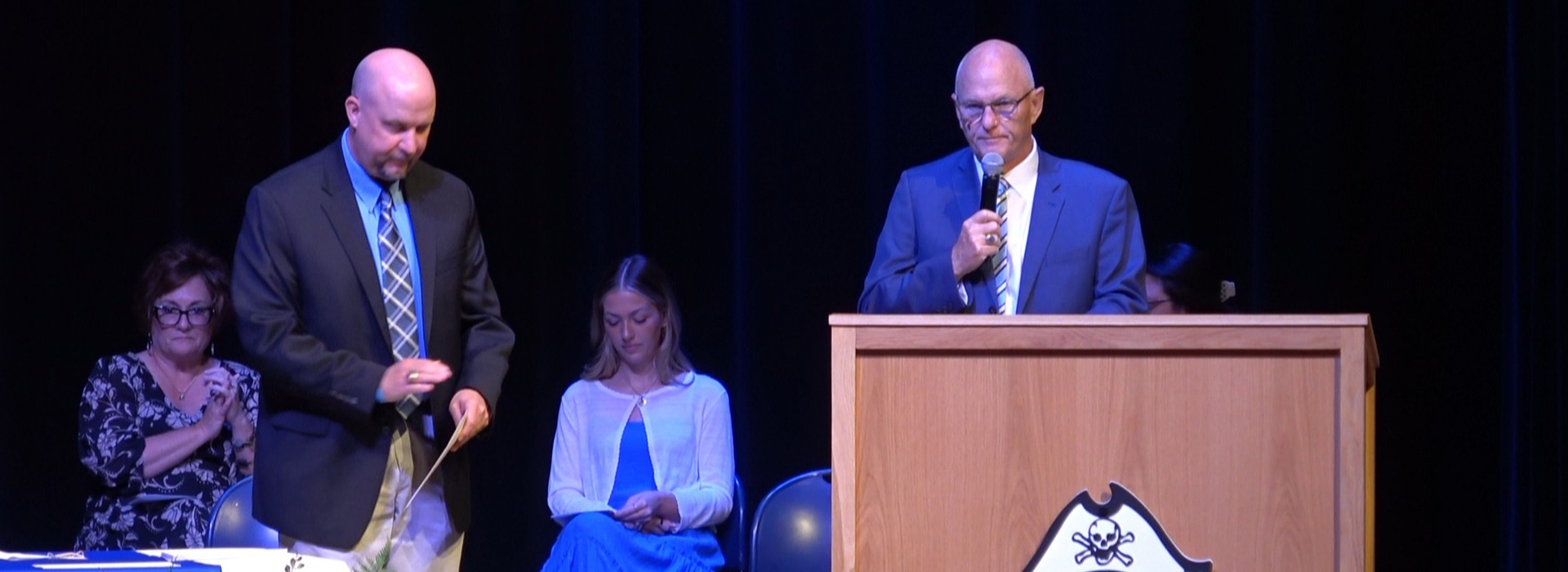
Superintendent Tom Hunter, a Greensburg graduate himself, captures that mission simply: to provide every opportunity possible for every kid. That clarity guides every decision—in curriculum, staffing, facilities, innovation, and community engagement.
“Our whole mission is providing opportunities so every student can decide their path,” Hunter says. “Whether it’s the workforce, a two- or four-year college, or the military, we want them exposed to enough experiences to make informed, confident choices. That starts in junior high and continues through high school.”
It is a philosophy that has grown stronger over time, not weaker. And as Indiana transitions to its new diploma model for the Class of 2029, Greensburg finds itself ahead of the curve, not scrambling to adjust.
A District Committed to Shaping Futures, Not Assigning Them
Hunter, now in his 26th year with the district—and a product of it—speaks often about opportunity as both responsibility and promise. He does not believe in telling a kindergartener what they should become at eighteen. Instead, he sees the K–12 journey as a curated exposure to meaningful experiences, empowering students to discover their strengths through STEM, trades, advanced academics, CTE, and early work-based learning.
This approach has earned Greensburg multiple Project Lead the Way Distinguished School recognitions and certification as an Early College High School, reflecting both rigor and real-world relevance.
Perhaps more importantly, it embodies the district’s belief that a student’s background—not even Hunter’s own less advantaged family origin—should never determine their trajectory.
“When students leave us,” he says, “I want them prepared to be the best in whatever career they choose. Whether they’re becoming welders, teachers, doctors, or technicians, they need a foundation strong enough to carry them into the next stage.”
Innovation Through Virtual and Hybrid Learning
Although the pandemic sparked a national shift toward virtual learning, Hunter is candid: COVID did not motivate Greensburg’s virtual school model. In fact, he says the pandemic could have dissuaded him from pursuing it. But the new economy—and the needs of certain students—made virtual and hybrid learning a necessity, not an option.
“There are kids who cannot function in a building with 600 others, but who are academically strong and highly motivated,” he explains. “They need a different way of learning.”
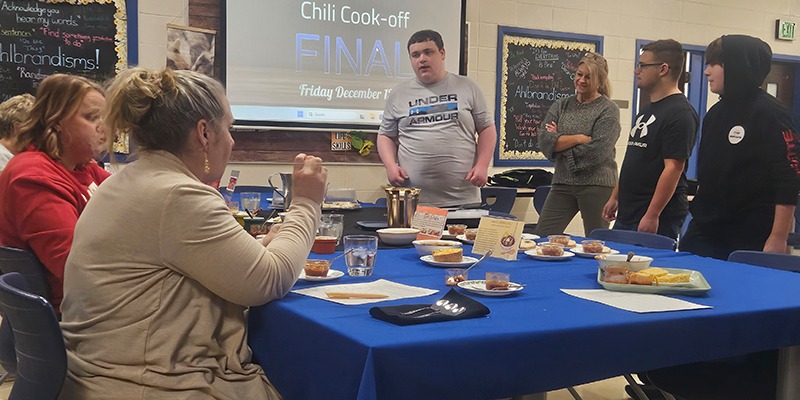
The GCS model is intentionally hybrid. Students can take some classes online while attending one or two periods on campus, or they can participate in extracurriculars, athletics, and clubs. It blends autonomy with belonging—mirroring modern workforce expectations.
Hunter initially hoped for twenty students. The virtual school now enrolls sixty-two, with rapid growth fueled by the leadership of its coordinator, a former high school counselor gifted at relationship-building and student support.
In Greensburg, virtual learning is not a retreat from school—it is another doorway into it.
A Decade of Investment in Career & Technical Education
If there is one area where Greensburg’s leadership shines brightest, it is career and technical education. For years, the district depended on a regional vocational partnership in Columbus. But students were not boarding a bus for an hour-long ride each way to attend a single class. Access was limited. Engagement was low.
Hunter went to the community with a bold ask: build a vocational school in Greensburg.
The Community Said Yes.
Today, the district’s state-of-the-art CTE facility—built with a $2 million local investment—is a high-demand hub of hands-on learning. Students walk down their own hallway to take multiple CTE courses in the time they once would have spent commuting.
Participation skyrocketed. What once counted 80 to 100 course enrollments now sees several hundred CTE classes per semester.
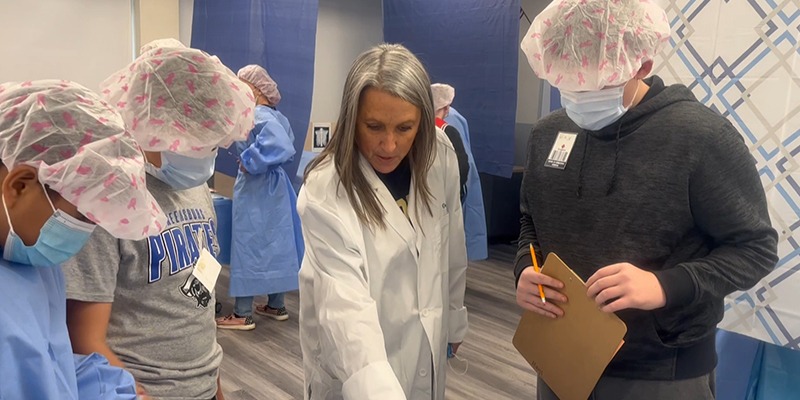
The programs themselves reflect the needs of the local economy—an economy driven by manufacturing, agriculture, healthcare, and early childhood education. Decatur County Memorial Hospital is one of the largest regional employers, and the district’s science labs, Z-Space virtual lab, and mock hospital suite mirror the standards of university-level education. Students train in nursing, medical science, and health technologies, then apply their skills in local hospital and care facilities.
Students graduate with CNA certifications, child development associate credentials, and welding certifications that align directly with industry expectations.
“We create the best possible students,” Hunter emphasizes. “It’s the employer’s job—not the school’s—to train them for a specific assembly line. Our job is preparing them with skills that translate anywhere.”
Early childhood education is another standout program—now serving more than 100 students—further strengthened by a new partnership with a daycare facility housed in a repurposed district building. Students walk down the hallway to gain hands-on experience, creating a pipeline to meet the region’s growing demand for early learning professionals.
The welding program, supported by high-grade equipment and industry-aligned curriculum, has become a model for the region. Manufacturing employers consistently cite welding as a top need—and Greensburg students are graduating ready to fill it.
A Community That Steps up When the State Steps Back
Federal and state funding pressures have affected school districts nationwide. Greensburg is no exception. When Indiana abruptly removed workforce development funding for the district’s JAG program (Jobs for America’s Graduates), many districts cut their programs entirely.
Greensburg refused.
The district absorbed the cost itself, recognizing JAG as an essential support system for students at risk of disengagement. Under the leadership of a dynamic coordinator, JAG enrollment jumped from 27 in its first year to 90 this year.
“It’s a program you cannot afford to lose once you have it,” Hunter says. “Funding or no funding, we are keeping it. Our kids deserve it.”
The district has also generated more than 3,000 college credits for students, saving families nearly $900,000 in tuition costs—another example of how Greensburg leverages every avenue to expand opportunity.
Best-in-Class Facilities Built with Foresight
Even as fiscal uncertainty looms, Greensburg’s facilities are among the most well-maintained in the state. Hunter credits aggressive planning and preventive maintenance for keeping the district ahead of economic downturns.
Every building has been renovated in the last five years. Furniture has been replaced districtwide. HVAC systems, controls, and LED lighting have all been upgraded. The district’s buildings are positioned to remain modern and efficient for the next decade without major capital strain. Hunter saw the downturn coming and prepared accordingly.
“I didn’t know exactly how bad it would be, but I knew it was coming,” he says. “We did everything possible to make sure we could withstand the next five to ten years.”
At the Heart of Everything: The Students
When asked what keeps him motivated after decades in the district, Hunter gives an answer that is both simple and profound.
“If we’re not doing everything we can to give kids the best experience possible, we’re in the wrong profession. Kids are what matter. Everything else is secondary.”
He compares education to building a car: if one were building a vehicle, they would want to build the safest, highest-quality version possible. In schools, the product is young people, and the responsibility is infinitely greater.
That perspective permeates every CTE pathway, facility upgrade, instructional innovation, and new program launched under his leadership.
Looking Ahead: Funding Pressures, Industry Partnerships, and Sustaining Innovation
The next 18 to 24 months will shape how Greensburg adapts to a very real financial challenge: a projected million-dollar loss from Indiana’s property tax issue.
Hunter is frank about the implications. Innovation becomes harder without funding to support it. Programs that elevate students require resources, not just goodwill. He expects that at some point, private industry—especially the large manufacturers that rely on these graduates—must become more active partners in education.
“Industry wants skilled workers, but they have to put some skin in the game,” he says. “We prepare the students. They need to invest in training them for their specific roles. That’s their job.”
Even so, he remains confident in the district’s future. Greensburg’s community is deeply giving, he says, and the district’s success stories prove that when the community invests in students, the return multiplies across generations.
“We’ll find a way,” he says. “We always have. Because it’s about kids.”
Greensburg Community Schools enters the future with clarity, resilience, and a commitment to preparing students not just for the jobs of today, but for the opportunities of tomorrow. With a superintendent guided by lived experience, a faculty united by purpose, and a community willing to stand behind its schools, Greensburg is not simply reacting to the new economy—it is helping to shape it.
AT A GLANCE
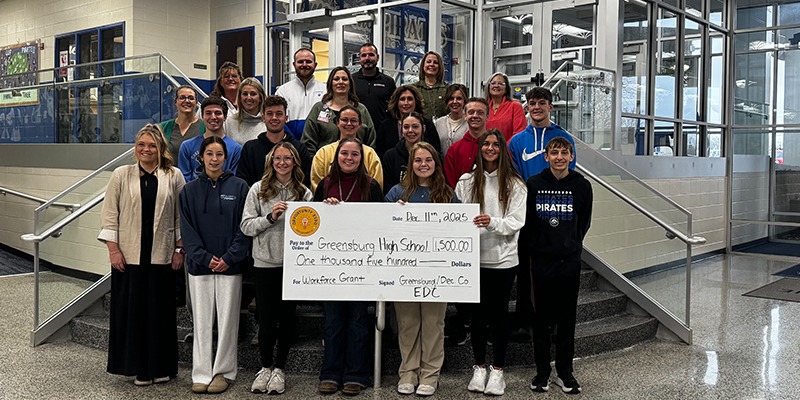
Who: Greensburg Community Schools
What: A thriving school district committed to its student’s current and success well into the future
Where: Greensburg, Indiana
Website: www.greensburg.k12.in.us
PREFERRED VENDORS/PARTNERS
Decatur County Memorial Hospital: www.dcmh.net
At Decatur County Memorial Hospital, your health is our priority. Established in 1922 in Greensburg, DCMH is a community-focused healthcare provider offering comprehensive services, including primary care, oncology, orthopedics, surgical care, and more. Dedicated to personalized, patient-centered care, DCMH fosters long-term health through proactive initiatives, health screenings, and education on healthy lifestyles.
