Economic Impact Through Agricultural Education and Youth Development
This Perry Facility Proves That Investing in Youth Agriculture Delivers Measurable Returns.
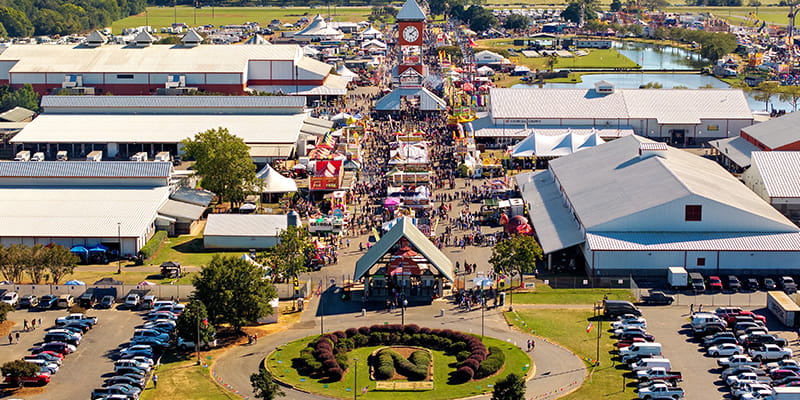
In the heart of Perry, Georgia, where Interstate 75 cuts through the geographic center of the state, sits a 1,100-acre facility born from a father’s frustration with the dismal conditions his children faced while showing livestock in the 1980s. Larry Walker, then a state legislator, approached the Georgia General Assembly with a modest proposal to renovate existing facilities. The legislature had a bolder vision. “Instead the legislature said, no, let’s just start from new,” explains Stephen Shimp, executive director of the Georgia National Fairgrounds and Agricenter.
In 1985, the state established the Georgia Agricultural Exposition Authority with a nine-member board appointed by the governor. Construction followed with an investment totaling $26.2 million by the facility’s 1990 opening. “Larry Walker was a state representative at the time,” Shimp notes. “His kids actually showed pigs and possibly some other livestock.” The parkway leading to the facility now bears Walker’s name.
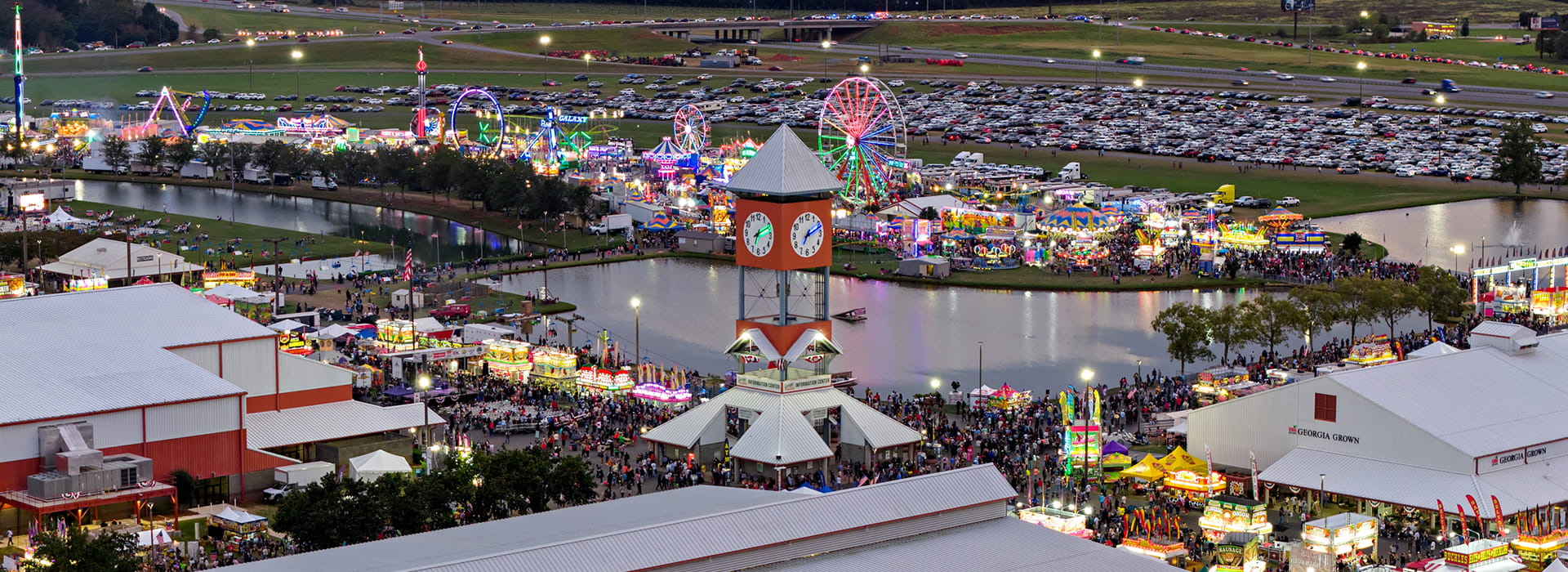
Today, the operation runs year-round with four arenas serving diverse events. “We have 60 plus events a year just in livestock events total. We have close to 200 events a year with livestock and commercial sales,” says Kelley Owen, agricultural and youth livestock director. The Georgia National Fair draws hundreds of thousands of visitors over 11 days each October. “This year our attendance was 600,000 people during the Georgia National Fair,” Shimp reports.
February brings the Georgia National Rodeo, while July hosts the NBHA Youth and Teen World Championships. The 2025 Barrel Racing Championship drew 2,148 horse and rider pairs from countries including Canada, Australia, France, Italy, Mexico, and New Zealand, distributing $585,000 in payouts. “Currently this NBHA show, which is barrel racing, their home is in Texas and their riders come from California, Canada, from out of Central America,” Shimp explains. “There’ll be folks here from across the pond, and from all over the world.”
Youth Agriculture at the Core
The Georgia Agricultural Exposition Authority operates under a clear mandate from the state legislature. Shimp reports directly to the nine-member board appointed by Georgia’s governor, tasked with a dual mission: “I work at their pleasure to carry out the missions of the Georgia Agricultural and Exposition Authority,” he says. “The mandate that we operate under, number one in our business, is to make sure that we showcase Georgia’s agriculture and showcase Georgia’s agricultural youth.”
This focus on youth programs represents a significant financial commitment. The authority invests $2.6 million annually to maintain facilities and provide access to Georgia’s young people at no cost or very low cost. “That’s to maintain our facilities as well as opportunity costs,” Shimp explains. Youth programs occupy approximately 60 days annually, limiting commercial rental availability during prime weekends. The authority balances this investment through revenue from equine events, livestock shows, conventions, and commercial rentals throughout the year.
The business model prioritizes accessibility over profit maximization. Where commercial venues might charge premium rates to youth organizations, the fairgrounds subsidizes participation to remove financial barriers.
“The authority, that’s their number one priority, is youth in Georgia and geared towards agriculture and introducing them to agriculture,” Shimp states. The facility serves as essential infrastructure for programs like 4-H and FFA, providing professional-grade arenas and exhibition spaces that would otherwise be unavailable to most rural communities. Georgia’s investment recognizes that cultivating the next generation of agricultural professionals requires more than classroom instruction. It demands hands-on experience in facilities that mirror industry standards.
Educating the Next Generation of Agricultural Leaders
The fairgrounds serve as more than a venue for exhibitions. Owen describes the core educational offering: “We’re offering the opportunity to give someone a place to show their animals or their projects in a facility top notch to the world. When you bring them here, our facility’s open for everybody to come see and they’re presenting their animals or their projects in an environment set up for that.”
Additionally, the facility runs a selective leadership program. The ambassador initiative accepts several young people annually for intensive training in facility operations, promotional skills, and agricultural business concepts. “We take 10 young people every year into the leadership program,” Owen explains. “We teach them how the facility works, and what we do here. They help us promote this facility and we use them to help reach out to the young people to help them understand what we do and how it all works together with 4-H and FFA and the Georgia National Fairgrounds.”
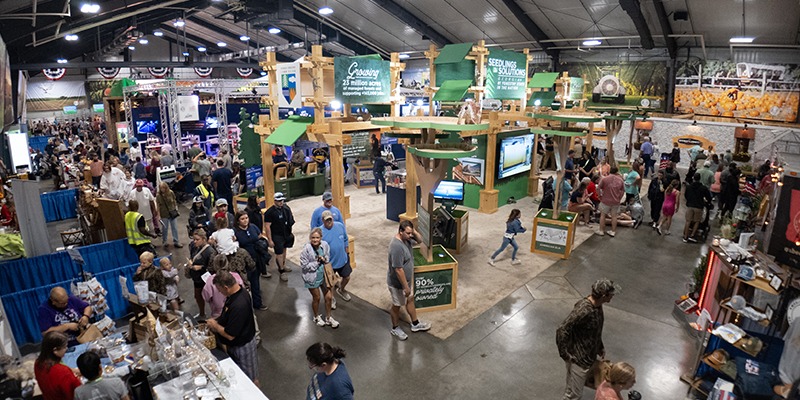
Partnership with the Georgia Department of Agriculture adds to the educational reach. The Georgia Grown building houses detailed exhibits demonstrating agricultural production processes. “We have what’s called the Georgia Grown Program, which is a building, an educational display of major products that are produced in Georgia through agriculture,” Shimp says. Visitors learn about forestry products, the seed-to-shirt journey of cotton, and peanut cultivation and processing.
The educational impact operates at scale. “The number one component that I always talk about and think about is the youth involved in these programs,” Shimp notes. “We’re hoping to spark an interest in them into a career in agriculture.” Georgia’s agricultural sector contributes $83.6 billion to the state’s economy and supports 323,300 jobs, creating substantial workforce demand.
Revenue and Regional Impact
The 2025 Georgia National Fair delivered strong financial performance across all metrics. “This year we had a significant rise across the board, attendance, food vendor sales, midway ride sales, everything was up at least 12%,” reports Lori Dowd, chief administrative and financial officer. The 11-day October event generated approximately $1.5 million in state and local tax revenue for Houston County..
A 2022 economic impact study conducted by the University of Georgia’s Carl Vinson Institute of Government quantified the facility’s broader influence. The fairgrounds’ activities produced $133 million in goods and services for Georgia’s economy, with Houston County alone capturing over $36 million of that total. “Our economic benefit, we estimate to be around $50 million to the entire state,” Dowd says. “So pretty significant as far as number of visitors that attend and the revenue that’s generated back to the fairgrounds to support our mission as well as back to the state.”
The facility’s economic contribution goes even further. Shimp emphasizes the importance of attracting out-of-state participants: “Currently with the NBHA show, their riders come from California, Canada, Central America, and other parts of the world, representing new dollars that are brought into Georgia.” The 2022 study estimated out-of-state visitor spending exceeded $56 million annually. “As soon as that horse trailer or that cattle trailer, that motor home, the dog show van, as soon as it crosses the state line of Georgia, that calculator starts rolling for their spending,” Shimp explains. The fairgrounds ranks fourth in Georgia for generating domestic overnight tourism visits, contributing to the state’s position as fifth nationally in this category.
Infrastructure Investment and Workforce Strategy
The fairgrounds employs 75 full-time staff year-round with state benefits, expanding to over 200 workers during peak events like the October fair. “We have full-time staff year-round. And we of course increase that as needed for different events throughout the year,” Dowd says. The seasonal employment model addresses labor market challenges by offering unique experiences beyond typical retail positions. “When we hire part-time people to come help at events, that gives those folks the opportunity to get out here and see what we’re doing. It is something exciting and different that you’re not going to have just by going to your normal Walmart part-time job.”
Capital investment focuses on expanding youth livestock capacity. Construction is underway on a new barn and arena complex with a $21.5 million budget and November 2026 completion date. “Right now we are in the process of building a new barn and arena here on site. That’s mainly to facilitate that youth exhibition,” Dowd explains. The expansion will increase stall capacity from 2,625 to 3,000, accommodating growth in youth programs.
A separate project brings hospitality infrastructure to the grounds. “The hotel, which is not ours, but a joint venture with Marriott,” Shimp clarifies. The property operates under a private-public land lease arrangement. “We did a land lease with a 126 room hotel that’ll sit on site and serve, helping us become a true convention center.”
At the same time, technology infrastructure required substantial upgrades to support modern event operations. “We sit in very rural Georgia, so we have invested heavily,” Shimp says. “We used to run on a couple of copper wires twisted together technology wise. Zoom meetings that we’re having right now would’ve been very challenging five years ago.” Partnerships with local providers brought fiber optic connectivity to the facility, enabling the digital capabilities expected by contemporary event organizers and participants.
Future Growth and Vision
Growth in youth programs continues to drive facility planning going into the near future. Owen identifies the immediate priority: “Our biggest thing we’re wanting to achieve is to get the new barn established. We currently hold the Youth World Championship every year, and this past year we had 2,625 stalls. Next year we’re hoping to have 2,700 stalls, and when the barn is completed, we should hit right at having 3,000 stalls for that show.” The expansion addresses capacity constraints as participation increases. The Youth World Championship alone brings over 1,000 family RVs during its summer run, creating substantial economic activity for Perry and Houston County.
Maintaining accessibility for all Georgia youth remains paramount. “We don’t want that program to outgrow us,” Shimp says. “We don’t want to, in the state of Georgia, turn away a child who wants to display their agricultural project. So, we’re really pushing on the forefront of this to get in front of that with this expansion.”
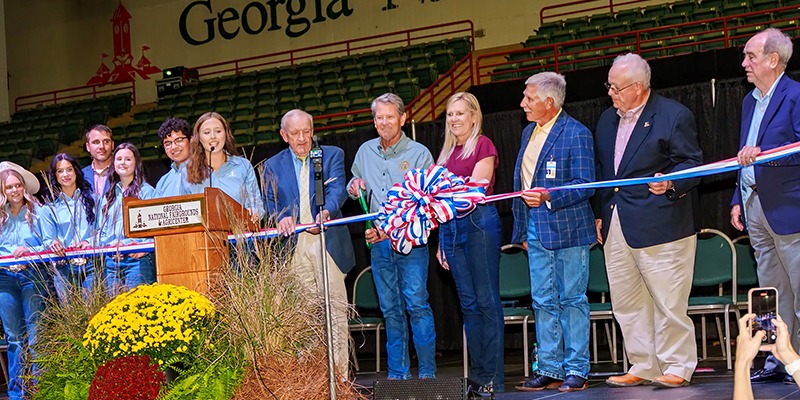
The Marriott hotel project targets commercial revenue diversification. Scheduled for completion by year-end, the property positions the fairgrounds as a full-service convention destination. “To drive the commercial side of our business, which is conventions and training, and state trainings are one thing that we have in mind,” Shimp explains. “We sit directly in the center of Georgia, so we’re easy to get to from anywhere in the state of Georgia.”
Perry’s location at Exit 135 provides access advantages for statewide organizations seeking neutral meeting venues. The hotel reduces reliance on livestock and equine revenue streams while supporting existing programs. “We’re looking to stay ahead of the customer,” Shimp states. “We don’t want any of our shows that we currently have to outgrow us and we want to make sure if the largest show in the world comes to us, we can handle it and we can make it happen.”
From Larry Walker’s vision in the 1980s to today’s internationally recognized facility, the Georgia National Fairgrounds has maintained its dual focus on youth development and economic impact. The $21.5 million barn expansion and Marriott partnership are the latest chapters in a growth story that has consistently prioritized accessibility over profit while generating substantial returns for Georgia’s economy.
AT A GLANCE
Who: Georgia National Fairgrounds and Agricenter
What: A state-owned, 1,100-acre multipurpose facility hosting 200+ annual events including the Georgia National Fair, Georgia National Rodeo, and international livestock championships, with a core mission of providing world-class venues for agricultural youth programs
Where: Perry, Georgia
Website: www.gnfa.com
PREFERRED VENDORS/PARTNERS

Parrish Construction: www.parrishconstruction.com
Founded in 1995, Parrish Construction is a Georgia-based firm built on people, trust, and excellence. With 157 professionals and 700+ projects statewide, Parrish delivers education, municipal, industrial, water/wastewater and healthcare facilities through multiple delivery methods, earning long-term partnerships, repeat clients, and sustained community-focused growth through leadership development and future investment.
Reithoffer Shows, Inc.: www.reithoffershows.com
Reithoffer Shows, established in 1896, is America’s only five-generation family-owned and operated midway ride company. Our long-standing partnerships, such as with the Georgia National Fair in Perry, GA since its beginning in 1990, reflect our commitment to quality, safety, and family fun, setting the standard for excellence in the industry.
