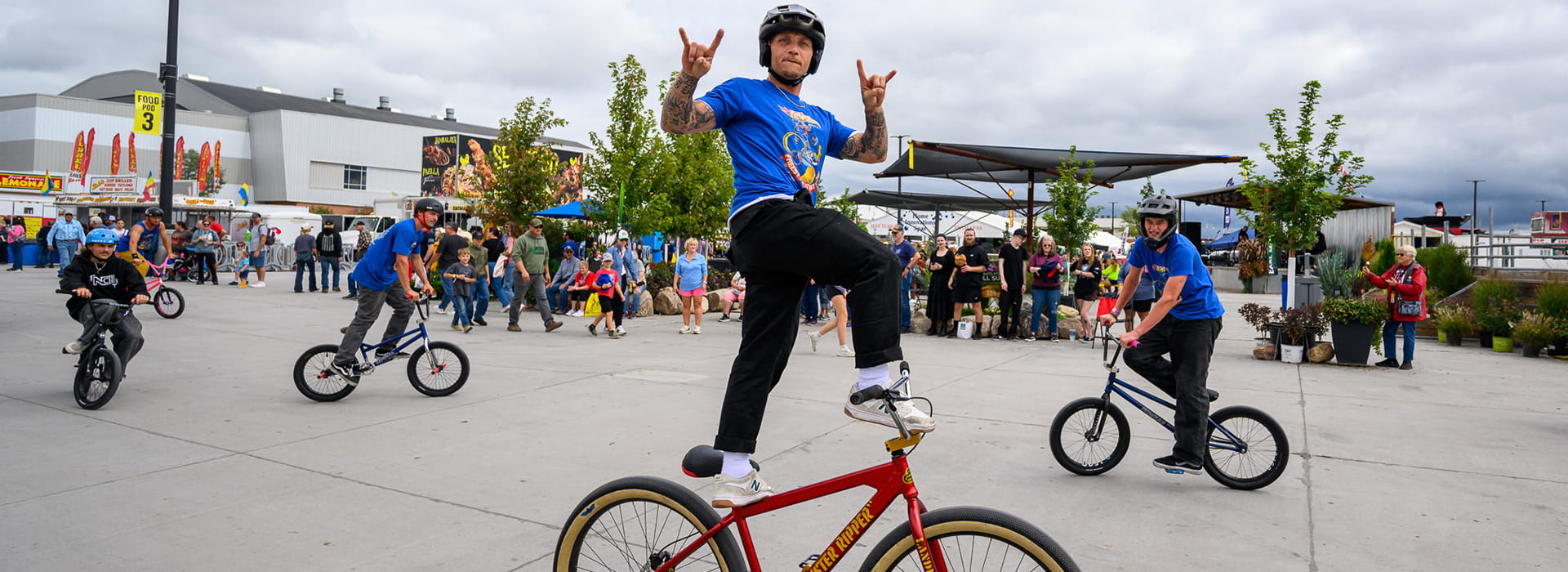
Take Me Out to the Fair16
A Community Anchor in Grand Island, Nebraska
Over more than seven decades, Fonner Park has built a legacy in Grand Island and central Nebraska, evolving from a horse racing venue into a multifaceted campus with year-round community attractions. At the heart of it all is the Nebraska State Fair, an event that celebrates agriculture, youth achievement, education, and community pride, while generating economic impact for the region and the state. Together, Fonner Park and the Nebraska State Fair represent a partnership grounded in history and focused on the future.
The Nebraska Springtime Tradition
Fonner Park’s origins begin in the early 1950s and is named after Gus Fonner, a land owner who allocated some of his land toward the development of the campus. CEO Chris Kotulak shares, “It was April 29,1954 that the first thoroughbred horse race was run at Fonner Park. For close to 75 years we have had a racing season that begins in mid February and concludes on the first Saturday in May, which is always the Kentucky Derby. At Fonner Park, our racing season and our presentation of horse racing we refer to as the ‘Nebraska Springtime Tradition.’”
Over time, Fonner Park has expanded well beyond its original footprint, into a 230-acre campus housing multiple attractions and facilities. Among those additions is the Heartland Event Center, a 6,000-seat arena that opened in the mid 2000s. Additional amenities followed, including a variety of community events, Fonner Keno, and eventually the Nebraska State Fair itself. More recently, the campus welcomed the Grand Island Casino Resort, a seven story, 162 room hotel and casino that became fully operational in April 2025.
Beyond entertainment and tourism, Fonner Park has also contributed land for public use. “There’s a fire station that was formerly on the Fonner Park grounds that Fonner Park gave to the city of Grand Island,” Kotulak expands. “There’s the Island Oasis Waterpark that used to be just a soccer field. We really have quite a little gem here in central Nebraska.”
Bringing the Fair to Grand Island
The relocation of the Nebraska State Fair from Lincoln to Grand Island was a turning point, both for the fair itself and for the community. That move required legislative approval, community vision, and a clear plan. “That was not a decision that the legislature made lightly, but it was a decision that they made within one session, which is pretty phenomenal when you think about moving an event that has been in the capital city for decades,” acknowledges Cindy Johnson, who works with the state fair on governmental relations and other special projects.
As the University of Nebraska explored expansion needs in Lincoln, Grand Island saw an opportunity. “When that plan by the University started to actually take shape, we convened a group of community leaders, both elected and non elected, and put together a plan of what the State Fair could look like in Grand Island, Nebraska, with Fonner Park as one of our core anchors,” she recounts.
“As a strong ag community in central Nebraska, along with Husker Harvest Days, which is the largest irrigated working farm show in the country, we felt we were well positioned to offer something special to the Nebraska State Fair and to the fair goers.”
The plan succeeded, and in just 13 months, $42 million in new facilities were constructed on the Fonner Park campus. “We closed the fair in Lincoln in 2009, packed everything up, and we opened the fair in Grand Island in 2010,” Johnson shares.
Agriculture, Education, and Fun
With this move, Executive Director Jaime Parr says the fair has remained dedicated to its mission, which is, “to recognize the achievements of Nebraskans, to celebrate youth and fair traditions and to showcase agriculture while providing educational and entertaining experiences for all.” The event’s offerings reflect that mission, with livestock and equine competitions alongside competitive exhibits that include food, gardening, textile arts, photography, and bee culture.
The experience wouldn’t be complete without the dynamic interactive offerings that help connect visitors to agriculture. “We have a birthing pavilion, where we have cows, goats, chickens, swine giving birth during the 11-day Nebraska State Fair,” Parr describes. “We have a milking parlor where we’re milking dairy cattle multiple times each day, with commentary and Q&A sessions. We also get to do entertainment in the form of dirt events, rodeos, and bull fighting.”
In addition, the Raising Nebraska exhibit brings hands-on learning from the University of Nebraska. “You can do a simulator of driving a combine. You can see from farm to fork. You can see elevational changes across our state by a large map, where you can stand on your county and learn something about it,” she continues.
Entertainment complements this education, with rodeos, tractor pulls, demolition derbies, and national concerts held both indoors and outdoors. “We also create a delicate balance between traditional and new items in our shopping and our food experiences during the State Fair,” Parr adds, noting that food and shopping consistently rank among the top reasons people attend.
The success of the Nebraska State Fair would not be possible without its volunteer program. “When the fair arrived in Grand Island, we had people showing up at our office space and calling, because they wanted to be a part of it,” Parr recalls. Today, more than 800 volunteers contribute over 16,000 hours annually.
“They provide a lot of customer service and guest experience benefits to our event each year,” Parr says. “They’re greeting our guests, they’re working our information kiosk, and providing their recommendations and suggestions of what people should not miss during their visit to the fair.”
Economic Impact
The impact of the Nebraska State Fair extends well beyond its 11-day run. A recent Johnson Consulting study highlights the Fair’s substantial fiscal contributions, noting that both the annual event and the State Fair’s year-round business operations generate millions of dollars in economic benefits for the community each year. Additionally, “the opportunities available because of the Nebraska State Fair in Grand Island are significant,” Johnson imparts.
Additional events hosted through the Grand Island Livestock Complex Authority (GILCA) bring substantial benefits. In 2024, a junior national Hereford show generated more than $3 million in total impact, while a national Australian Shepherd event produced $2.4 million in spending. “The events that we hold at the campus are big money for our community,” Johnson asserts.
Investing for the Long Term
Maintaining and improving a campus of this scale is a shared responsibility. Kotulak notes that while Fonner Park serves as landlord, Nebraska State Fair plays a major role in reinvestment. “Many improvements that you’ve seen have been the result of this Nebraska State Fair initiative,” he says.
Thanks to $20 million in federal ARPA funding, a major investment was made in storm water mitigation. “Grand Island is very flat, and the water table is very high. When it rained, people would have trouble going from our outdoor venues up into those new facilities that we’re so proud of,” Parr details.
“It’s hard to fundraise for piping that’s underground, so the ARPA funds certainly have been helpful.” Along with underground drainage improvements, parking lot upgrades, seating areas, and landscaping have further transformed the campus, improving accessibility and the guest experience.
Looking Ahead
As the fair prepares for its 157th edition in 2026, the focus remains on growth and collaboration. “In partnership with our landlord, we look forward to continuing to grow the Nebraska State Fair as it works for the Fonner Park campus,” Parr affirms. Plans include potential improvements to small animal housing and equine facilities, guided by a shared master plan with Fonner Park.
Kotulak notes, “We appreciate their interest in trying to develop their fair to the best they can. And if it can work in sync with Fonner Park’s needs, then we’re all on board to hear that.” As for Fonner Park, the organization is reaching a point where it can begin to look beyond basic maintenance and pursue improvements that were not previously possible. The primary objective remains the presentation of its thoroughbred race meet, which brings horses and horsemen to the property for nearly half the year.
The 2026 fair will also coincide with America’s 250th anniversary, bringing a strong patriotic theme to the celebration. The event will feature red, white, and blue decor, USA bunting throughout the campus, and American flags representing the past, present, and future. Fireworks and a drone show will return for six nights of the fair, along with an enhanced Veterans Day event that includes a parade. “An overall patriotic atmosphere, showing the growth of agriculture in America will all be seen at the 2026 Nebraska State Fair,” Parr conveys.
The partnership between the Nebraska State Fair and Fonner Park exemplify what can happen when history, community, and vision align. “‘It All Happens Here’ is the theme for the 2026 Nebraska State Fair,” concludes Parr. “And it really does all happen here.”
Click The Cover To View Or Download The Brochure
AT A GLANCE
Who: Nebraska State Fair and Fonner Park
What: A state fairgrounds and racing campus supporting statewide and community events
Where: Grand Island, Nebraska
Website: www.statefair.org & www.fonnerpark.com
PREFERRED VENDORS/PARTNERS

Grand Island Casino & Resort: www.grandislandresort.com
Experience the thrill at Grand Island Casino Resort! Indulge in a world where excitement never sleeps with our 24-hour, Vegas-style gaming and captivating live entertainment. Savor exquisite flavors with both fine and casual dining experiences. Grand Island Casino Resort is your destination for unforgettable moments and non-stop action. Get ready to live it up!
