Balancing Tradition with Workforce Transformation on Long Island’s North Shore
How a National Blue-Ribbon District is Reshaping Education to Prepare Students for Jobs That Didn’t Exist a Decade Ago.
On Long Island’s North Shore, the Mount Sinai School District serves approximately 2,000 students across a three-school compact 65-acre campus. Since earning recognition as a 2021 National Blue Ribbon School, the district has balanced its reputation for academic excellence with an urgent need to prepare students for an economy that looks nothing like the one their parents entered. Dr. Christine Criscione arrived as superintendent in 2023 to lead that transformation.
“When I came to Mount Sinai, it was immediately clear that our district had strong traditions and a real need to accelerate into the future,” Dr. Criscione says. “My focus has been on building on that legacy while positioning our students to thrive in a rapidly changing world.” The district’s strategic plan, Mustang Pride Building our Future 2030, was born from extensive collaboration with staff, families, and community members who identified five priorities: teaching and learning, wellness, finance and operations, student experience, and parent and student engagement.
Dr. Criscione frames the district’s direction with measured precision. “Everything we do is about aligning our work to do what people told us matters most.” The approach aligns with the economic reality of Mount Sinai itself, a predominantly residential hamlet of nearly 12,000 people with a median household income of $170,188 and minimal commercial development. Without major employers in the immediate area, the district looks outward to prepare graduates for regional job markets while maintaining the close community ties that define the area.
The Mustang Pride Culture
The district’s identity goes beyond test scores and graduation rates into something harder to quantify but easier to observe. “Mustang Pride is really about our community being the heart of everything we do,” Dr. Criscione explains. “Students are engaged in service, whether it’s local partnerships, district-wide Mustang Pride events, or simply the way older students mentor younger ones.” At the middle school level, this translates into the Mustang Manners program, which Christopher Elsesser, middle school principal, oversees as part of the broader cultural framework.
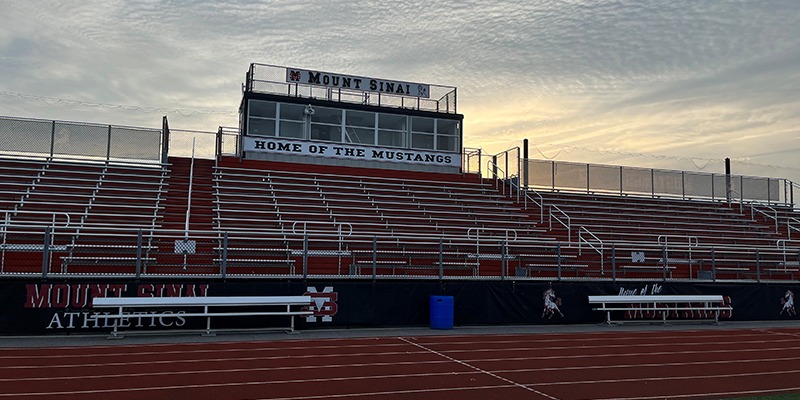
Community voice shapes major decisions in ways that produce tangible outcomes. The district recently passed a bond referendum focused on safety, security, athletics, and learning environments. “It wasn’t just about the facilities,” Dr. Criscione says. “It’s really about families coming together to invest in our kids. I see that as a powerful statement of confidence in our future.” The September 2025 vote confirmed how a residential community with limited commercial tax base can prioritize education spending when given clear information about needs and benefits.
The emphasis on stakeholder input isn’t merely procedural. Dr. Criscione notes that the strategic plan came from what “people told us matters most,” a process that required synthesizing sometimes competing priorities across different constituencies. In a district where the student-teacher ratio of 12 to 1 allows for closer relationships than many Long Island schools, that collaborative approach reinforces the small-community atmosphere. The result is a culture where institutional decisions accommodate collective values rather than top-down mandates, particularly important in a hamlet where 98% of residents are U.S. citizens and families tend to stay long-term.
Preparing Students for Tomorrow’s Workplace
The shift from college-as-default to career-informed education marks a significant pivot in how Mount Sinai approaches student preparation. “We always have college nights. That has always been the standard, but now we are looking at adding in career opportunities for students to get a sense of the different careers out there,” Dr. Criscione says. The district is planning career evenings that expose students to employment pathways that do not necessarily require four-year degrees, acknowledging an economic reality that many families already understand.
At the high school level, Principal Peter Pramataris has expanded this philosophy through course offerings that build practical skills alongside academic strength. Mount Sinai High School’s curriculum reflects a well-rounded program designed to prepare students for success with skills that extend beyond the classroom. In addition to Mount Sinai’s strong foundation in math, science, and the humanities, the business, computer science, technology, and fine and applied arts departments continue to revise and enhance offerings to meet the needs of an evolving society and workforce. Newer courses in Python programming, home improvement and construction systems, advanced culinary arts, and ceramics give students experience in fields aligned to industry trends. Participation in Virtual Enterprise International competitions offers authentic entrepreneurial learning experiences. These initiatives work in tandem with Mount Sinai’s ongoing partnership with Eastern Suffolk BOCES, where students gain access to accredited vocational programs that can lead directly to future employment. Pramataris notes that he is excited about the growth of these opportunities for students, particularly in light of the NYS Portrait of a Graduate initiative and revised graduation pathways.
Partnerships with Eastern Suffolk BOCES remain a major asset, giving students access to specialized programs the district cannot offer independently. Students can pursue training in aviation, health industries, and other technical fields at BOCES facilities, gaining hands-on experience in equipment-intensive programs. “We do a lot of work with our local BOCES as far as sending kids based on their interests so they can have opportunities,” Dr. Criscione explains. “If we do not have them here in our district, they can certainly access those opportunities at BOCES, which are very specific.”
The academic framework also includes expanded dual enrollment courses that allow students to earn college credits while still in high school. “We have dual enrollment classes for many of our courses at the high school, and we have been increasing our AP and dual credit classes with different colleges,” Dr. Criscione says. The expansion serves two purposes, reducing college costs for families and creating more schedule flexibility for students to explore career pathways. While the district has not yet established formal co-op programs with local businesses, the foundation for such partnerships is being built through stronger relationships with community organizations that already support scholarship opportunities for graduating seniors.
Preparing for the New Economy
Recent flexibility from the New York State Education Department opened doors that Mount Sinai moved quickly to enter. Dr. Peter Branscombe, deputy superintendent, describes the opportunity: “New York State Education Department allowed for some flexibility with certifying some of our teachers with additional computer science certifications. We’ve had numerous additional teachers take on that responsibility coming into this school year, and it just opens a number of different doors for us to go down that path, whether it’s with AI, whether it’s with coding.”
The multi-teacher approach to computer science expands course offerings without major budget increases, a practical solution for a district spending $28,757 per student annually. “The more of our teachers we can get computer science certified, the better,” Dr. Branscombe says. “It’s only going to help us in the long run.” The certification push aligns with workforce trends across Suffolk County, where educational services and professional sectors employ significant portions of the population.
Dr. Criscione frames the broader curricular evolution as addressing jobs that didn’t exist a decade ago and anticipating ones that will emerge. “We are looking at ways to restructure our middle school to align with the high school with some of the new pieces that we want: coding, financial literacy, computer science,” she says. Elsesser has already adjusted scheduling to accommodate more electives at the middle school level, creating room for students to explore technical subjects earlier. The district is also integrating civic readiness programs starting in middle school, recognizing that workforce preparation includes understanding how economic and political systems function. “It’s kind of like a multi-pronged approach,” Dr. Criscione adds, describing how changes at different grade levels compound to create more options by the time students reach their senior year.
A Graduate’s Vision for Middle School Transformation
Elsesser brings an unusual perspective to his role as middle school principal: he graduated from Mount Sinai and credits the district with shaping his career trajectory. “I am a graduate of this district. I’m very proud of that,” he says. “I think that I’ve achieved things at this point in my life because of my education here.” That personal investment informs how he approaches restructuring the middle school experience for current students.
Having spent most of his career in high school education and administration, Elsesser saw firsthand what separates successful graduates from those who struggle. “I’ve seen what is successful, what skills and abilities are needed to be successful high school graduates,” he explains. The new elective wheel programs starting in grade five aim to build capacity for 21st-century workplaces while giving students earlier exposure to subjects that might spark genuine interest.
“We’re trying to build the capacity of our learners as they grow across, really starting in grade five, and really actually with the choice of classes too,” Elsesser says.
The scheduling changes serve a specific purpose. “Giving them more opportunities in high school, to take more challenging courses, whether it’s one of the partnership courses with the colleges to be able to graduate with the most fulfilled experience possible for each of the students and their individual needs,” Elsesser says. The goal is efficiency: students shouldn’t waste time in high school discovering their interests when that exploration could happen earlier, allowing them to pursue those passions with greater depth before graduation.
Strategic Partnerships and Community Connections
Building relationships with external organizations has yielded concrete benefits, particularly in scholarship funding for graduating seniors. High School Principal Peter Pramataris has established strong partnerships with local organizations that have significantly increased the number of scholarship opportunities available to students. “He has established many relationships with our local organizations, and they provide scholarship opportunities that have grown greatly over the years on behalf of each of those organizations to our students,” Dr. Criscione explains. These relationships include the chamber of commerce, economic development groups, and local businesses that contribute funds to help offset college costs for families.
Expanding those relationships into career pathways and potential co-op programs is the next phase. “That’s certainly something we’re going to be leaning on in the future to enhance our opportunities,” Dr. Criscione notes. However, Mount Sinai faces a challenge uncommon among Long Island districts: “The problem that’s unique to Mount Sinai is that we don’t have a big commercial base at all here,” she explains. The hamlet’s residential character, while creating the family-oriented atmosphere that attracts affluent residents, limits local employment partnerships.
Even the chamber of commerce serves multiple communities. “It’s actually a lot of residential, so there are not a lot of Mount Sinai businesses,” Dr. Criscione says. “The Chamber of Commerce is a multiple. It’s Mount Sinai and Miller Place, and Miller Place really has the majority of businesses, not us.” The geographic reality means students will likely work outside their immediate community, making regional partnerships and BOCES programs more valuable than hyperlocal business connections. Dr. Criscione acknowledges the constraint directly: “It does become a bit challenging for us.”
Embracing Change While Honoring Identity
The immediate future presents challenges that require flexibility more than fixed plans. Over the next 18 to 24 months, Dr. Criscione emphasizes adaptation over specific initiatives. “Really trying to be adaptable as the policies and the funding shift. I mean, that’s a huge issue,” she says. “We really don’t know what’s ahead of us with the state, and we are just trying to transform our campus into a more modern student-centered environment.”
The balance between innovation and tradition defines much of the district’s strategic thinking. “I want to stay true to our community values, innovating the best way we can, but having that balance of honoring who we are while preparing what we want to become,” Dr. Criscione explains. For a district that earned National Blue-Ribbon recognition in 2021 and maintains high academic performance with 99% of high school students testing proficient in math, change carries risk as well as opportunity.
Elsesser’s priority centers on ensuring middle school students arrive at high school ready to pursue their interests immediately. “I want students to be able to sample all those things in middle school so that when they get to high school, they don’t necessarily have to waste as much time figuring out what does motivate them, but that they’re ready to springboard and follow those areas of passion,” he says.
Dr. Branscombe focuses on leadership and resourcefulness. “It really is about empowering leaders,” he says. “Oftentimes we say no to things because we can’t afford it, we can’t find the time. I think it’s about empowering leaders to find ways around those obstacles, whether it be grant money, whether it be volunteers joining us to help out.”
The Mount Sinai School District operates in a unique position: serving an affluent residential community while preparing students for jobs in a regional economy shaped by forces beyond local control. The strategic plan through 2030 provides direction, but the real work happens in incremental changes across grade levels, in partnerships that take learning beyond campus boundaries, and in the willingness to adjust course as state policies and workforce demands evolve.
Click The Cover To View Or Download The Brochure
AT A GLANCE
Who: Mount Sinai Union Free School District
What: A National Blue-Ribbon K-12 public school district serving approximately 2,000 students across three schools on a 65-acre campus
Where: Mount Sinai, Suffolk County, New York
Website: www.mtsinai.k12.ny.us
PREFERRED VENDORS/PARTNERS

BELFOR Property Restoration: www.belfor.com
As the world’s largest disaster restoration company, we strive to deliver proactive support and turnkey solutions for clients across all industries. From simple repairs and remodeling to total construction or capital improvement projects, BELFOR has the resources to deliver fast reliable results with minimal disruption.

Ameresco: www.ameresco.com
Founded in 2000, Ameresco is a leading energy infrastructure solutions provider helping customers reduce costs, enhance resilience, and advance decarbonization. We deliver energy efficiency, infrastructure upgrades, and distributed energy resources for government, utility, data centers, education, healthcare, housing, and C&I customers. Headquartered in Framingham, MA, Ameresco employs 1,500+ experts across North America and Europe.

HNE Equipment: www.hneny.com
At HNE Equipment it is our mission to provide educational furniture and equipment that will be conducive for students and faculty. Our modern and unique furnishings contribute to the classroom’s environment, creating spaces that promote engagement, collaboration, and productivity. We work closely with you each step of the way to achieve your objectives and create beautiful enhancing learning spaces.

Energia: www.energiasaves.com
Energia USA, Inc. is a certified Woman-Owned, Technical Owner’s Representative and Energy Engineering and Design Consultancy. We manage energy performance contracts, provide energy modeling, retro-commissioning, and auditing, and deliver MEP engineering, design, and solar solutions that reduce costs, modernize systems, and advance sustainability for our school district and AEC partners.