Transforming Five Decades of Patient Capital into Colorado’s Next Main Street
With Infrastructure Underway and 2 Million Square Feet of Commercial Space Planned, This Dynamic Denver Suburb is Building the Downtown It Always Wanted.
Twenty miles south of Denver, Castle Pines rises approximately 1,000 feet above the surrounding communities, offering something increasingly rare in metropolitan corridors: breathing room. The city of roughly 16,500 residents occupies a unique position along Interstate 25, sandwiched between the bustle of Park Meadows to the north and the retail density of Castle Rock to the south, yet maintaining a distinctly quieter character.
“I think we view ourselves as somewhat unique, engaged, affluent,” says Michael Penny, City Manager of Castle Pines. “There’s pretty dense, larger population communities on either side of us. But when you drive in, there’s kind of that sense of you can take a breath because you drive down the road and there’s not a lot of commercial development. It’s mainly residential. So, you feel like it only took you 10 minutes and you were at the mall, but now you’re completely away.”
The landscape tells the story: forested hills thick with Ponderosa pine and Gambel oak, rock outcroppings framing panoramic views of Pike’s Peak and the Front Range. Fourteen miles of paved trails wind through the community, supporting an active outdoor culture that defines daily life here. A Lifetime Fitness facility currently rises from the ground, joining another gym set to open soon. “People like to ride their bikes, they like to walk,” Penny notes. “We’re building more trails, improving the signage for those trails, those kinds of things.”
The $42 Million Game Changer
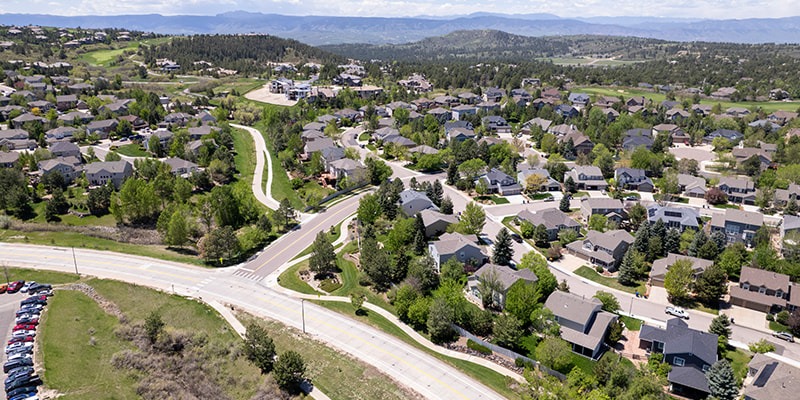
Interstate 25 slices Castle Pines nearly in half, creating two distinct worlds within the city’s nine square miles. The west side, developed since the 1980s, hosts established neighborhoods of high-end single-family homes where prices start at $750,000 and climb past $1 million in select areas. Three investment companies own the commercial properties here, nearly 100 percent leased, generating steady returns but offering little room for the main street atmosphere residents desire.
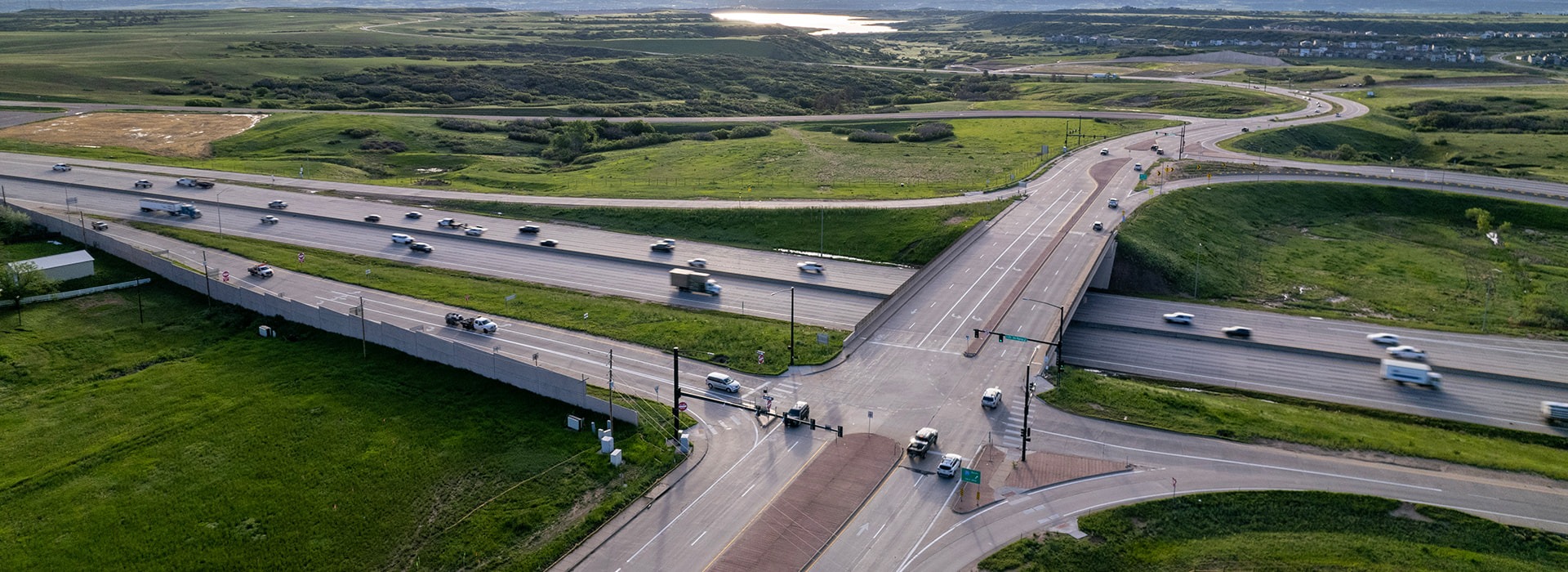
The east side tells a different story. Across 3,500 acres, new development is transforming open land into the city’s commercial and residential future. Currently, access remains limited to Castle Pines Parkway, creating bottlenecks that a $42 million interchange project aims to eliminate. An additional $6 million in potential funding from the Colorado Department of Transportation could support bridge replacement as part of the overall improvement.
“This interchange is really going to free up the east side of town,” Penny explains. “Right now, they only have access on the Castle Pines Parkway. And so, this interchange is going to allow a much greater free flow of traffic and easier access if you want to go south toward Castle Rock, Colorado Springs, wherever you’re going south on I-25.”
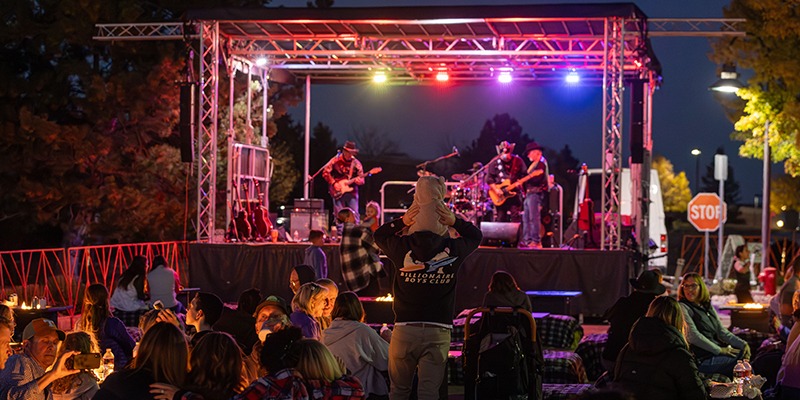
The Happy Canyon interchange will employ a diverging diamond design, an innovative traffic pattern that shifts vehicles to the left side of the road, eliminating dangerous left-turn conflicts. Colorado Department of Transportation reports show this configuration removes T-bone accidents entirely while reducing signal phases from four or six down to two. Construction begins in late 2027 or early 2028, funded primarily by Douglas County’s $20 million commitment, with Castle Pines and developers covering the remainder.
Housing Evolution and Market Dynamics
Castle Pines has added 6,000 residents in six years, climbing from 10,500 in 2019 to its current population of 16,500. The buildout potential reaches 30,000, though the timeline depends heavily on economic conditions that have slowed what was once breakneck growth.
“In 2019 we were at about 10,500,” Penny says. “To give you an idea, when the economy was really good, I think Shea was running a six-month wait list to get the lot that you wanted. Castle Pines is definitely a desirable place to be. It’s just the economy at this point.”
Interest rates and construction costs now govern the pace. Tariffs add pressure. When rates drop into the high fours or low fives, Penny expects home builders to accelerate rapidly. Until then, the units wait, platted and ready but unbuilt.
The city’s housing stock is diversifying from its origins as an exclusively high-end single-family community. Three to four years ago, council began approving apartments, townhomes, and for-rent single-family products alongside traditional for-sale homes. One development introduced a model where single-family homes function as rental properties, a concept that has since spread across Colorado.
“Council realized that not everybody can afford a single-family home that at the time started at $750,000,” Penny notes. “We needed a diversification to the housing stock.”
The next step involves workforce housing. Council is amending codes to fast-track proposals for attainable units, recognizing that restaurant staff, CPAs, and medical office workers need places to live within the community they serve. No projects have emerged yet, but the framework now exists to welcome them.
Utilities, Schools, and Essential Services
Two water districts serve Castle Pines, divided predictably by Interstate 25. The Castle Pines North Metro District handles the built-out west side, while Parker Water and Sanitation District has committed to the entire 3,500-acre eastern expansion. Long-term water plans are in place, removing a constraint that hampers many Colorado communities.
Internet connectivity reaches one gigabit speeds throughout town, with Comcast working toward 10-gigabit capacity within existing infrastructure. “Metronet is entering the west side as an additional competitor,” Penny confirms. “Both 5G and fiber optic networks continue expanding, supported by law enforcement and fire protection services that are pretty strong.”
Meanwhile, Douglas County School District ranks among Colorado’s top systems, operating on an open enrollment model that assigns students by proximity rather than rigid geographic boundaries. Castle Pines currently has three elementary schools, with middle and high schools located minutes north in unincorporated county land.
“We do have land over on the east side right now for an elementary school and then middle slash high school, which I think is the future design,” Penny says. “We are next on the list for additional schools on the east side to accommodate that.”
The city was excluded from the most recent bond measure, a disappointment tempered by expectations of inclusion in the next round. The school district focuses resources where the bulk of school-aged children live. Castle Pines’ housing costs, while attractive to many buyers, skew demographics away from families with multiple children compared to communities with more modest price points. Over 61 percent of Douglas County residents hold bachelor’s degrees or higher, and nearly 99 percent have completed high school.
A 50-Year Downtown Vision Realized
A landowner and his brothers purchased 3,500 acres in 1975 for cash, then waited. For decades, the timeline remained uncertain. Five years out, perhaps ten, maybe a project for grandchildren to complete. That ambiguity has ended.
“A couple years ago, if somebody called us up, there was no real timeframe around this,” Penny says. “We could have been five years or 10 years or maybe he was going to leave it to his grandkids to develop, and it was going to be 20 years out. And now I think what we’re starting to see and say is, look, the owner has a vision. That vision complies with the desires of the community and they’re moving forward on this.”
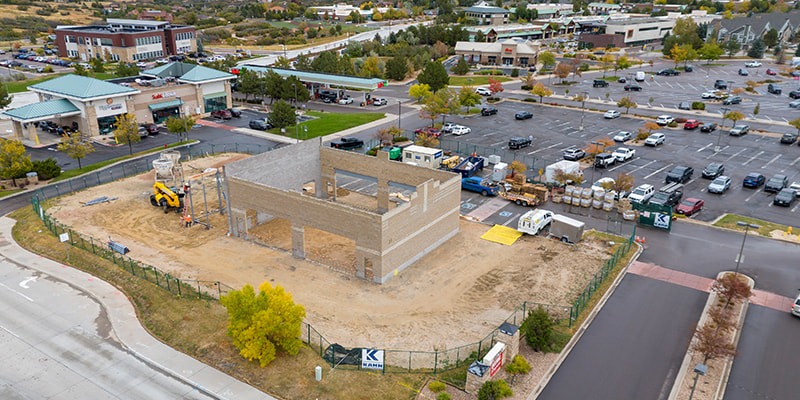
Heavy trucks now move dirt across the site. Drainage systems are being installed. Water, sewer, and electrical infrastructure advances ahead of vertical construction. The scale is substantial: 2 million square feet of commercial space, 2,000 residential units within the commercial core, and an additional 3,500 residential units extending east, predominantly single-family homes.
DPZ Design, a nationally recognized firm, has created two concept variations for approximately 150 acres of the total site. Both feature central plazas, walkable main streets lined with boutique retail, and larger-format stores positioned on the perimeter. Office space will line the Interstate 25 corridor, buffering residential areas from highway noise. South of the main development, another 100-plus acres are designated for light industrial uses and medical facilities.
“He’s really one of those types of landowners that wants to hear what we want from the community, which again, is this main street,” Penny explains. “But then he’s a little bit more hands off, okay, I heard you. I’m going to take care of this.”
Target Industries from Aerospace to Main Street Retail
Castle Pines currently employs people in community services: grocery stores, restaurants, medical offices, nail salons, dry cleaners, veterinarians. The standard retail and professional mix of a residential suburb. Residents want more, specifically boutiques, additional dining options, and what Penny calls “that kind of place where you’ve got your home.” “Right now, it’s residential based, but they want to drive somewhere and say, oh, this is mine. “This is Castle Pines,” he says.
Medical uses rank high on the target list, potentially including a hospital. Recreational amenities align with both Douglas County priorities and community preferences: parks, ice rinks, regional sports facilities. Light industrial operations will occupy space south of the main street core.
The aerospace sector presents a particular opportunity. Douglas County hosts over 27,000 aerospace workers across major employers including Lockheed Martin’s 2,300-employee Waterton Canyon campus, Blue Origin, Boeing, and United Launch Alliance. Colorado claims the nation’s second-largest aerospace economy, and Douglas County continues expanding its footprint. Safran Defense & Space recently chose neighboring Parker for its U.S. expansion, adding to a supply chain serving the North American small satellite market projected to reach $5 billion by 2030.
“We’ve got Lockheed Martin, Blue Origin is in, both of those are in Douglas County,” Penny notes. “A lot of the companies that work with the federal government under the subsidiaries under Lockheed Martin, we’ve got a lot of greenfield development. It’s really hard to retrofit an existing building for all the security requirements.” Department of Defense and NASA compliance demands purpose-built facilities, making greenfield sites particularly valuable for aerospace tenants seeking to meet stringent federal specifications.
The Invitation and Competitive Edge
Eighteen months will tell the story. “We want to get people excited about what’s coming,” Penny says. “Look at this great thing that’s happening over the next 18 months. I would fully expect that the utilities are put in there, the roadway system is platted out, or at least the major roadway system is platted out. And we welcome phone calls and curiosity around who wants to be part of this development.”
The city positions itself deliberately between Park Meadows and Lone Tree’s density to the north and Castle Rock’s outlet stores and traffic congestion to the south. Easy Interstate 25 access without the complications. Greenfield land without competing development crowding the market. Residential support is already in place, with median household incomes of $189,918 and average home values approaching $918,000.
“This is truly easy access in and out,” Penny explains. “There’s not going to be, there’s nothing else that’s really going to be in this area. You’ve got residential off to the right hand side. Come be part of this incredible vision and help us make it real.”
The log jam has broken. What was uncertain five years ago, possibly a decade away or longer, now has infrastructure work underway and a clear timeline. Castle Pines, incorporated only in 2008 and still among Colorado’s youngest municipalities, is building the commercial center it lacked at formation. The patient capital invested in 1975 is finally coming to market, and the city is ready to connect interested parties with the landowner, guide them through municipal processes, and deliver the council support needed to transform dirt and drainage into the community gathering place residents have long desired.
AT A GLANCE
Who: City of Castle Pines
What: A home rule municipality in Douglas County with 16,500 residents, building toward 30,000 at full buildout with 2 million square feet of commercial development
Where: Castle Pines, Colorado
Website: www.castlepinesco.gov
PREFERRED VENDORS/PARTNERS

Douglas County School District: www.dcsdk12.org
The Douglas County School District is the top scoring district in the Denver/Metro area and has a 92% graduation rate. Spanning 850 square miles, DCSD is the third-largest school district in Colorado, with 62,000 students across 92 neighborhood and charter schools, supported by 7,600 teachers and staff members.

Sage Design Group: www.sagedesigngroup.com
Sage Design Group listens first, and uses intuitive design to shape environments that meet real community needs and enrich everyday experiences. We design with intention and collaboration, creating places that leave a lasting positive impact.

Elite Surface Infrastructure (ESI): www.elitesi.com
Founded in 1998 and headquartered in Englewood, Colorado, Elite Surface Infrastructure (ESI) is a diversified civil construction company serving commercial, municipal, and government clients. ESI is Colorado’s largest self-performing contractor of asphalt, earthwork, utilities, and concrete, delivering efficient, high-quality infrastructure solutions across the western United States.
