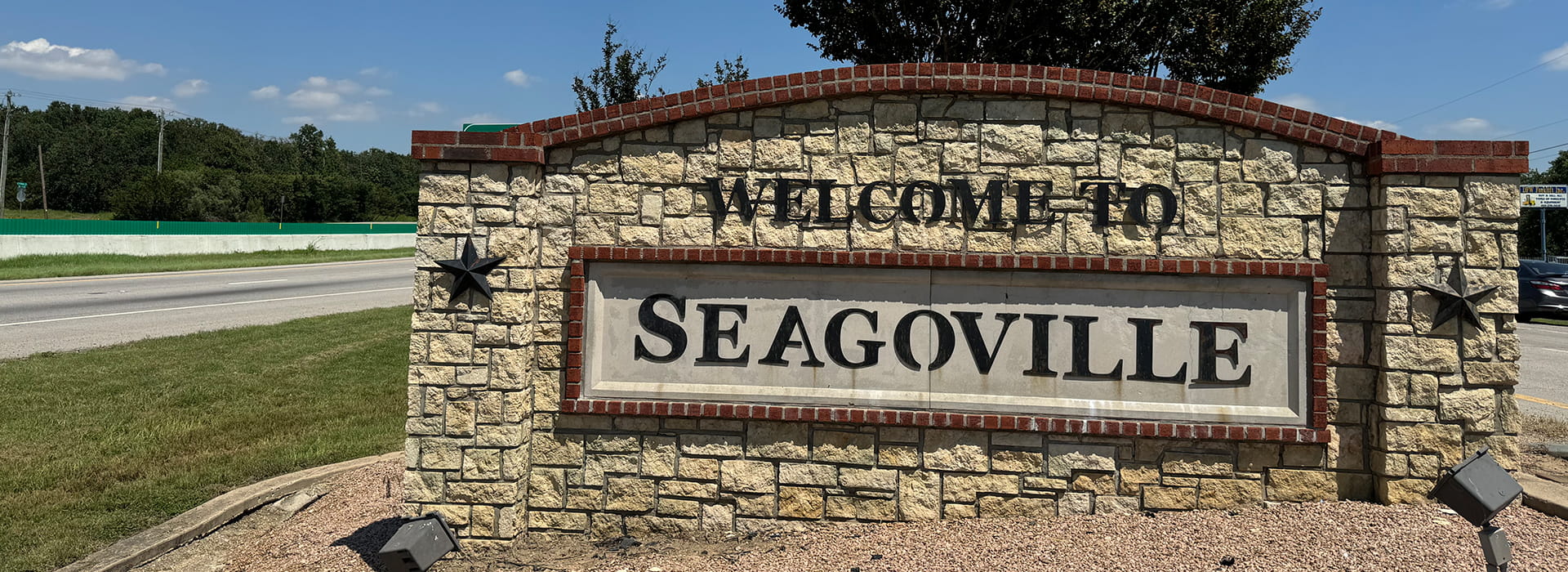
Small-Town Heart, Big-City Opportunity
Downtown Momentum, Diversified Development, and Targeted Infrastructure Investments Position Seagoville for Its Next Chapter of Growth
Just beyond the bustle of Dallas, the City of Seagoville is proving that growth does not have to come at the expense of community identity. For Mayor Dennis Childress, that identity is simple to describe and difficult to replicate: a modern community that still feels like a town where people wave, say hello, and look out for one another.
“We’re a small community next to a big city,” Childress says. “We’ve got modern amenities, but still that small community feel—the old country friendly wave to your neighbors.”
That balance—close to a major metro, but rooted in connection and livability—is at the core of Seagoville’s appeal. It is also the foundation beneath a fast-moving development story that includes downtown reinvestment, significant residential growth, expanded public safety infrastructure, new healthcare access, and a deliberate push to diversify the city’s business base.
Downtown Revitalization Anchored by Real Investment
Seagoville’s downtown is a clear priority for city leadership and the Economic Development Corporation. Centered around the intersection of Kaufman Street and Malloy Bridge Road, the city is working to strengthen the downtown corridor through a mix of targeted redevelopment, business recruitment, and long-range planning rooted in a 2019 downtown corridor study.
A signature project is the city-owned hard-corner property where the EDC controls multiple buildings. One of those buildings underwent a major transformation last year—taken down to the studs and rebuilt with new walls, electrical, water, and sewer infrastructure. The result is the downtown home of Doe Belly’s Kitchen, a regional restaurant that opened in January and has already become a visible driver of foot traffic and activity.
City leadership sees Doe Belly’s Kitchen not as a one-off win, but as a model. With other EDC-owned buildings nearby, Seagoville is aiming to replicate the strategy and continue recruiting destination-style tenants. A new partnership is also underway to bring a barbecue restaurant downtown in 2026, reinforcing the idea that successful downtown revitalization often happens through clustering—one strong anchor creates momentum for the next.
From the mayor’s perspective, the intersection itself is the heartbeat. While State Highway 175 is widely seen as Seagoville’s main commercial corridor, the downtown core carries its own power. “If you stand at Kaufman Street and Malloy Bridge Road, there’s all kinds of traffic,” Childress notes. “The more we can put down there, the more successful everything around it will be.”
Business Incentives Designed for Real Projects
Seagoville is not relying on generic “open for business” messaging. The city and EDC operate with an incentive model designed to meet projects where they are, and leadership notes that support is evaluated case by case based on community benefit and feasibility.
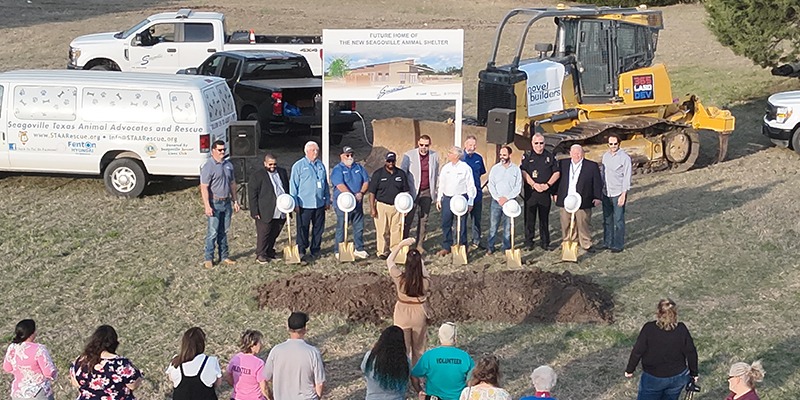
Over time, Seagoville has deployed a wide range of tools, including tax increment financing, public improvement districts, Chapter 380 agreements, sales tax rebates, and sales tax sharing agreements. More recently, the EDC modernized its façade grant program and introduced a new downtown destination grant program to further strengthen downtown investment and quality.
This combination of redevelopment ownership, flexible incentives, and targeted grant programs has allowed Seagoville to take an active role in shaping the type of growth it wants, rather than waiting passively for it to arrive.
Residential Momentum with Real Variety
Residential growth in Seagoville is broad, multi-phased, and designed to serve more than one demographic. A key recent milestone is the Malloy Bridge market-rate apartment community, a roughly $40 million project that is already open and leasing to residents.
The development was enabled through a city-backed agreement that helped fund critical sewer improvements—an infrastructure investment that the city notes will also support future commercial development in the same frontage area, including a planned grocery store tied to the same utility line.
Beyond multifamily, Seagoville continues to expand its single-family inventory through both established neighborhoods and new master-planned communities. The city points to housing that ranges from early-2000s family options to new-build product across multiple price points, reflecting a broader goal: offer housing variety so that families, professionals, and long-term residents all have viable options.
One of the most ambitious developments is the planned Santorini community, envisioned as a highly amenitized lagoon-style neighborhood. When built out, it is expected to include nearly 2,000 homes, roughly 1,000 apartments, and a commercial district featuring restaurants and entertainment such as a bowling alley.
Early phases are already underway, and leadership views the project as a major long-term asset for the city’s housing mix and lifestyle offerings.
Seagoville’s ability to support residential growth at this scale is notable, particularly at a time when many cities across North America face housing shortages and limited inventory across affordability tiers.
Industrial Growth and Diversification Along Environmental Way
While residential rooftops help drive local retail demand, Seagoville is also focused on deeper economic diversification through industrial recruitment and expansion. A key emphasis is the continuation of industrial development along Environmental Way, where the city is actively marketing available pads for heavy industrial uses.
A major recent win was the arrival of Gotham Greens, which opened a significant facility in the city and marked the company’s first location in Texas. Projects like this help expand Seagoville’s job base with positions that go well beyond entry-level wage bands, bringing stronger earning potential and more stable long-term economic impact.
Infrastructure Built to Support Growth, Not Chase It
Behind every growth story is an infrastructure story, and Seagoville’s leadership has made it clear they intend to stay ahead of demand. Water capacity is not currently a constraint, supported by a strategic partnership with the City of Dallas. In practical terms, Seagoville has access to contractual capacity far beyond current consumption, and leaders estimate the city is using only a fraction of what is available.
The focus therefore shifts from capacity to connectivity—getting water and sewer lines to the right places at the right time. Utility planning is managed in coordination with developers, often through development agreements that ensure infrastructure extensions align with project sequencing.
One of the most impactful examples of public-private infrastructure partnership is the Stonehaven development, led by Meritage. The project is bringing roughly 800 homes to the city and required major sewer access expansion. Through a development agreement that included a public improvement district, Meritage installed and oversized the northern basin sewer line—an expensive piece of infrastructure that now enables not only Stonehaven but future adjacent development across that side of the city. Seagoville also leveraged ARPA funds to support the broader infrastructure objective.
Flood mitigation is also part of the infrastructure conversation. Along East Malloy Bridge Road on the north side of town, floodplain considerations have influenced how the city evaluates potential new development. The focus is ensuring emergency access remains reliable and that future residents can be served safely, even in challenging conditions.
Quality of Life: Parks, Events, and Connected Amenities
Seagoville’s growth narrative is not only about rooftops and tax base. City leadership repeatedly returns to quality of life—parks, community gathering spaces, and public events that reinforce the identity Mayor Childress described at the start of the conversation.
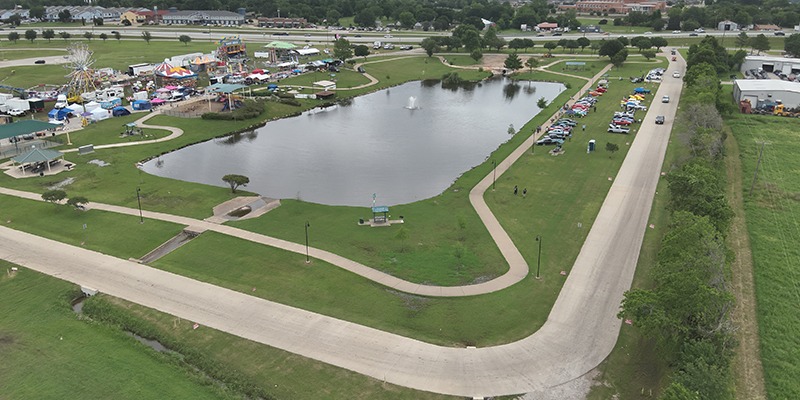
The city’s park system continues to evolve, with improvements to lighting, facilities, and sports infrastructure. Bruce Central Park plays an outsized role as a community hub, hosting major events such as Mayfest and the holiday tree lighting. The city and Chamber of Commerce collaborate closely on these gatherings, blending public support and private coordination to keep events successful year after year.
Seagoville also hosts July 4th fireworks and regional events that draw visitors from across the DFW area. Additional signature programming includes the “Some Run,” a benefit event that brings participants from across the U.S. and beyond to support research and awareness for a rare disease, reflecting the community’s ability to combine civic spirit with meaningful cause-based engagement.
Trail connectivity is another focus, particularly within new developments on the north side of the city. Seagoville is requiring new projects to include trail amenities and ensuring those trails connect between developments, creating a more cohesive and walkable residential environment over time.
Public Safety and Healthcare Access Expanding in Step with Gowth
As Seagoville grows, public safety investment has accelerated. The city recently opened a new police station and a new fire station on the same property—modern facilities designed with enough long-term capacity to support growth for many years before expansion becomes necessary.
Healthcare access is improving as well. A new urgent care facility opened this year on Malloy Bridge Road, providing residents with closer access to essential services. For broader hospital needs, Seagoville residents continue to access established regional networks including Baylor, Presbyterian, and Mesquite-area providers.
Seagoville is also participating in a regional mental health task force partnership with Mesquite, Balch Springs, and Sunnyvale. The goal is to ensure incidents that are not strictly criminal but require specialized intervention are addressed with the appropriate mix of trained law enforcement and social service professionals—an increasingly essential model in modern municipal public safety.
Governance and Engagement: A City That Invites Participation
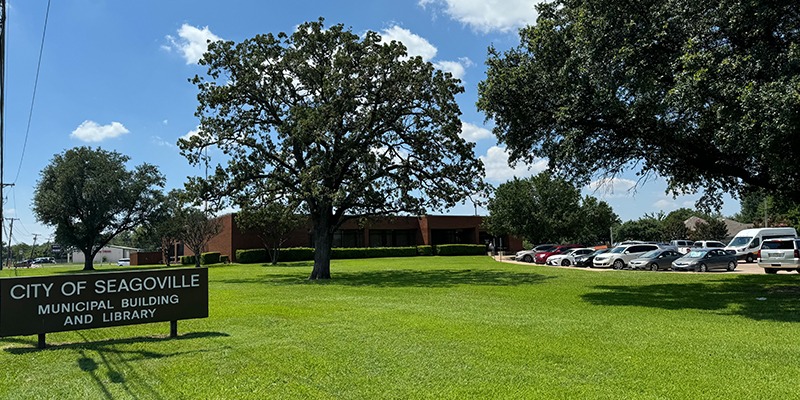
Seagoville is actively encouraging civic participation through structured resident involvement. The city operates six community boards and commissions, with residents appointed on two-year terms. Recruitment takes place annually, offering residents meaningful avenues to contribute to local decision-making and ensure that growth remains aligned with community priorities.
For City Secretary Sarah Egan, expanding community awareness is a key focus—reaching residents who may not have historically engaged and helping them understand how to participate and have a voice.
Looking Ahead: Coordinated Growth, Stronger Engagement, and Diversification
Over the next 18 to 24 months, Seagoville expects to remain in a period of high activity. Downtown will continue to build around new restaurant anchors. Residential growth will expand through master-planned communities and additional multifamily options. Industrial recruitment will accelerate along the Environmental Way, with particular attention to high-quality job creation and long-term economic diversification.
One possible land use that is being explored is data centers, which are growing in need and desire within the United States. Seagoville has proactively approved zoning in the City allowing data center uses. While these projects often move slowly due to due diligence and infrastructure requirements, city leadership describes growing interest from the data center community as a major potential catalyst on the horizon, and city leadership views landing the right partner as a defining opportunity.
Underlying all of it is a leadership philosophy that the mayor describes as collaborative and unified—city council, staff, the EDC, and the Chamber working hand in hand, not in competition, with the single objective of strengthening Seagoville for current and future residents.
For a community that still values waving to neighbors and keeping a small-town feel, Seagoville is demonstrating that modern growth can be both ambitious and grounded—and that the best boom towns are the ones that grow smart.
AT A GLANCE
Who: Seagoville, Texas
What: A small city with big city amenities putting the needs of its residents first as it welcomes commercial and housing growth
Where: Dallas County & Kaufman County, Texas
PREFERRED VENDORS/PARTNERS

C&M Concrete: chris@concretepaving.net
C&M Concrete has over 25 years of experience serving municipalities and developers in both Dallas and Kaufman counties. With Inter-Local Agreements in place, it’s easy to do business with us! In addition to repairing and replacing concrete, we offer underground utilities, soil stabilization, and earthwork services.
