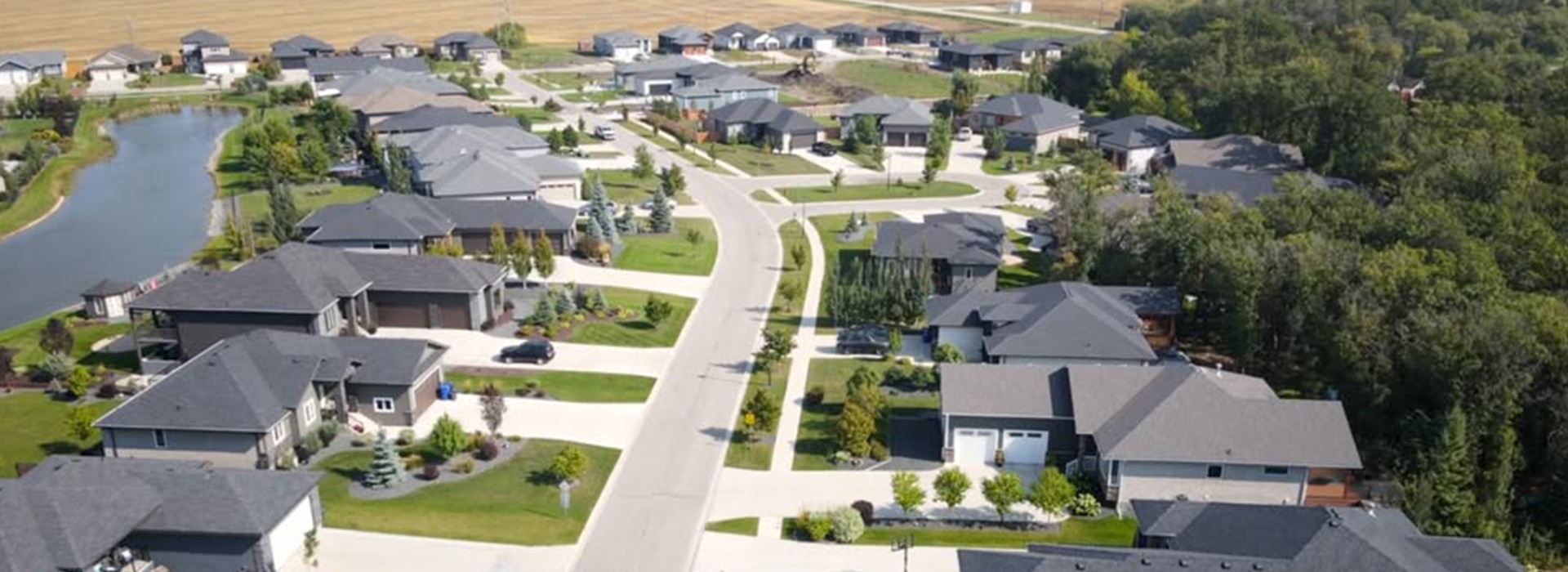
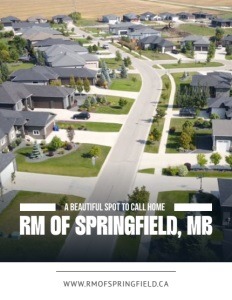
A Beautiful Spot to Call Home
Growth with Intention in Manitoba’s Fast-Growing Corridor
Located just east of Winnipeg, the Rural Municipality of Springfield remains at a critical intersection of opportunity and constraint. Its proximity to Manitoba’s capital, access to major transportation corridors, and reputation as a desirable place to live and do business have positioned the RM as a magnet for residential, commercial, and industrial interests. At the same time, Springfield’s leadership remains acutely aware that future growth depends on the pace and capacity of core infrastructure, particularly water and sewer services.
As Springfield advances a broad portfolio of projects ranging from senior housing and recreation facilities to industrial expansion and climate planning, municipal leaders are focused on balancing growth with long-term sustainability. Their approach reflects a municipality that is not reacting to growth pressures but actively planning for them in a way that supports community wellbeing, accessibility, and economic resilience.
Improving Mobility and Accessibility
While water infrastructure remains central to Springfield’s long-term growth, steady progress continues across transportation and pedestrian improvements throughout the municipality, reinforcing a focus on safety, accessibility, and connectivity.
This year, Springfield completed a road rehabilitation project using a new construction method. As Colleen Draper, Chief Administrative Officer, explains, the pilot involved removing the existing roadway, stabilizing the base, and rebuilding the surface on one of Oakbank’s main roads. The project served as a test case for more efficient and durable approaches to future road renewal.
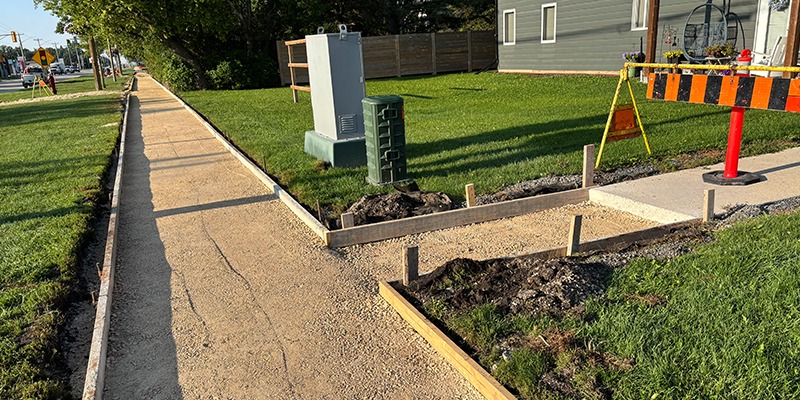
Pedestrian upgrades have also been prioritized, particularly in older neighbourhoods where infrastructure no longer meets accessibility standards. Interlocking brick sidewalks in parts of Oakbank were replaced with asphalt along Main Street and nearby routes, creating safer, smoother connections to key community facilities, including the arena and seniors’ home.
Pathway development remains a core element of Springfield’s planning philosophy. As Draper notes, walkability is essential to building livable communities, supporting safe movement for seniors, students, and families alike.
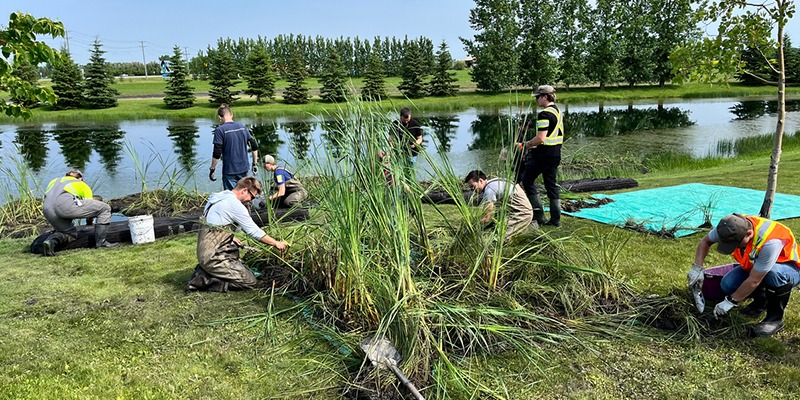
That focus extends to newer developments such as Dugald, where pathways are integrated with retention ponds to provide both functional and recreational space. Enhanced pedestrian crosswalks with additional lighting have also been added in Oakbank and Dugald, improving safety and reducing risk, particularly for seniors.
Growth Dependant on Infrastructure
While Springfield has made progress across many areas, its ability to move forward at scale remains constrained by water and sewer capacity. The municipality is currently awaiting an environmental license for its new water treatment plant, a process that has proven lengthy and unpredictable.
“We are still waiting for our environmental license,” says Patrick Therrien, Mayor of the RM of Springfield. “It is taking an exorbitant amount of time, but it remains a work in progress.”
The implications of this delay are far-reaching. Residential subdivisions that are already approved must be phased carefully based on available capacity. Commercial and industrial opportunities, some of which are highly sought after, cannot proceed until infrastructure is in place.
“This water and sewer infrastructure is vital to any housing opportunities,” Mayor Therrien says. “We are hearing the same message from the Federation of Canadian Municipalities, from the Association of Manitoba Municipalities, and from Ottawa.”
He adds that provincial leadership has acknowledged the urgency of infrastructure investment for rural municipalities.
“Our premier has been very clear about the need to address infrastructure so rural municipalities can thrive,” Mayor Therrien notes. “We are doing the walk and the talk, but we need the water treatment plant to move forward.”
Aging in Place
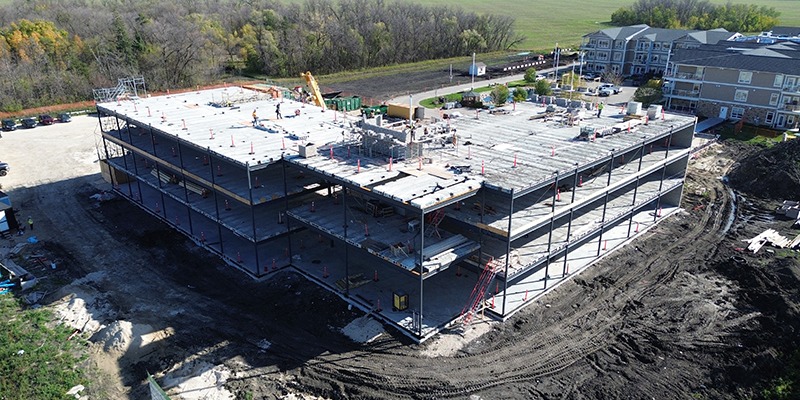
One of the most visible projects currently underway is Dugald Place, a senior housing development that reflects Springfield’s long-standing commitment to aging in place. “It is going very well,” Mayor Therrien explains. “All four floors are up right now, three of them are fully enclosed, and the fourth will be enclosed shortly.”
The 54-unit development includes a community pool shared by residents across the RM, reinforcing the project’s role as a community asset rather than a standalone facility. Completion is expected in September 2026.
“Aging in place is a huge component of what we are looking at,” Mayor Therrien notes. “Dugald Place allows grandparents to stay in the community instead of having to leave to find appropriate housing.”
Beyond Dugald Place, the municipality continues to explore additional options to support an aging population, including the long-term possibility of a personal care home. “We are working with a volunteer committee called Vision 2020 to look at financing options,” Mayor Therrien adds. “There are many initiatives underway to keep our older residents here and supported.”
Planning for Diverse Housing
Housing demand in Springfield remains strong, driven by population growth and the municipality’s proximity to Winnipeg, while affordability and accessibility continue to shape new development.
“It is a highly desirable area,” Mayor Therrien says. “We are close to the city, which draws young families, but affordability is a real issue.”
In response, Springfield is promoting a broader mix of housing options, including medium-density and semi-detached developments. One such project is planned north of the tracks in Oakbank and will proceed once water service is extended through Main Street.
Accessibility is also becoming central to housing discussions. As Draper notes, young families often cannot afford single-family homes, while seniors require different options, driving growing interest in duplexes, apartments, and accessible housing formats.
Currently, four residential subdivisions are approved within the RM, with development proceeding in phases tied to water and sewer capacity to ensure long-term sustainability.
Industrial Growth Gains Momentum
While residential development is constrained by capacity, Springfield’s industrial sector continues to expand, particularly in areas not reliant on municipal water and sewer services.
“Our industrial park is getting very bold,” Mayor Therrien says.
The Waterside development near Plessis Road, located directly along the Winnipeg boundary, is already moving into its second phase. Additional industrial proposals are advancing near Fermor Avenue and Green Acres, including one significant proposal encompassing approximately 400 industrial lots.
“People are coming to us,” Mayor Therrien says. “We do not have to do much advertising because our location is prime.”
That appeal is reinforced by Springfield’s access to two national railways, proximity to the Winnipeg Water Works, and significant electrical infrastructure, including the Louis Riel Substation. These assets have positioned the RM as an attractive location for logistics, manufacturing, and technology-related investments.
“It looks like McDonald’s will be starting construction next year,” Mayor Therrien says. “At the same time, we have had to turn down opportunities like Dairy Queen and Dollarama because we simply do not have the water and sewer capacity yet.”
Advancing Recreational Infrastructure
Recreation remains a key priority for Springfield, with the new recreation centre playing a central role in supporting community health and wellbeing. “We have just put out the tender for Phase One,” Draper says. “It closes before the end of the year, and we hope to have council approval early in January.”
Once approved, construction is expected to begin in 2026. Phase Two—which includes an indoor turf facility and fitness centre—will proceed, subject to funding availability and council direction.
To maintain momentum, the RM is building funds through development levies, aiming to move between phases without lengthy gaps. The municipality is also actively seeking donations and sponsorships to support future programming and facility enhancements, recognizing the recreation centre’s role as a hub for residents of all ages.
Preparing for Future Schools
Springfield’s growth is also driving conversations around education infrastructure. Based on population trends, a new school will be required sooner rather than later.
“There is strong interest in locating a future school near the recreation centre,” Draper says. “That allows for shared green space and shared facilities that benefit both partners.”
The RM has also strategically acquired 39 acres of land east of Elm Street, providing flexibility to meet future community needs, such as daycare facilities.
“We are not developers, but it was a smart acquisition,” Mayor Therrien says. “Once the water treatment plant is operational, that land becomes extremely valuable to the community.”
Revitalization in Downtown Oakbank
Downtown Oakbank revitalization is emerging as a priority, driven by developer interest in mixed-use projects that combine commercial and residential spaces.
“There is growing pressure to allow three-storey buildings with commercial at street level and residential above,” Draper says. “Our current development plan restricts that, so it is something the council will need to review.”
Other emerging initiatives include plans for a dog park, expanded pathways connecting Oakbank and Dugald, and a cottage-style housing concept focused on shared green space and community living.
“It would be something new for Springfield,” Draper says. “It supports accessibility, social connection, and a strong sense of neighbourhood.”
Strengthening Municipal Resilience
As Springfield looks to the future, its leadership is focused on strengthening long-term resilience while positioning the RM to access future funding opportunities. Lagoon expansion remains a critical, unfunded priority, with applications submitted to provincial and federal programs and to the Manitoba Water Services Board.
At the same time, the municipality is advancing a Climate Adaptation Plan supported by funding from the Federation of Canadian Municipalities. As Draper explains, many upcoming grant programs are expected to be tied to climate readiness, making proactive planning essential. Having this framework in place ensures Springfield is prepared when new opportunities arise.
Tree-planting initiatives, expanded inventories, and thoughtful green space planning are part of this broader strategy, supporting environmental resilience while enhancing overall quality of life.
As growth continues, Springfield’s leadership remains committed to deliberate, well-planned progress.
“We are expanding and planning with intention,” Mayor Therrien says. “Everything comes back to infrastructure, but the vision is clear.”
Click The Cover To View Or Download The Brochure
AT A GLANCE
Who: Rural Municipality of Springfield
What: A rural municipality characterized by its strong agricultural base, small communities, and blend of rural living with modern services and infrastructure.
Where: Located in Manitoba and surrounds the eastern edge of the City of Winnipeg.
Website: www.rmofspringfield.ca
PREFERRED VENDORS/PARTNERS


Access Credit Union: www.accesscu.ca
Access Credit Union is a financial institution that puts its members first. As the largest credit union in Manitoba, Access is dedicated to demonstrating leadership and commitment within the communities we serve and making a difference in the lives of our members.
