How Rural Districts Can Compete on Career Preparation
With 51 Industry Partners and a One-Megawatt Solar Array, This Indiana School District Proves Size Isn’t Destiny in Rural Education.
In the small city of Winchester, Indiana, a school district of just 1,395 students is quietly highlighting what’s possible in rural education. Randolph Central School Corporation, the largest district in Randolph County, serves a community where nearly half the students qualify as economically disadvantaged. Yet this hasn’t stopped the district from offering something remarkable: 49 dual credit courses at its high school of 389 students. The breadth rivals districts three or four times its size, a feat that catches the attention of educational researchers nationwide.
“Our board actually did quite a bit of work on that not too long ago, and our mission statement is creating pathways for lifelong success and limitless opportunities for all students,” says Rolland Abraham, the district’s superintendent. “I really think that sums up what we’re trying to do.” The mission is more than aspirational language. Winchester, founded in 1818 by Quaker settlers and once a stop on the Underground Railroad, has long valued educational opportunity. Today, that heritage manifests in a comprehensive early college program that goes far beyond traditional college prep.
Abraham explains the district’s distinctive approach: “It’s not just focused on four-year kids going to four year institutions, but that’s actually a piece of it. A lot of those dual credit courses are in welding, they’re in precision machining, they’re in family and consumer sciences, they’re in agriculture.” Students can earn technical certificates from Ivy Tech Community College alongside their diplomas, positioning them for immediate employment or further education. The model addresses a fundamental challenge in rural America: creating economic mobility without requiring families to leave their communities.
P-TECH: Reimagining Success for All Students
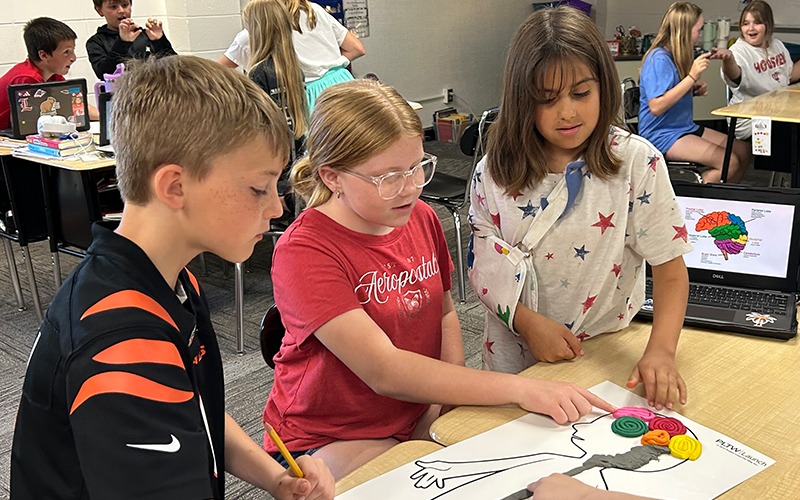
The district’s most transformative initiative is the P-TECH program, housed in a purpose-built 4,200 square foot facility constructed by Smarrelli Construction, which operates on a different educational model entirely. Abraham describes the shift: “Kids that traditionally do not perform well in high school can apply for our P-Tech program where those kids get a technical certificate from Ivy Tech in either welding, precision machining or agriculture.”
What distinguishes P-TECH from remedial programming is its integration with local industry. Students work directly with 51 business partners. “The industry partners come in and present an issue that they’ve had in their local industry or business,” Abraham explains. “The kids spend a couple weeks trying to solve that problem and creating a presentation to present to that industry partner. Students then refine their solutions and deliver formal presentations, receiving immediate feedback from executives and managers who may become future employers.”
TOA Winchester LLC, a stamping plant, exemplifies this partnership model. The company sources its parts-transport carts from Falcon Industries, a student-run business associated with the welding and precision machining programs. Other partners include Whisenhunt Construction, Astral (a metal casket manufacturer in nearby Lynn), Culy Contracting, and Cobalt Civil. Kristen Weigand, the district’s workplace learning coordinator, manages these relationships across all grade levels, ensuring continuity from kindergarten through graduation.
The Rural Alliance Zone and Career Technical Excellence
Traditional school district boundaries often limit what small rural systems can offer students. Randolph Central solved this constraint through Rural Alliance Zone 32. Abraham outlines the arrangement: “We’re part of the Rural Alliance Zone 32, so now we share CTE programs with our neighboring schools. We house welding, precision machining, and CDL. Those are the programs that we contribute to the rural alliance zone.”
The reciprocal system allows Randolph Central students to access programs at partner schools. Students travel to Randolph Eastern for health careers and business marketing, while Monroe Central hosts early childhood education, cybersecurity, and precision agriculture courses. Randolph Central maintains its own traditional agriculture program but sends students to Monroe Central specifically for precision agriculture technology.
This collaborative approach caught the attention of the Carnegie Foundation for the Advancement of Teaching. “We’re part of the Carnegie Foundation grant where they’re studying what we’re doing to try to make recommendations to the whole nation,” Abraham notes. “I think there might be as many as 30 that are involved in that.” The foundation, which historically shaped American education through innovations like Pell grants and the credit hour system, now focuses on making rural educational excellence measurable within traditional metrics.
Carnegie Foundation President Tim Knowles has emphasized that rural communities consistently prioritize the same core employability skills as urban and suburban areas: communication, collaboration, critical thinking, and work ethic. Randolph Central’s RAZ 32 model shows how resource-constrained districts can deliver comprehensive career preparation without duplicating expensive equipment and specialized instructors.
Supporting Mental Health and Basic Needs
Academic achievement becomes secondary when students lack stable housing, adequate nutrition, or mental health support. Randolph Central addresses these fundamental needs through strategic partnerships. The district maintains strong relationships with Centerstone, a mental health organization that operates two offices directly within school buildings, and Meridian Health, whose clinicians work regularly with students on site.
Following a student suicide several years ago, the district expanded its mental health infrastructure significantly. Abraham explains the preventive approach: “We added a guidance counsellor at the elementary level. We realized that we were trying to play catch up with some of the issues kids were having, and we really need to help teach coping strategies for kids in terms of mental health issues.” The district now employs separate counselors for grades K-2 and 3-5, who spend four out of six days weekly teaching social-emotional skills directly in classrooms.
Practical support matters equally. Student support specialists ensure children have coats, hats, gloves, shoes, and clothing. Julie Northcutt, assistant superintendent of curriculum and instruction, secures funding for the Feeding Thinkers program, which sends food home on weekends for students facing food insecurity. The district also partners with Parent Guidance.org, subscribing to a coaching service that provides 26 households with free weekly 30-minute parent coaching sessions. “You can actually get a parent coach, and you have 30 minutes a week with that parent coach,” Abraham says. “Sometimes it’s just, I’m not getting along well with my teenager.”
Technology Integration
Every student in Randolph Central carries a Chromebook, part of a K-12 one-to-one device program that forms the foundation of the district’s technology strategy. Clear Touch interactive panels now occupy every classroom, mounted on motorized stands in elementary buildings so younger students can reach them. Northcutt describes the broader implementation: “We definitely utilize technology in the classroom. We have integrated project-based learning in high school and into middle school and are rolling that down into elementary. STEM is obviously a focus in all of our areas.”
Project Lead the Way, a national STEM curriculum provider, operates in elementary and middle schools. Six robotics teams compete across grades three through eight, with plans to extend the initiative to high school. The district is currently rewriting curriculum maps to integrate Indiana’s STEM innovation standards throughout all grade levels, ensuring systematic rather than sporadic technology exposure.
Artificial intelligence presented initial resistance from teachers concerned about student misuse and job security. Northcutt addressed these fears directly: “We did go through a couple rounds of training for teachers on what AI was and how to utilize it appropriately in the classrooms. I think some of that fear and hesitation have gone away.” Teachers now use tools like Khanmigo, MagicSchool, and TurnItIn across grade levels, focusing on ethical application rather than prohibition.
Abraham highlights an emerging partnership: “We’re in early stages in working with the Winchester Foundation. They’re turning the Goodrich room into an AI room where all of the different historical figures that are part of that space become generated AI avatars that kids will be able to interact with.” The Goodrich Room at Wabash College honors Pierre Goodrich and former Indiana Governor James Goodrich, both Winchester natives, creating a local connection to cutting-edge educational technology.
Infrastructure and Energy Innovation
Randolph Central’s physical transformation over recent years hints at strategic investment in sustainability and educational capacity. The district now operates three solar arrays totaling one megawatt of generating capacity, a substantial commitment for a system of five schools. Abraham describes the progression: “We did our LED conversion across the district everywhere. All our lighting is now LED. And then after that, we worked with Veregy, and they built our first solar array out at the high school/middle school, which is about 600 kilowatts.”
Veregy subsequently installed arrays at Willard Elementary, placing panels atop a new roof, and Baker Elementary, where the 280-kilowatt system is the most recent completion. The initiative aims to reduce monthly electricity costs significantly, a practical consideration for any district managing tight budgets. Freije Engineered Solutions has led HVAC modernization across multiple buildings, installing new systems at Willard Elementary, Deerfield Elementary, and the academic wings of both the high school and middle school. The company also completed a full boiler room reconstruction at the high school.
Whisenhunt Construction tackled energy efficiency from a different angle, replacing massive window walls at the high school and Baker Elementary with smaller, more efficient configurations. The same contractor redesigned and built a second welding lab to accommodate Rural Alliance Zone 32 students. Athletic improvements included complete renovations of baseball and softball facilities, adding dugouts, press boxes, and restroom facilities between fields. Milhollin Electric modernized all athletic lighting across the district with significant donations from other local businesses.
Culy Contracting handled site work including sewer and water infrastructure. Abraham notes one crucial lesson learned: “We can’t do that kind of education, that whole project-based learning education in traditional spaces, they just weren’t big enough.” The purpose-built P-TECH facility addressed that limitation directly.
The Science of Reading Revolution and Portrait of a Graduate
Literacy outcomes provided the most dramatic validation of Randolph Central’s strategic investments. After implementing Orton-Gillingham training for all K-5 staff and establishing a literacy coach position, second-grade IREAD-3 passage rates jumped from 25 percent to 75 percent in a single year. Northcutt explains the expansion: “Now we’re moving that implementation into three through five followed by strategic work in the middle school to make sure that we’re helping those students that might have gaps in instruction before the science of reading was implemented in the state of Indiana.”
The literacy cadre approach, which trains teacher leaders who then support building-level implementation, proved more effective than traditional professional development. Indiana mandated science of reading instruction statewide, but Randolph Central’s early adoption positioned the district ahead of the compliance curve. The results suggest that systematic phonics instruction, even for older students who missed foundational skills, can produce measurable gains.
Project-based learning continues expanding downward from secondary schools. “We’ve moved it into Willard Elementary School this year,” Abraham says. “We’re going to see the growth of project-based learning and really focusing on employability skills including communication, collaboration and work ethic that the state of Indiana is really pushing.”
The district formalized these priorities through its Portrait of a Graduate framework, identifying five core attributes: persistent critical thinker, respectful citizen, initiative-driven collaborator, dependable leader, and efficient worker. Abraham emphasizes the integration work ahead: “We have a great positive behavior program that’s K through 12, but we want to really strengthen that in the next couple of years.” Our positive behavior program fits hand in glove with our Portrait of a Graduate.
For a district serving fewer than 1,400 students in a rural county of 24,502 residents, Randolph Central is a great example of how resource constraints need not limit ambition. By utilizing partnerships, sharing infrastructure, and focusing relentlessly on measurable outcomes, the district creates genuine economic mobility for students who might otherwise face limited options.
Click The Cover To View Or Download The Brochure
AT A GLANCE
Who: Randolph Central School Corporation
What: Public school district serving 1,395 students across five schools in rural Indiana, offering comprehensive career and technical education through 51 industry partnerships and Rural Alliance Zone collaboration
Where: Randolph County, Winchester, Indiana
Website: www.rc.k12.in.us
PREFERRED VENDORS/PARTNERS

Smarrelli General Contractors: www.smarrelli.com
Smarrelli General Contractors, your local contractor focusing on commercial and residential concrete, steel, and carpentry construction. With over 60 years as a staple of Wayne, Randolph, Fayette and surrounding counties, we pride ourselves in not only building great buildings, but great people. A vision making our partnership with Randolph Central that much more special.
