Building Growth Through Family Trust and Fixed-Cost Innovation
One Tennessee Construction Company Masters the Art of Turnkey Cabin Development in America’s Most-Visited National Park Region.
When Brandon Christoffer talks about his company’s niche, the pitch is refreshingly straightforward: one contact for everything a short-term rental investor needs in the Smoky Mountains. Mountain Cabin & Home Builders handles design, construction, and interior furnishing, a rare trifecta in an industry where most builders hand off finishing work to third parties. “We allow our clients to have one contact to serve every potential need they might have in creating real estate assets in the Smoky Mountains,” says Christoffer, owner of the family-run general contractor based in East Tennessee. “We design, build and furnish turnkey with the one-stop shop model.”
The company primarily serves investors capitalizing on Sevier County’s powerful tourism economy. Last year, visitors spent nearly $4 billion in the region, drawn by the Great Smoky Mountains National Park, the most-visited national park in America with 13.2 million annual visitors. The county’s short-term rental market maintains a 61% average occupancy rate, three points above the national average, with properties commanding over $350 per night, the highest rate in five years.
Sevier County ranks third in Tennessee for visitor spending, trailing only Nashville and Memphis. Christoffer represents the third generation of his family to build in these mountains. His grandfather-in-law started in the 1980s, followed by his father-in-law Jeff, who began operations in 2004. Some clients have been working with the family for two decades.
“We’re blessed to work in the beautiful mountains every day and build on really challenging lots with amazing views, but very steep slopes,” Christoffer says. The company operates on a fixed-cost basis, eliminating budget uncertainty for investors navigating construction loans. Projects range from custom residential builds to commercial ventures, including four-story structures with rooftop decks, indoor pools, and theater rooms all fall within their capabilities.
From Tiny Cabins to Four-Story Lodges
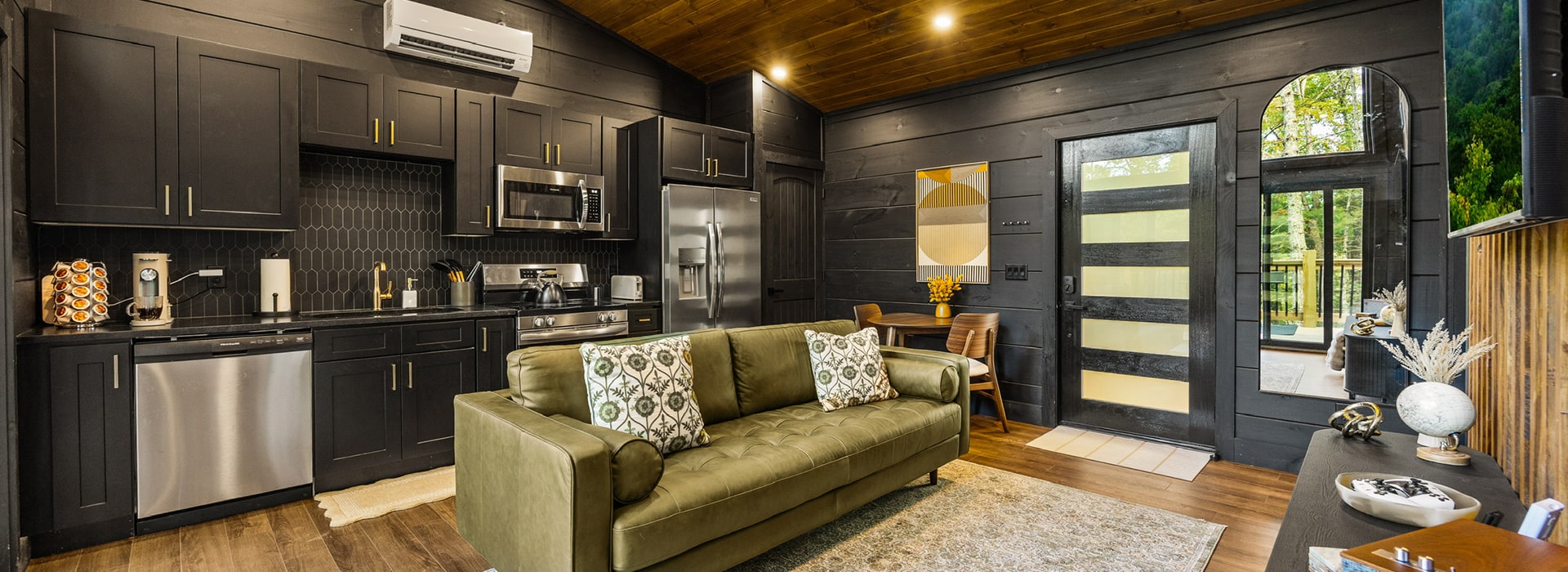
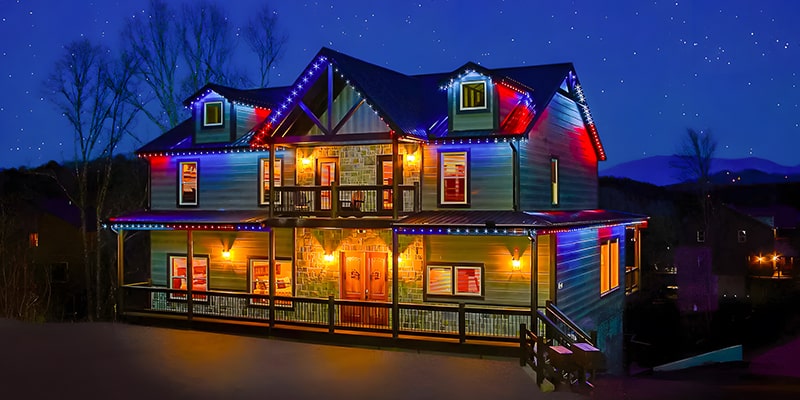
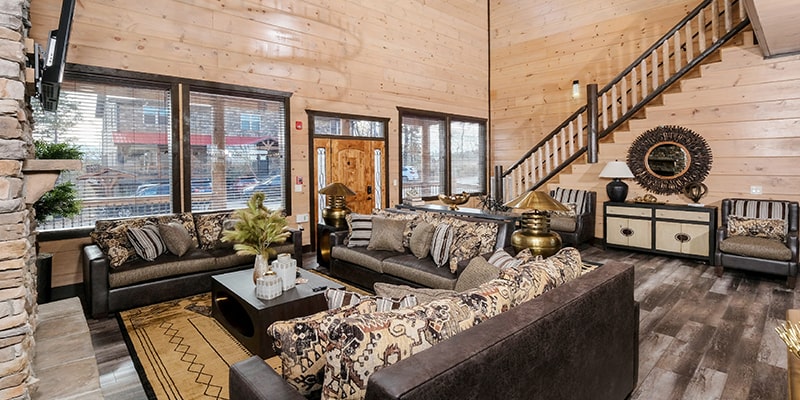
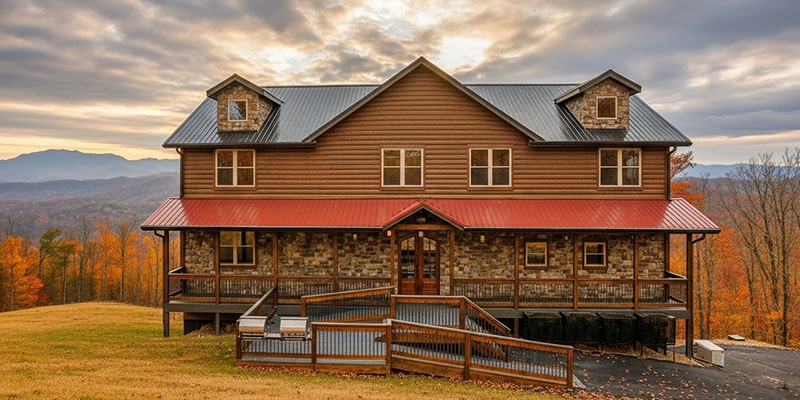
The company’s portfolio reveals an unusual breadth. A recent 472-square-foot tiny home features high-end finishes with a full wraparound deck, blending wood tones with matte black accents in what the client called a “moody” aesthetic. On the opposite end, Christoffer’s team completed a 20-bedroom lodge with four stories, complete with an elevated third-story pool, splash pad, indoor spa, and in-suite bathrooms with jacuzzi tubs in every room.
“I think it shows our ability to create unique designs,” Christoffer says. Among upcoming projects is Shell Mountain Lookout, a three-story watchtower designed to resemble an old fire tower. “It has full panoramic views off the top of the mountain from the third story, and it just makes me very joyful that we can design whatever we feel, and the customers and clients trust us to do so.”
The work splits heavily toward new constructions, roughly 95% ground-up builds versus 5% renovation. “We certainly prefer that,” Christoffer explains. “I think we can control a lot of the variables and narratives from the front end versus a remodel.” The company has built hundreds of cabins since its founding, with only five to ten remodel projects in its history.
Material selection changed dramatically after the 2016 Gatlinburg wildfires destroyed over 2,400 structures and claimed 14 lives. Fire-retardant materials became standard across the region. “We’re building things that look like wood cabins that aren’t made of wood,” Christoffer says. Concrete board siding, log-look concrete, stone, and metal now dominate exteriors, choices that eliminate maintenance issues like carpenter bees and bi-annual staining while meeting stricter fire codes. The shift indicates how a regional tragedy reshaped construction priorities without compromising the cabin aesthetic that drives rental bookings.
Earning Trust, From Lot to Keys
Mountain Cabin & Home Builders starts every relationship with a $7,500 pre-construction agreement. The fee gets credited back toward the first construction draw, but the initial investment serves a strategic purpose. “The goal is that we get in a financial bed together, I guess is an easy way to say that,” Christoffer says. “They trust me to look at their lot, help develop it, help design, make sure we’re understanding all the utilities and the topography for the foundation.”
Every Friday, clients receive a detailed update including budget estimates and project photos. Weekly drone footage provides aerial views of progress on mountain sites where terrain can shift dramatically from one elevation to another. “Transparency, full transparency, no profit made on the front end for us, but our goal is to get them into the build and do it in a partnership manner,” Christoffer says.
The company offers flexibility on land acquisition that competitors rarely match. About half of clients already own lots when they call. The other half work with Christoffer from the beginning, sometimes purchasing through the company’s own developments where land and construction can be financed together through a single construction loan. Properties in the region generate substantial returns with one-bedroom cabins averaging $4,000 monthly, while larger builds can exceed $10,000 per month. Guests book an average of 66 days in advance, ten days longer than the national average, indicating strong forward demand. “The clients we prefer are the ones who can work with us from the front end,” he says. “We have a lot of repeat clients because of that, because it’s so easy for them.”
The relationship approach produces unusual outcomes. Some clients never visit their property until they receive keys at completion, managing the entire process by phone and email. After projects finish, many clients allow the construction team to stay in completed cabins to test appliances and amenities, a gesture that speaks to earned trust. Christoffer maintains contact through monthly newsletters and personal texts, building friendships that go beyond transactions.
Building Teams, Not Just Cabins
At 31, Christoffer manages a team spanning four decades in age, from a 26-year-old interior designer to a 59-year-old project manager. “I’m not a good leader if I can’t cater to everyone to have an enjoyable workplace environment,” he says. The operational structure includes weekly Monday team meetings and Thursday huddles, but the cultural investments run deeper. Monthly third-Thursday lunches gather the entire staff, while quarterly events like go-karts, arcades, or office entertainment break up the routine.
“I would want someone that works with us to say that we cared about the person and not just the number or the role of the person,” Christoffer says. The industry faces a skilled trades shortage across the Smoky Mountains region, where 61% employment growth is projected over the next 25 years. With competition for talent intensifying, retention matters. “Culture is the biggest thing in employee attraction and retention,” he adds.
His hiring philosophy prioritizes character over credentials. “We can teach new things, new processes, but can’t change someone’s character as much. So that’s what I look for.” Despite strong demand in a market where visitors now spend billions annually in Sevier County, Christoffer deliberately limits growth. Tourism generates such substantial tax revenue that the average household saves $11,191 annually compared to what they would pay without visitor dollars funding local services. Attractions like Dollywood alone bring over 2 million visitors each year. The company targets $15 million to $20 million in annual construction sales, which allows hands-on management without expanding into operations he can’t personally oversee.
“I am not too fond of that idea,” he says about scaling beyond daily touchpoints. “I am happy where we’re at and until the market shows issues supporting our need for workflow and business, I don’t see a reason to expand.” That philosophy includes terminology: he calls employees “team members,” a small but significant distinction that signifies his generation’s workplace expectations.
Market Pressures and Building Forward
The Smoky Mountains market enjoys unusual stability. Year-round tourism and proximity to major population centers within a one-day drive create consistent demand. The region shows a unique booking pattern, with 35% of reservations coming through direct bookings rather than platforms like Airbnb, significantly higher than national trends. Most clients invest for tax purposes through cost segregation strategies, timing purchases to meet December 31 deadlines when the “Big Beautiful Bill” provisions maximize deductions. “We’re blessed to have some immunity to those things,” Christoffer says about typical market fluctuations.
But immunity has limits. From March 2024 through mid-2025, sales dropped more than 60% as interest rates climbed. The company generated $18.5 million in 2024 but projects only $9 million for 2025. “The numbers just didn’t pencil out with some of these investments on cashflow monthly and how it’s going to work out,” Christoffer explains. The 2026 pipeline, however, shows strong recovery.
Tariff concerns created brief anxiety around lumber from Canada, steel from Mexico, and Chinese imports, leading to lost clients in May and June. “I haven’t seen much from the tariffs yet,” Christoffer says. “We’re buying at such a small scale on the residential side that I don’t think it’s hit our vendors yet on where they’re brokering lumber from.”
Technology provides the operational backbone. Resio handles construction management with Gantt charts, job logs, and automated client updates. Builder Bid produces detailed takeoff estimates between $600 and $1,000 per plan, syncing with Resio’s cost codes. QuickBooks integration tracks every dollar spent. “We know where every dollar is spent because of the technologies that we use,” Christoffer says. Job site cameras and QR code build signs maintain accountability, while weekly drone photography keeps clients informed across all active projects.
Strategic Consolidation and Self-Sufficiency
Christoffer’s 18-month roadmap focuses on vertical integration rather than geographic expansion. He holds a septic license and wants to bring permitting and installation in-house using company-owned machinery. Foundations are another target for internalization; equipment purchases and personnel hires that would eliminate subcontractor dependencies on critical path items. “I have a desire for expansion with our breadth of services for the projects we already commit to, meaning sub less and complete more from an in-house basis,” he says.
His commercial license and public utilities license, covering water, gas, and sewer lines, position the company to control infrastructure development on its own land holdings. Rather than subbing out groundwork on future developments, Christoffer wants his team handling site preparation from excavation through utility installation. “I would like to capitalize on the land we have for future development and the partnerships we have in those future developments to scale to a way where I can control most of the process within our team structure,” he explains.
The strategy keeps the company’s footprint manageable while improving margins on complex mountain sites where infrastructure often determines project feasibility. Subcontractors would still handle most construction work, but development and foundation phases would run under direct supervision. “Still sub a lot of construction elements, but not the infrastructure or development process,” Christoffer says. “That’s what my goal is in the next 18 months.”
Personal motivation factors into the timeline. With a 10-month-old son, Christoffer thinks about resource management and sustainability for future generations. Building on steep Smoky Mountain terrain requires careful site work and controlling that process from the start aligns both business efficiency and environmental responsibility. This third-generation builder is already planning for the fourth.
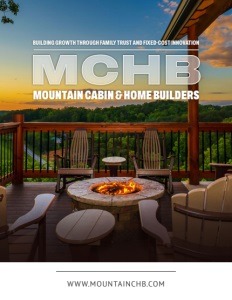
Click The Cover To View Or Download The Brochure
AT A GLANCE
Who: Mountain Cabin & Home Builders (MCHB)
What: Family-owned residential and commercial general contractor specializing in turnkey design-build-furnish services for short-term rental properties and second homes in the Smoky Mountains
Where: Sevier County, Tennessee
Website: www.mountainchb.com
PREFERRED VENDORS/PARTNERS

84 Lumber: www.84lumber.com
84 Lumber is the nation’s largest privately held supplier of building materials, manufactured components, and industry-leading services for single and multifamily residences and commercial buildings. The company operates 320 facilities which include stores, component manufacturing plants, custom door shops, and engineered wood product centers in 34 states.

Smokey Mountain Blind Company: www.smokymountainblinds.com
The Smoky Mountain Blind Company was established in 1999. We have proudly served the Smokies and surrounding area for over 25 years. Our blinds, shutters and shades are produced at my family’s factory in Atlanta Georgia. Each product is backed by a limited warranty, providing you with peace of mind. We offer a diverse range of options, perfect for adding the finishing touch to your home or rental property.