
Preserving Heritage While Building a Sustainable Future
Downtown Reinvestment, Housing Innovation, Cultural Vitality, and Thoughtful Planning Position This Gem as the Gateway to the Berkshires’ Next Chapter
Tucked into the western hills of Massachusetts, the Town of Lee has long played a defining role in the Berkshires’ economic and cultural story. Incorporated in 1777, Lee grew from a mill town of national significance into a modern community that balances historic preservation, economic diversity, and quality of life with uncommon care. Today, with a population just under 6,000, Lee is widely known as the “Gateway to the Berkshires,” a title that reflects both its geography and its evolving identity.
For Town Administrator Christopher Brittain, that identity is rooted in continuity and adaptation. Once a national leader in paper production and marble quarrying—Lee marble can still be found in landmarks such as the U.S. Capitol, Grant’s Tomb, St. Patrick’s Cathedral, and Arlington National Cemetery—the town has steadily transitioned into a more diversified economy. Advanced manufacturing, biotechnology, tourism, and small business now coexist alongside Lee’s historic core, creating resilience that many peer communities strive to achieve.
“Lee has always been a working town,” Brittain explains. “While tourism is important, we’re not solely reliant on it. We’ve maintained a diverse economy, strong local employment, and a downtown that still feels like a real town rather than just a seasonal destination.”
A Downtown Shaped by Planning and Preservation
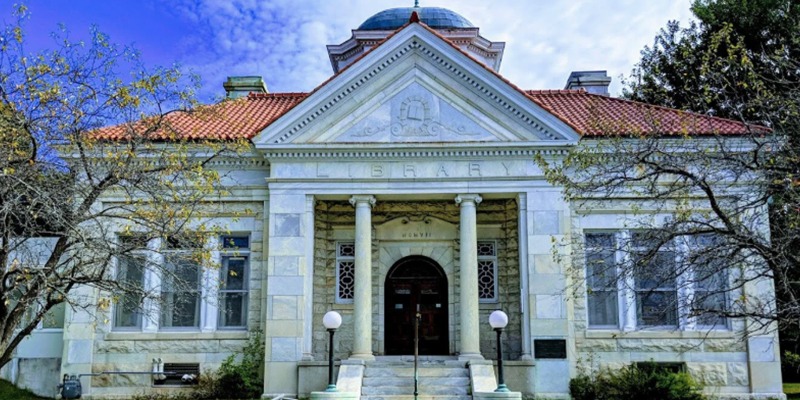
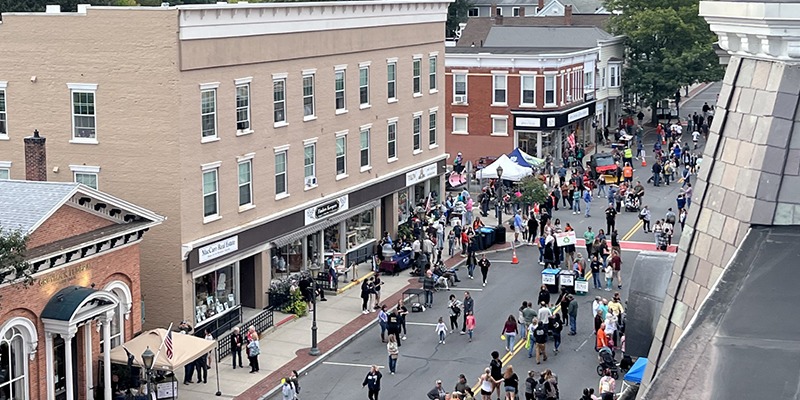
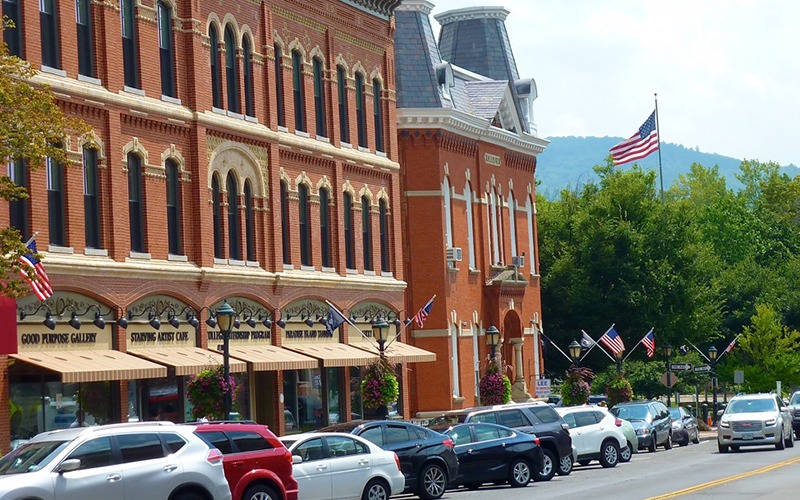
Lee’s downtown remains one of its most defining assets. Centered around a classic New England streetscape of historic buildings, including the last remaining Carnegie Library in Berkshire County, town green, and a Congregational church crowned by what is believed to be the tallest wooden steeple in New England, the downtown has avoided the hollowing-out that has affected many small towns.
That outcome is not accidental. In 2023, Lee adopted a comprehensive master plan that placed downtown revitalization, housing growth, open space, recreation, and economic development at its core. Brooke Healy, the town’s planner, was hired as part of that effort, bringing renewed capacity to implement long-range goals.
While Lee’s vacancy rate remains relatively low, the town recently secured a state-supported vacant storefront grant that will provide incentives for businesses to occupy long-empty commercial spaces. An inventory conducted with the regional planning commission identified roughly a dozen vacant storefronts, several of which have already been filled, underscoring both demand and opportunity.
Preservation has been equally important. Lee’s downtown retains its historic character while accommodating modern uses, allowing the town to remain visually distinctive and economically functional at the same time.
Eagle Mill and a New Chapter for Main Street North
One of the most transformative projects underway is the Eagle Mill redevelopment at the north end of Main Street. Once the site where paper was first made from wood pulp, the historic mill is being reimagined as a mixed-income residential and commercial district that preserves its industrial heritage while meeting modern needs.
Phase one of the project will deliver approximately 60 housing units, with residents expected to move in during the coming months. Ultimately, the project will include between 120 – 130 units across multiple phases, combining affordable and market-rate housing with ground-floor commercial and community spaces. Future phases include new construction adjacent to the historic structure, additional mixed-use buildings, and the adaptive reuse of the former machine shop for potential retail, restaurant, or event space.
Across the street, a complementary development is moving forward with roughly 69 additional affordable units, including both apartment buildings and smaller multi-unit homes. Together, these projects will help Lee reach the Commonwealth’s 10 percent affordable housing goal while expanding housing options for individuals, families, and workers across a range of income levels.
Looking ahead, Lee is exploring adaptive reuse opportunities for the final former paper mill site, envisioning a mix of commercial, cultural, and residential uses that would further strengthen Main Street North as a hub for economic activity and community life.
“These developments are about more than housing numbers,” Healy notes. “They’re about supporting families, strengthening our school system, and allowing people who work here to actually live here.”
A Public Safety Investment with Community Roots
Just as significant is Lee’s forthcoming public safety complex, a project exceeding $30 million that will modernize police, fire, and building department facilities while honoring the town’s architectural heritage. Construction begins this winter.
The new complex will replace a century-old fire station originally designed for horse-drawn apparatus and relocate the police department from its cramped quarters in Town Hall, which dates back to 1874. The historic fire station will be preserved for future community use, while the new facility will reflect traditional New England design and incorporate modern operational needs.
Town Hall itself remains a point of pride, housing a preserved historic courtroom made famous by Arlo Guthrie’s “Alice’s Restaurant,” which was filmed there and took place in real life. The space continues to serve as the setting for Select Board and civic meetings, linking Lee’s governance today with its cultural past.
A Business Community with Character and Diversity
From the Chamber of Commerce perspective, Alexandra Heddinger, Executive Director of the Lee Chamber, describes a downtown economy that thrives on diversity and authenticity.
“We’re very community-oriented,” she says. “Supporting businesses means supporting residents, culture, and place. It all goes hand in hand.”
Lee’s Main Street offers an unusually global mix for a town of its size. Residents and visitors can choose from Peruvian, Burmese, Mexican, French, and New American cuisine, alongside longtime institutions such as Joe’s Diner, a local icon once frequented by mill workers and rumored to have inspired a Norman Rockwell painting. Adaptive reuse stories abound, including a former five-and-dime transformed into the College Internship Program headquarters, now home to a café and rotating art gallery known as The Starving Artist.
Another standout is The Station GastroPub, housed in a restored historic train station where original ticket windows, wood paneling, and architectural details remain intact. Outside the downtown core, High Lawn Farm continues a centuries-old agricultural tradition, producing ice cream, cheese, and dairy products that are enjoyed locally and served in restaurants as far away as Boston and New York City.
Culture, Sustainability, and Civic Pride
Lee’s commitment to culture extends well beyond storefronts. The town was selected as one of six Massachusetts communities to host the Smithsonian traveling exhibit “Voices and Votes: Democracy in America,” drawing visitors from across the region and serving as a springboard for further programming supported by Mass Humanities. That cultural momentum is now being aligned with preparations for Lee’s 250th anniversary in 2027, with planning already underway across town boards, civic groups, schools, and the Chamber.
Sustainability is woven into these efforts. The Greener Gateway Committee leads year-round initiatives focused on waste reduction, composting, and environmentally responsible events. From zero-waste festivals to compostable vendor supplies and community recycling education, Lee has embraced practical sustainability without sacrificing charm or accessibility.
The town is also pursuing designation as a state cultural district, a step that would further formalize its cultural assets and unlock additional resources to support arts, heritage, and placemaking.
Outdoor Assets and Connectivity
Lee’s natural setting remains one of its strongest draws. Two state forests lie within town boundaries, alongside multiple parks, conservation areas, and access points to the Housatonic River. A new kayak launch is in development to improve safety and access upstream of a dam, while the Appalachian Trail passes directly through town, supported by an active committee dedicated to serving long-distance hikers.
Looking ahead, a fully funded riverwalk and bike path is in advanced design. Once built, it will connect downtown to shopping areas and the Mass Pike interchange, enhancing walkability and reducing reliance on vehicles. The project reflects Lee’s broader planning philosophy: growth that enhances daily life rather than overwhelms it.
A Future Grounded in Balance
As Lee looks toward 2026 and beyond, priorities are clear. Downtown vitality, housing delivery, and cultural investment will continue, alongside targeted economic development that welcomes both small businesses and advanced industries. With industrial and commercial zones already established near the Massachusetts Turnpike, Lee remains open to new employers seeking regional connectivity without sacrificing community character.
At the same time, conservation remains non-negotiable. More than 250 acres are permanently protected, ensuring that Lee’s growth does not come at the expense of the landscapes that define the Berkshires.
“We’re not trying to be everything to everyone,” Brittain says. “We’re trying to be Lee—honoring our past, serving our residents, and planning thoughtfully for the future.”
In an era when many small towns struggle to reconcile growth with identity, Lee offers a compelling example of how heritage, housing, culture, and sustainability can move forward together. It is a town that understands where it has been—and is clear about where it is going.
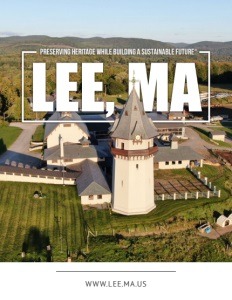
Click The Cover To View Or Download The Brochure
AT A GLANCE
Who: Lee, Massachusetts
What: A historic city which holds the title as the gateway to the Berkshires and the gateway to growth
Where: Berkshire, Massachusetts
Website: www.lee.ma.us
PREFERRED VENDORS/PARTNERS
Lee Chamber of Commerce: www.leechamber.org • 413-243-1705 www.lee.ma.us • 413-243-5517
The Town of Lee and the Lee Chamber of Commerce collaborate to advance economic development, downtown revitalization, and investment readiness. With strategic infrastructure improvements, active redevelopment projects, and a growing business community, Lee is an emerging destination for businesses and investors seeking opportunity in the Berkshires.
