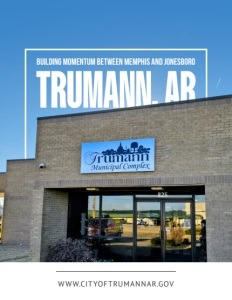
Building Momentum Between Memphis and Jonesboro
Strategic Location, Modern Infrastructure, and Community-Minded Investment Power This City’s Next Era of Growth
Positioned almost perfectly between Memphis and Jonesboro, the City of Trumann, Arkansas, is leaning into the advantages that geography, infrastructure, and community spirit have given it. Just 45 minutes from Memphis, with direct interstate access and an active rail line, Trumann sits in a sweet spot for logistics, commuting, and business attraction. Yet for Mayor Jay Paul Woods, the city’s real strength is not what it looks like on a map, but what it feels like to live there.
“We’re not Jonesboro, we’re not Batesville, we’re not any of those other towns,” he says. “We’re Trumann – and we want to be the City of Trumann, where we are. We have the perfect opportunity to be an explosive town.” That opportunity rests on a compelling mix: a much lower cost of living than larger regional centers, an exceptionally low crime rate, and the ability for residents to work in bigger markets while enjoying a quieter, safer community at home.
For years, Trumann has been viewed largely as a bedroom community for major employers in Memphis, Jonesboro, and the nearby steel mills in places like Osceola. The city’s leadership agrees that there is real value in that role, but they are equally clear that a bedroom community cannot thrive on housing alone. A strong tax base, local jobs, and a vibrant commercial offering are just as essential if Trumann is to grow on its own terms. That realization has become the catalyst for a far-reaching program of infrastructure upgrades, real estate development, trail and green space expansion, and industrial support.
A Plan for 2040 – and a Vision for Now
Trumann is not proceeding by guesswork. A comprehensive city plan, “What Will Trumann Be in 2040?” sits on the mayor’s desk as a reference point and guide. Introduced under a previous administration, the plan called for positioning the city as a desirable bedroom community. Woods respects that ambition but is quick to point out an important gap in the thinking: people who live in Trumann still need meaningful things to do and places to work locally. In many households, both adults work. They should not have to drive to Memphis or Jonesboro to enjoy a sit-down meal, buy essentials, or find a good job.
That philosophy is reshaping how Trumann approaches its future. The goal is to continue welcoming residents who work elsewhere while steadily building the commercial and civic amenities that allow the city to stand on its own. From retail and dining to public services, the city wants everyday life to be as convenient in Trumann as it is in any larger urban center—without sacrificing the feeling of safety and community that residents value.
Connectivity, Walkability, and the Sunken Lands Trail
Part of building a modern small city is making it easier and safer to move around without relying solely on cars. Trumann is investing heavily in exactly that.
One of the flagship initiatives is the ST. Francis Sunken Lands Trail, part of the broader “Connect Arkansas” concept. The trail begins at the new Steel Creek development and will eventually run through the city and out toward the St. Francis River and its basin, an area known locally as the Sunken Lands. That expanse of bottomland hardwood forest is a destination for kayaking, canoeing, hunting, and fishing, giving the trail both recreational and ecological significance.
When fully built out over an anticipated five phases, the trail will give residents and visitors a safe corridor to walk, jog, and ride bicycles. It will also support local mobility in a practical way. Designed to accommodate golf carts as well, the trail will eventually provide a safer path to destinations such as Walmart, Dollar Tree, and other key commercial nodes, reducing conflicts with vehicle traffic. Funding is already in place for the first two phases, and the city is moving steadily toward construction.
In parallel, Highway 69, a key route coming off the interstate and running through town, is slated for widening. The project will create a three-lane cross-section with a center turn lane and sidewalks on both sides, improving safety, traffic flow, and pedestrian connectivity.
In Trumann’s case, “downtown” does not look like the traditional town square. Over the past 80 years, the commercial heart of the community has moved—first from either side of the railroad tracks, then to what is now Highway 463. Today, the city is candid about the fact that its “new downtown” is forming near the interstate, anchored by Steel Creek, the new nursing home, and other interstate-adjacent development. Older commercial corridors along 463 are being revitalized, but the gravitational pull of traffic and opportunity is unmistakably toward the highway.
Steel Creek: A Game-Changing Development
If there is a single development that captures Trumann’s emerging potential, it is Steel Creek. Conceived and underwritten by the Roach family, long-time owners of a major conveyor manufacturing company in the city, Steel Creek is both a statement of confidence and a tangible blueprint for how Trumann can grow.
The project includes an 80,000-square-foot warehouse that can be leased or sold to bring in new businesses, or retained for Roach’s own distribution operations. Surrounding that anchor are multiple commercial lots earmarked for banks, restaurants, retail, and other service uses. A portion of the site is designated for residential development. The vision is a fully integrated mixed commercial and residential neighborhood where families can live, work, dine, and recreate within walking distance.
Residential plans at Steel Creek focus on smaller-lot, single-detached homes targeted at median to upper-income families—exactly the demographic that often wants modern housing, strong schools, and convenient amenities, but prefers a smaller, more manageable community to raise children in. For Trumann, securing that kind of new housing is an important step toward diversifying its population and tax base.
Green space and stormwater are built into the concept from the start. A large retention pond, already installed and stocked with fish, serves triple duty as drainage infrastructure, recreational fishing spot, and aesthetic focal point. Fountains, trails, and green edges help unify the site while also supporting broader city drainage objectives. In a low-lying, flat landscape where stormwater can linger, holding ponds and carefully designed flow paths are critical tools. At Steel Creek, they support both beauty and resilience.
Commercial Momentum Beyond Steel Creek
Steel Creek is not the only sign that private capital is betting on Trumann’s future. Just to the south, a new office and retail park has been constructed and is already fully leased. The fact that this newer construction commands higher rents and still finds ready tenants is a clear indicator of pent-up demand for quality retail and office space.
Haag Brown Commercial Real Estate, represented in the conversation by Executive Broker Zach Qualls, has played an important role in these developments. While the firm focuses exclusively on commercial real estate and does not lead standalone residential projects, its partnership with the Roach family and involvement in several commercial builds in Trumann has been instrumental in shaping the city’s emerging growth corridor near the interstate.
The success of these projects sends a strong signal: businesses are willing to pay for good space in Trumann, and investors are willing to spend their own money to make that space a reality. For a community of approximately 7,500 residents, that kind of confidence is no small thing.
Rebuilding, Reinvesting, and Tackling Blight
While new projects gather attention, much of the city’s progress is also rooted in quieter, block-by-block improvements. Since taking office, Woods and his administration have condemned more than 50 derelict houses that posed safety risks and dragged down neighborhood appearance. Around 30 of those have already been removed, and private developers have stepped in to acquire, clear, and rebuild on additional sites.
Local investors such as the Huey brothers, Osment Construction, the McKenzies, the Slinkard Family, and others have been purchasing older or damaged properties, tearing down what cannot be saved, and constructing new homes in their place. The result is a steady reduction in blight and a noticeable lift in the overall look and feel of established neighborhoods.
The December 2021 tornado, whose anniversary the city quietly notes each year, also played an unexpected role in renewal. While the storm was devastating, Trumann was fortunate: there were no fatalities and only a few injuries. Many of the homes destroyed were older properties in need of repair. The replacement of these structures with modern homes has accelerated the upgrade of several areas. The city has also rebuilt key civic facilities, including a new fire station that stands as a symbol of resilience and forward momentum.
Chamber Leadership and Civic Partnerships
Economic growth in Trumann is supported by a strong institutional framework. The Trumann Chamber of Commerce and the Trumann Industrial Development Commission, both led by Executive Director Bob Sowell, are active partners in both business retention and attraction.
Along Highway 463, often considered the city’s downtown spine, private contractors are purchasing older buildings and refurbishing them, helping to transform what residents see every day as they travel through the heart of the community. The city has plans to enlarge another retention pond and convert it into a combined drainage, fishing, and park facility, with the Sunken Lands Trail eventually running nearby. These kinds of projects blend infrastructure, recreation, and placemaking into a single investment.
The Chamber and Industrial Development Commission work closely with the Arkansas Economic Development Commission and the Arkansas State Chamber of Commerce, ensuring Trumann is aligned with statewide programs and visible to potential investors. While confidentiality often limits what can be said publicly about prospective projects, the groundwork is being laid through networking, site marketing, and relationship-building.
Existing Industry: A Powerful Base
Much of Trumann’s current strength lies in its existing industrial base. Five key manufacturers anchor the local economy, several with international reach.
Quanex, previously known as Bilco, has recently invested approximately $5.5 million in upgrades to its Trumann facility. The company is a world-class producer of commercial building components, including smoke vents, doors, security elements, and related systems. Their products ship not only across the United States but overseas, with doors and components installed in buildings as far away as Italy, France, Ireland, and beyond.
Roach, the conveyor manufacturer whose family is driving the Steel Creek project, operates a major facility just across from the new development and employs around 400 people, making it the city’s largest employer. Their success and commitment to Trumann are central to the local economy and to the community’s confidence in its own potential.
Other prominent manufacturers include WinField Solutions, RAGE Fabrication , and Ashley Lighting. Rage Fabrications, though a smaller operation with roughly ten employees, serves international customers with aftermarket parts for ATVs, four-wheelers, and utility vehicles. Ashley Lighting is a major supplier of custom commercial lighting, particularly in the hospitality sector. There is a good chance that many hotel guests across America have walked under Ashley fixtures designed and manufactured in Trumann.
Together, these companies not only provide jobs but also demonstrate that a small Arkansas city can be deeply integrated into global and national supply chains. Several of them have made significant capital investments in their local facilities in recent years—a tangible vote of confidence in Trumann’s future.
Grants, Infrastructure, and the Importance of Water
Behind the scenes of growth and development lies a backbone of critical infrastructure, and Trumann has been aggressive in pursuing external funding to modernize it. Through a combination of grants and forgivable loans from agencies such as the Economic Development Administration and the Delta Regional Authority, the city has secured roughly eight million dollars to support water and sewer upgrades.
The flagship project in that portfolio is a new clear water tank and treatment facility complete with enhanced filtration. For a city of 7,500 people, Woods is clear, an $8 million investment in water infrastructure is a very big deal. The project is fully funded, and the city is now moving through the bidding and preconstruction stages. At the same time, Trumann is upgrading its sewer ponds and collection systems, and systematically locating and mapping aging water and sewer lines—many of which were installed decades ago without comprehensive documentation.
A merger with Trumann Rural Water has brought an additional 1,100 to 1,200 customers into the city’s water system, extending service all the way down to the community of Payneway, about ten miles to the south. As the city contemplates future commercial and industrial growth, having a reliable, well-managed water system is non-negotiable.
Woods likes to remind people that while electricity and fiber optics are vital, it is water and sewer that determine whether development can happen at all. You can live without electricity for a while, he notes, but you cannot live without water. For many residents, turning on the tap is something they take for granted. His administration’s job is to make sure that remains possible.
Beyond utilities, the city has improved communications infrastructure for law enforcement, giving local police direct, real-time connectivity with the Poinsett County Sheriff’s Office and other first responders. Three different providers offer fiber-optic internet service within the city limits, a rare level of connectivity for a community of Trumann’s size. On the electrical side, Craighead Electric and Entergy are upgrading power poles—replacing 70-plus-year-old infrastructure to better carry aerial services and withstand modern loads.
Selling the City, Not Discounting It
Unlike some larger cities in Arkansas, Trumann does not own its own combined water and light system, which limits its ability to offer major utility incentives. State rules also restrict the kinds of tax breaks that municipalities can extend directly. Instead of relying on incentives, the city focuses on “selling Trumann” to prospective businesses and residents.
That pitch is increasingly compelling. Crime has dropped dramatically, with the city recording a 25 percent reduction in the mayor’s first year in office and a further 28 percent decrease in the second. A brand-new high school, a new elementary school, and upgraded sports facilities—including a standout football stadium and revitalized baseball and softball complex—underscore a serious commitment to youth and education. Trumann’s Walmart has become something of a regional magnet in its own right, drawing shoppers from places like West Memphis, Marion, and South Jonesboro. They come not only to avoid traffic in larger centers, but also because the store takes pride in staying clean, well-stocked, and customer focused.
For Woods, progress is about looking forward rather than dwelling on the past. The city is working continuously to remove blight, improve services, and prepare for the next wave of growth. Infrastructure upgrades are designed not as temporary fixes but as long-term solutions that future leaders can build on.
Looking Ahead to 2026 and 2027
As Trumann enters a new budgeting and planning cycle, the priorities are clear. Completing the new water treatment and storage project stands at the top of the list. Alongside that, the city is beginning to explore options for a new judicial complex and police department to replace aging facilities.
Annexation is also on the horizon. Woods is already working through the lengthy process of bringing roughly 2,000 acres of primarily agricultural land north of the current city limits into the municipality. That territory, stretching toward the county line and in the direction of Jonesboro, represents Trumann’s future growth. Ensuring it is inside the city limits will make it possible to respond quickly when commercial or industrial prospects surface.
Other projects are moving from blueprint to reality. A new fire station has been completed to replace the one destroyed in the tornado. New traffic signals are on the way for key intersections. The sewer treatment plant is operating at roughly 55 percent of capacity, giving the city ample room to accommodate new users. And every mile of trail laid, every pole replaced, and every outdated structure removed adds another piece to the bigger picture.
For all the physical changes, the heart of Trumann’s story remains its people: the Roach family investing deeply in Steel Creek and the broader community; local builders quietly rebuilding neighborhoods; manufacturers adding capacity and new product lines; and residents, like Qualls himself, who grew up in Trumann, built careers nearby, and still proudly call it home.
“We can’t move forward by looking back,” Woods says. “We learn from our mistakes and move forward. Everything we do is about the citizens and about the City of Trumann.” With vision, discipline, and a growing circle of partners, Trumann, Arkansas, is turning that belief into a very tangible, very promising reality.
Click The Cover To View Or Download The Brochure
AT A GLANCE
Who: Trumann, Arkansas
What: A fast growing municipality where technology, infrastructure and housing merge along a positive path forward
Where: Poinsett County, Arkansas
Website: www.cityoftrumannar.gov