Pointing Skyward
Southeast Oklahoma’s Aviation Hub
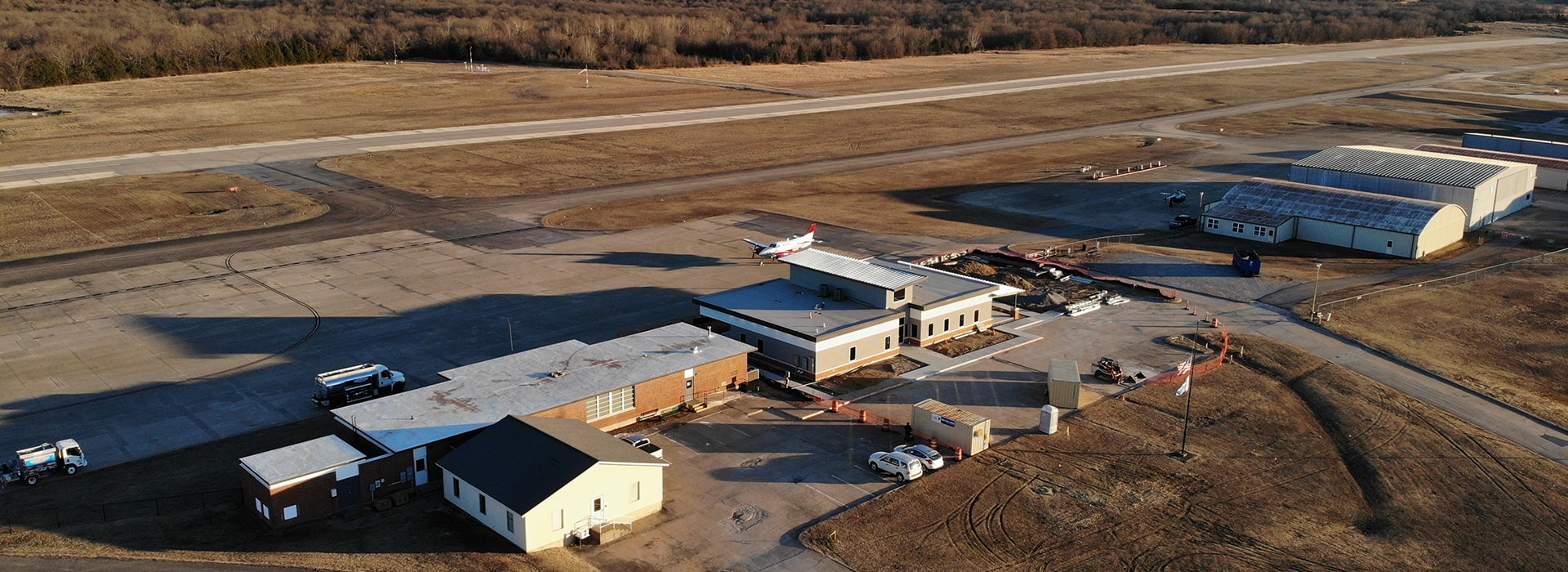
The transformation of McAlester Regional Airport reads like a case study in strategic repositioning. In 2021, the facility was underutilized and viewed as an expense to maintain vast stretches of pavement and grass.
Four years later, the airport is now Southeast Oklahoma’s aviation hub, anchored by a $2.76 million terminal that opened in October 2025, and a high school aviation program ranked third in the state. The airport is now arguably a major economic engine fueling the region generating close to $11 million annually. The evolution of the airport did not happen by accident. Rather it is the result of strategic focus by airport staff and a long term economic outlook.
Former Airport Manager Chase Tindle orchestrated the pivot on his first day in June 2021, successfully arguing for the facility’s transfer to Economic Development. The move reframed how city leadership approached the airport’s 257 acres and 5,602-foot jet-capable runway. Rather than viewing operations through the lens of infrastructure burden, the city began leveraging the airport’s position as the only facility capable of handling business jets within a 50-nautical-mile radius. Annual operations hover around 8,000 to 9,000, generating an estimated $11 million in economic impact.
The new terminal nearly doubles the footprint of the original 1951 structure it replaced, incorporating conference rooms, aerospace classrooms, and a covered patio designed to make the airport a community gathering place. Funding came through a coalition approach: federal infrastructure grants, state aeronautics funds, and a donation from the Choctaw Nation Development Fund. The project is the first major construction at the facility in more than a decade, signaling McAlester’s intent to compete aggressively for aviation-dependent business investment across the region.
Training Tomorrow’s Aviators
Flight training accounts for 40 percent of operations at McAlester Regional, drawing student pilots from universities across Oklahoma and flight schools in Tulsa who find the facility less congested than metro alternatives. The airport’s most ambitious training initiative, however, happens not in cockpits but in McAlester High School classrooms, where over 200 students are enrolled in a four-year aviation curriculum that has earned recognition as the state’s third-ranked program.
The curriculum’s capstone project puts students to work constructing a Van’s RV-12iS Light Sport Aircraft through partnership with Tango Flight, a Georgetown, Texas-based nonprofit that provides aircraft kits and instruction to schools nationwide. Students spend two years learning mechanical, electrical, and aerospace engineering fundamentals while assembling the two-seat, all-metal plane powered by a Rotax 912iS engine. Upon FAA inspection approval expected in spring 2026, participating students will fly in the aircraft they built. McAlester is one of only five Oklahoma schools undertaking such a project.
The program addresses a concrete workforce challenge. Aviation companies across Oklahoma provide 120,000 direct jobs, yet the industry struggles to fill positions for aircraft maintenance technicians and pilots. Former McAlester students have progressed to Airframe and Powerplant certification programs, professional flight training, and maintenance careers at regional aviation employers.
A Terminal Built for the Future
The 4,500-square-foot terminal that opened in October 2025 nearly doubles the size of the structure it replaced, a cramped facility dating to 1951 that had seen minimal updates since 2004. Designed by GHN Architects & Engineers and built by Jim Cooley Construction, the new building incorporates features absent from any previous McAlester aviation facility: conference rooms for business travelers, dedicated classrooms for the high school aviation program, a modernized pilot’s lounge, and a covered patio with food truck hookups intended to activate the airport as a community gathering space.
The $2.76 million project highlights how regional airports can leverage federal infrastructure investments when paired with other partnerships. The Federal Aviation Administration contributed $919,307 through the Airport Improvement Program and Bipartisan Infrastructure Law funds. The Oklahoma Aeronautics Commission added $869,880 in state grants. The Choctaw Nation Development Fund provided $250,000, with the city of McAlester contributing $972,028 in local matching funds. City officials utilized every available funding source to achieve what Interim City Manager Ken Wimer described as “getting a new terminal building at a third of the cost.”
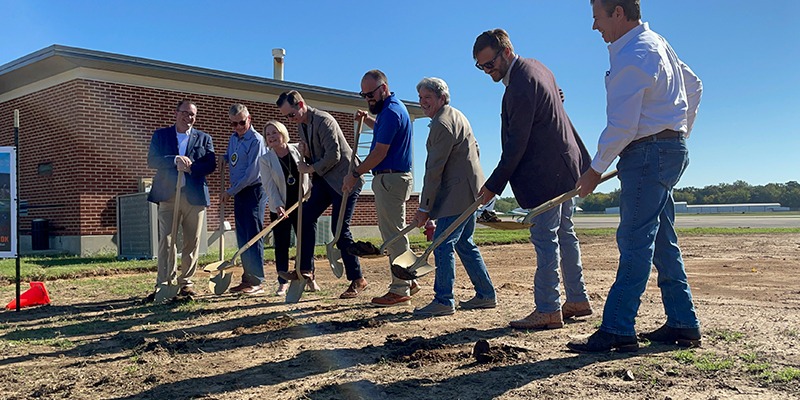
Tribal cultural elements appear throughout the terminal interior, revealing the Choctaw Nation’s investment in regional aviation infrastructure. Groundbreaking occurred in September 2023, with demolition of the original terminal following shortly after. Construction took roughly two years to complete. The facility positions McAlester to host events previously impossible in the old terminal, including planned annual fly-ins and air shows. Airport leadership envisions pancake breakfast fly-ins and expanded community programming now that adequate indoor and outdoor gathering space exists.
Building Momentum
Former airport manager Tindle’s connection to McAlester Regional began as a teenager pumping gas and sweeping hangars at the same facility he would later manage. After serving as Manager of Airport Operations at Ardmore Municipal Airport, Tindle returned to McAlester in June 2021 with a clear mandate: transform how the city viewed its aviation asset. On his first day, he successfully advocated for moving the airport from the Public Works Department to Economic Development, fundamentally reframing the facility’s role in city operations.
Tindle’s customer service philosophy was straightforward: “It doesn’t matter if someone flies in here in a Piper Cub or a G6, they are going to get the exact same service.” He backed the statement with operational changes, beginning with the city taking direct control of Fixed Base Operator services from a private contractor. The move gave airport management direct oversight of fuel sales, passenger services, and pilot experience. All fuel revenue flows back into airport improvements rather than private profits.
Within two months of assuming the manager position, McAlester Public Schools approached Tindle about teaching their aviation program. He agreed, taking on a dual role as airport manager and high school adjunct instructor that embedded workforce development directly into daily operations. Tindle taught courses at the high school while managing airport functions, an arrangement that connected students to real aviation operations rather than purely theoretical instruction. He earned recognition as one of the inaugural Oklahoma Certified Airport Professionals in July 2022. Tindle departed in late 2025, with Eric Suski assuming the airport manager role as the terminal project neared completion.
Engines for Economic Growth
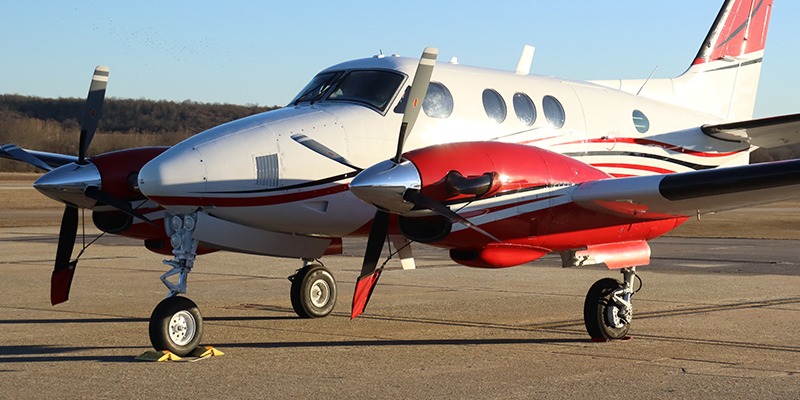
McAlester Regional generates approximately $11 million in annual economic activity according to Oklahoma Aeronautics Commission analysis, a figure driven by diverse revenue streams beyond typical airport operations. The facility’s role as the only jet-capable airport within a 50-nautical-mile radius creates a competitive advantage for attracting businesses seeking executive aviation access. Airport leadership points to multiple instances where companies flew executives into McAlester for site visits and subsequently opened local operations hiring over 100 employees at premium salaries.
Medical aviation is a critical component of operations often overlooked in economic impact calculations. The airport handles 30 to 60 medevac flights monthly, with MediFlight aircraft refueling year-round to support rural healthcare access across southeastern Oklahoma. The medical mission emphasizes how regional airports serve functions beyond business development, providing infrastructure that directly affects health outcomes in underserved areas.
Currently, 30 to 40 aircraft occupy enclosed hangars at the facility, yet Oklahoma Aeronautics Commission data indicates demand for 30 additional covered storage spaces. Meeting that need requires an estimated $3.75 million expansion, indicating both an infrastructure challenge and evidence of unmet market demand. The city-operated FBO provides 100LL aviation gasoline and Jet-A fuel, with all revenue reinvested into airport improvements rather than extracted as private profit.
Approximately 20 acres remain available for airside and non-airside development, with an additional 500-plus adjacent acres zoned for light industrial use. The airport’s location on U.S. Highway 69, positioned 2.5 miles from the Indian Nation Turnpike, enhances accessibility for aviation-related business development. The Oklahoma Airport System Plan identifies $13.5 million in 20-year investment needs to maintain and expand the facility.
Strategic Positioning and Future Plans
The Choctaw Nation’s terminal donation is one element of a deepening aviation partnership that goes well beyond single-project funding. In January 2026, the Federal Aviation Administration designated the Choctaw Nation Emerging Aviation Technology Center as one of only nine approved UAS test sites nationwide, marking the first new designation in nearly a decade. Located at Daisy Ranch approximately 30 minutes from McAlester, the facility on 44,600 acres of tribally owned land supports advanced drone research including Beyond Visual Line of Sight operations.
McAlester Regional is the closest airport with restaurants, hotels, and jet-capable runways for personnel working at the remote test site. The tribe’s Department of Advanced Technology Initiatives has articulated a five-year plan positioning the airport as critical infrastructure for an emerging aviation technology corridor. Chief Gary Batton presented McAlester’s first official tribal land acknowledgment at city council in December 2025, formalizing a partnership built on mutual economic interests rather than ceremonial gestures.
Infrastructure improvements continue with a $2.1 million taxiway rehabilitation project approved in August 2025. The work will repave taxiway surfaces, replace the lighting system, and upgrade navigation aids. Federal and state grants cover approximately 96 percent of project costs, with McAlester contributing just $79,810. Under Eric Suski’s current leadership, the airport has planned expanded community programming including fly-ins and an annual air show now that the terminal is fully operational.
Looking ahead, the airport does face ongoing challenges: hangar capacity meets only 46 percent of forecasted demand, no flight schools maintain physical bases on-site despite heavy training traffic, and sustaining the transformation’s momentum will require consistent institutional support. Yet the fundamentals suggest McAlester Regional has established a foundation for continued growth that will resolve these issues over time.
AT A GLANCE
Who: McAlester Regional Airport
What: A 257-acre general aviation facility and the only jet-capable airport within a 50-nautical-mile radius.
Where: McAlester, Oklahoma
Website: www.cityofmcalester.com
PREFERRED VENDORS/PARTNERS

Kiamichi Tech: www.ktc.edu
Kiamichi Technology Centers provides customized workforce training and economic development services for businesses across southeast Oklahoma. Serving more than 400 companies annually through the Oklahoma CareerTech System, Kiamichi Tech delivers flexible, hands-on training solutions that support employee growth, productivity and long-term economic prosperity.