
The Voice for the Industry
Championing Connectivity Where It Matters Most
In an era when broadband access is as essential to daily life as electricity and water, the work of the Competitive Carriers Association (CCA) has never been more vital. Representing the nation’s competitive and regional communications providers, CCA stands at the center of federal policy, rural connectivity challenges, and the evolving technologies that shape America’s digital future. From its roots as the Rural Cellular Association in 1992 to its position today as the leading advocate for smaller carriers, CCA continues to expand its voice, broaden its tent, and push for equitable access to reliable mobile and broadband services nationwide.
CCA President & CEO Tim Donovan explains that the association’s mandate is wide and increasingly complex. “CCA is really the voice of competitive and regional communications providers,” he says. “Our members are operating networks in some of the hardest-to-serve parts of the country—rural towns, mountainous terrain, and remote markets where connectivity is essential but challenging.” While the association’s origins were firmly rooted in wireless, convergence across telecom platforms has blurred old boundaries.
Today the membership includes mobile carriers, fiber operators, fixed wireless providers, and a diverse ecosystem of suppliers and technology partners that keep rural America connected.
At the heart of the association’s work is federal advocacy. Based in Washington, DC, CCA acts as the “Washington office” for many of its members, engaging directly with Congress, the FCC, federal agencies, and the administration. The association communicates industry needs, tracks regulatory developments, and translates complex policy changes into actionable intelligence for regional operators whose business planning depends on clarity and stability.
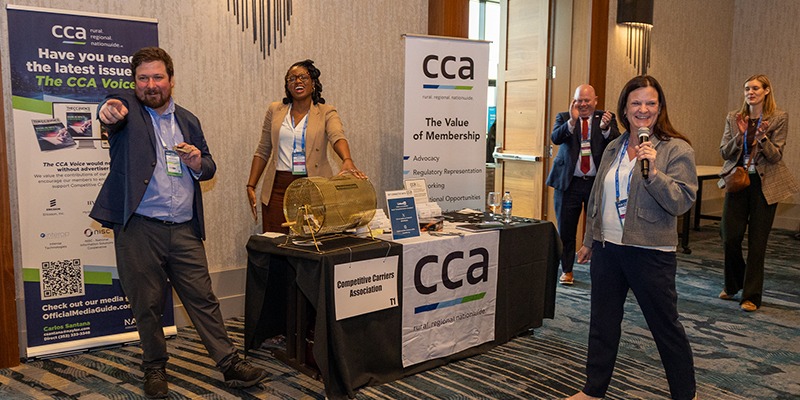
While advocacy is the central pillar, the association also delivers education, networking, and real-world business support. Its two major annual conferences serve as hubs for learning, collaboration, and partnership. Committees such as the Business and Innovation Group provide a dedicated forum for members to exchange best practices, troubleshoot shared problems, and explore emerging technologies.
“Because most of our carriers don’t compete with one another geographically, it creates a very collaborative environment,” Donovan explains. “When one operator figures out how to solve a challenge, they’re willing to help others find the best path as well.”
An Industry in Transition
The challenges faced by smaller and rural providers are substantial. Many operate in areas where the economics of broadband are inherently difficult, and where federal support mechanisms are essential to ensuring affordable service. Chief among these is the Universal Service Fund (USF), a cornerstone program designed to ensure comparable services in both rural and urban America.
The USF recently survived a historic test. A legal challenge that traveled through multiple courts and ultimately reached the United States Supreme Court threatened the very constitutionality of the program. The high court affirmed the legality of the framework, safeguarding a critical revenue stream that keeps broadband networks viable in places where customer density alone cannot.
Donovan describes it as both a victory and a reminder that modernization is overdue. A bipartisan, bicameral working group in Congress is now examining long-term solutions to keep the program sustainable for generations to come.
Another defining issue for the industry is spectrum access. Following Congress’s reauthorization of FCC spectrum auction authority, the next imperative is determining which frequency bands will be released and under what conditions. Donovan notes that the FCC must bring 800 megahertz of spectrum to auction, and those decisions will carry major implications for competition.
“Which frequencies and how they’re made available matters—especially in ensuring that every carrier, large or small, has a meaningful opportunity to compete and win spectrum.”
Permitting and siting remain ongoing hurdles as well. Many CCA members operate in states with vast areas of federally managed lands, including territories controlled by the U.S. Forest Service and the Bureau of Land Management. In regions where winters arrive early and construction seasons are short, even minor permitting delays can cascade into year-long project postponements. Donovan recounts a Wyoming carrier showing him photos of early-season snow at CCA’s September conference—an annual reminder that timing is everything. “A couple of weeks’ delay can determine whether a community receives upgraded service this year or next.”
AI, Automation, and the Next Frontier
Artificial intelligence looms large in policy discussions nationwide, but CCA’s focus is refreshingly practical. While the broader debate circles around regulation, standardization, and ethical frameworks, Donovan emphasizes a more foundational truth: none of AI’s transformative potential works without reliable, low-latency networks behind it. “As magical as it may seem, AI still needs to ride on a network,” he says. “If you leave the coverage area, the services you’re relying on simply stop working.”

AI also offers a powerful set of tools for network operators. From predictive maintenance and outage forecasting to administrative automation, AI can help scarce workforces become more efficient—an important factor given the labor shortages affecting rural markets. Donovan sees tremendous promise in self-optimizing and self-healing networks. “If AI models can predict an outage before it happens, you can pre-stage resources. It makes the entire operation more efficient.”
Meeting Workforce Demands
Like most sectors of the American economy, telecommunications faces a demographic and workforce crunch. Recruiting skilled technicians, engineers, and tower workers in rural regions is notoriously difficult. CCA has responded by partnering with Warriors for Wireless, a nonprofit that trains and transitions veterans leaving the armed forces into careers across the telecom ecosystem. The initiative connects companies with disciplined, technically adept workers while opening new career pathways for service members. Donovan calls it one of the partnerships he is most proud of.
Beyond policy and workforce development, CCA serves as a strategic ally for operators navigating day-to-day challenges. Many members seek guidance on everything from permitting issues to new technology deployments to business-model evolution. Whether through online resources, operator committees, or training delivered by CCA’s partner NTCI, the association ensures that rural and regional providers have access to the same depth of knowledge as their national competitors.
The Business and Innovation Group is particularly influential, merging technical expertise with operational insight. Conversation topics range from fiber backhaul and tower management to customer acquisition strategies and competitive positioning in increasingly blended wireless-fiber markets. With mobile and fiber operators now using overlapping technologies, convergence has made cross-sector collaboration more important than ever.
Shaping the Future of Connectivity
Looking ahead, CCA is positioning its members for both opportunity and risk. Ensuring stable support programs, streamlining permitting, and securing competitive access to spectrum remain top priorities. But Donovan is equally focused on the next wave of innovation—from telehealth and precision agriculture to the AI-driven applications that will define the coming decade.
“The industry reinvents itself about every ten years,” he reflects.
“When I joined telecom, the top-selling device was the BlackBerry. We weren’t even in the App Store era yet. Phones were still fundamentally telephony devices. Today they’re everything—video, apps, data, communications—and AI is accelerating that transformation.”
For Donovan, the excitement is personal as well as professional. A self-described technology enthusiast, he views the ongoing evolution of devices and networks with fascination. The possibility of screenless, AI-native devices—like those envisioned by Jony Ive’s design team—signals an entirely new chapter in mobility and connectivity, one that will rely heavily on the robust rural networks CCA members build and maintain.
Membership growth is a key focus for the association. As the lines blur between mobile, fiber, and fixed wireless, CCA is actively expanding its base to represent the full spectrum of local, community-based communications providers. “It matters in DC and it matters in the field,” Donovan says. “The more unified the voice, the more effective we can be—not only in shaping policy but in helping operators learn from one another and deliver the best possible service to their customers.”
A Mission That Matters
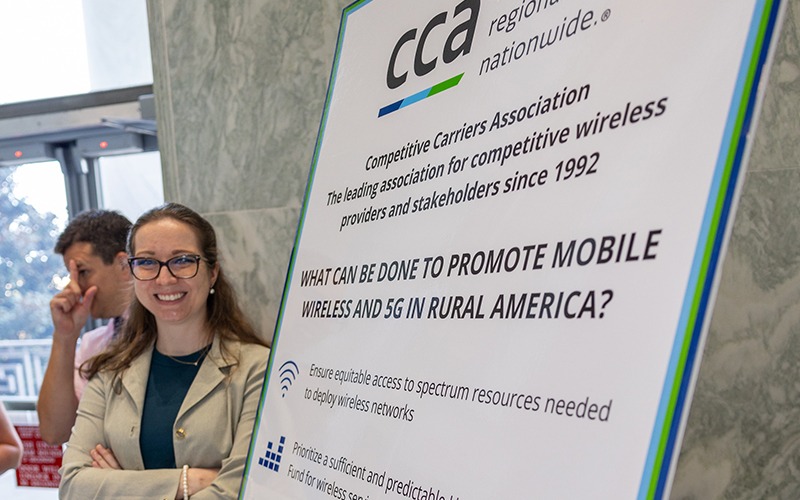
For rural carriers working in remote, rugged, and often overlooked markets, the role of the Competitive Carriers Association is indispensable. The organization acts as a conduit between federal decision makers and the companies whose networks ensure that small communities, farms, remote towns, and tribal lands remain digitally connected to the wider world.
As national policy debates, technological convergence, and AI-driven disruption accelerate, CCA stands as the steady, informed voice advocating for fair competition and equitable access. Whether advancing spectrum policy, supporting veterans entering the telecom workforce, or helping carriers navigate short build seasons and complex permitting regimes, the association’s work plays a direct role in shaping America’s communications landscape.
Connectivity is the backbone of the modern economy, and ensuring that all Americans—urban and rural alike—have access to reliable service is a national priority. Through its advocacy, collaboration, and unwavering commitment to its members, the Competitive Carriers Association continues to help chart the course for the industry’s next era.
Click The Cover To View Or Download The Brochure

AT A GLANCE
Who: Competitive Carriers Association
What: The leading advocacy and networking body that represents its members’ voice throughout a rapidly-evolving industry.