
Building the Right Mix to Deliver High Quality Real Estate Professional Expertise
Human Capital Driving Stability in a High-Pressure Market
In a city defined by scale, complexity, and constant motion, property management is never just about buildings. It is about people, trust, and the quiet discipline of doing the fundamentals well every single day. For Choice New York Companies, that philosophy has become the foundation of a business that continues to stand out in one of the world’s most competitive real estate markets.
At the helm is Michael Feldman, who brings a measured, people-first perspective to an industry often dominated by transactions, technology buzzwords, and market speculation. As Choice NY continues to evolve, Feldman remains grounded in a simple belief that great service, strong relationships, and consistent execution matter more than any short-term market swing.
“We are a company that provides three primary services to New York City building owners,” Michael Feldman, Co-Founder and CEO, says. “Those services are third-party property management, building staffing, and residential brokerage, primarily for the buildings we already manage.”
That integrated model allows Choice NY to serve a wide range of clients, from for-profit multifamily and mixed-use landlords to condominium and cooperative boards. It also positions the company as a long-term operational partner rather than a transactional service provider.
Long-Term Retention in a Short-Term Market
New York City real estate has experienced volatility over the past several years. Interest rate fluctuations, shifting workplace dynamics, and changing residential preferences have reshaped demand patterns across asset classes. Yet Feldman is careful to distinguish market observation from market dependence.
“I think it depends on where you are sitting in terms of asset type and asset class,” he explains. “The office has seen stabilization and a continued flight to quality. Multifamily continues to be strong, and the condo and co-op market has remained healthy, although supply is limited.”
Amid this shifting landscape, Feldman emphasizes that Choice NY’s role remains steady. As a third-party operator, the company’s responsibility is not to speculate but to execute.
“What the market is doing is almost irrelevant to us,” he says. “We need to understand it so we can be experts for our clients, but our job is to operate the building well, regardless of what is happening outside.”

That perspective reflects a broader operational maturity. While transaction-heavy markets can create growth opportunities, Feldman notes that long-term success depends far more on retention than acquisition.
“We have been fortunate to maintain a very high retention rate,” he adds. “That is really the direct result of doing a good job.”
People are the Core Product
Ask Feldman what truly differentiates Choice NY, and the answer comes without hesitation.
“The number one thing is our people,” he says. “Great people make everything easier.”
In an industry where labor is both the most significant expense and the most critical asset, Choice NY leans unapologetically into human capital. Feldman notes that the vast majority of company spending is directed toward payroll, reflecting the labour-intensive nature of property management and staffing services.
“Our people are our services,” he explains. “When you account for payroll, benefits, and burden, it represents the largest portion of both our costs and our revenue. That tells you everything you need to know about where value is created.”
While technology continues to reshape operational workflows, Feldman cautions against viewing it as a substitute for people.
“It may be trendy to say tech, tech, tech,” he says. “Technology matters, but it matters most when it supports our people and makes their work easier and more fulfilling.”
Technology That Serves, Not Replaces
At Choice NY, technology is treated as an enabler rather than a centerpiece. The company focuses on tools that improve efficiency, reduce administrative friction, and enhance communication for both employees and residents.
“We look at technology in two buckets,” Feldman explains. “One is how it supports our employees, and the other is how it improves the experience of our resident customers.”

By simplifying workflows and improving responsiveness, technology helps reduce pressure on staff while simultaneously raising service quality. Feldman points to a direct link between employee satisfaction and productivity, noting that happier teams ultimately deliver better client outcomes.
“If the resident customers are happier, the clients are happier,” he says. “And when clients are happier, retention improves across the board.”
This dual-focus approach ensures that innovation remains practical and aligned with real operational needs rather than driven by novelty.
Best Practices Built on Accountability
Operational discipline is another defining characteristic of Choice NY’s success. Feldman describes a culture of continuous improvement rooted in accountability and transparency.
One example is the company’s centralized purchasing department, which removes specific procurement responsibilities from individual property managers and subjects larger jobs to blind bidding and structured review.
“It is simply a best practice,” Feldman says. “It ensures fairness, consistency, and value for our clients.”
Vendor management is another area where Choice NY sets high standards. Approved vendors must adhere to formal ethical commitments, reinforcing professionalism and accountability across the supply chain.
“People can scoff at things like ethics pledges,” Feldman acknowledges. “But a lot of the cheesiest things in life are true.”
Rather than chasing perfection, the company focuses on consistency.
“Perfection tends to be the enemy of profit,” he says. “What matters is showing up every day and pushing the ball a little higher up the hill.”
That philosophy extends throughout the leadership team, where ongoing projects, clear accountability, and steady execution form the backbone of the organization’s operational rhythm.
High Entry Costs Shaping Residential Decisions
Residential trends in New York City continue to diverge sharply from national homeownership patterns, particularly in supply-constrained coastal markets. Feldman explains that the barrier to ownership is fundamentally financial.
“Supply-constrained cities, especially coastal cities domestically, are always going to lag behind national homeownership rates,” he says. “The main reason is simple. Prices are higher, so the entry point is higher.”
In practical terms, that entry point can be prohibitive. Feldman notes that purchasing a $2 million apartment in New York City typically requires a minimum down payment of $400,000, with a more realistic figure closer to $500,000. Additionally, buyers should expect approximately $100,000 in closing costs, depending on the transaction. Once the purchase is complete, additional expenses quickly follow.
“After you close on a $2 million apartment, you probably do not want to be eating Cheerios off the floor,” Feldman adds, pointing to the often-overlooked cost of furnishing a new home.
Banks also require buyers to maintain six months of principal, interest, taxes, and insurance reserves, which increases the upfront liquidity burden. When all factors are considered, Feldman estimates that a buyer may need roughly $750,000 in available capital to purchase a 1,000-square-foot apartment.
“That is going to keep a lot of younger professionals out of the marketplace,” he explains.
Combined with high transaction costs and a highly mobile workforce, these financial realities reinforce renting as the more practical option for many residents. Feldman adds that New York City’s transient population further limits the appeal of ownership, as buyers must often commit to staying for several years to justify the investment.

“You need to know you are going to be here long enough to make it worthwhile,” he says.
Relationships That Sustain the Business
If there is one theme that consistently surfaces throughout Feldman’s perspective, it is the centrality of relationships.
“I cannot put enough emphasis on relationships,” he says. “They drive everything.”
From clients and vendors to employees and residents, trust forms the connective tissue of Choice NY’s business model. Feldman points out that management contracts in the industry are typically cancellable with minimal notice, making trust and communication essential.
“If you have a good relationship and you are honest with people, you can withstand mistakes,” he explains. “That only comes from trust.”
Internally, those same principles apply.
“Our employees are also our customers,” Feldman says. “If they do not feel connected to the leadership and aligned with the company’s values, retention suffers.”
By fostering a shared sense of purpose, Choice NY ensures that its teams are not only operationally aligned but culturally invested.
Looking Ahead with Discipline and Curiosity
As for the future, Feldman is both candid and measured.
“I do not know what the future looks like,” he says. “That is the nature of the future.”
What he does know is that Choice NY is positioned for long-term stability, supported by strong systems, experienced leadership, and a people-centered culture. Feldman also expresses interest in exploring acquisitions, not limited to property management, but extending to related trades and service businesses.
“I am looking for profitable, well-run businesses with high-character owners,” he explains. “Strong systems, good technology, and a diversified customer base matter.”
Even as he contemplates new ventures, Feldman emphasizes his continued commitment to Choice NY’s legacy.
“I still care deeply about the company,” he says. “I want to see it succeed.”
Always Cheering for New York
Though not originally from the city, Feldman’s affection for New York is unmistakable.
“I love New York,” he says. “I may not cheer for the sports teams, but I always cheer for New York City.”

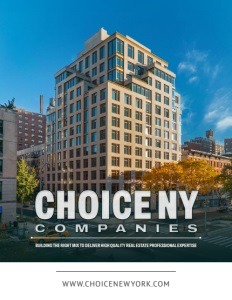
Click The Cover To View Or Download The Brochure
AT A GLANCE
Who: Choice New York Companies
What: A New York City–based firm specializing in property management, building staffing, and residential leasing services.
Where: New York City
Website: www.choicenewyork.com
PREFERRED VENDORS/PARTNERS
Able Restoration, Inc.: www.ablerestorationinc.com
Able Restoration Inc. is a family-rooted exterior restoration leader serving New York City for over 35 years. Known for craftsmanship, integrity, and transparency, the firm has completed 1,000+ projects preserving historic facades and structures. With 100% client retention for the past 20 years and a referral-only client base, Able Restoration delivers trusted, safety-focused services under experienced, forward-looking leadership.

The Alban Group: www.albanco.com
The Alban Group is a commercial construction firm strategically positioned near New York City and the Jersey City Gold Coast. Specializing in tenant fit-outs, multi-family renovations, corporate interiors, amenity spaces, and complex repositioning projects, the firm delivers design driven solutions, exceptional craftsmanship, and reliable, on-time execution across the region.

Approved Oil: www.approvedoil.com
Approved is a New York City–based full-service energy company with more than 90 years of experience delivering heating, mechanical, compliance, and emergency services. Serving all fuel types, Approved provides reliable, energy-efficient, and sustainable solutions to property owners and businesses across the NYC metropolitan area.
Superior Plumbing, Heating, &
Mechanical L.L.C.: www.superiorphm.com
Superior Plumbing, Heating & Mechanical delivers expert plumbing, heating and mechanical solutions across NYC, Long Island and Westchester. Family-owned and trusted for over 20 years, we offer 24/7 emergency service, preventative maintenance and reliable long lasting results for property managers, owners and engineers. Superior service you can count on—every job, every time
